


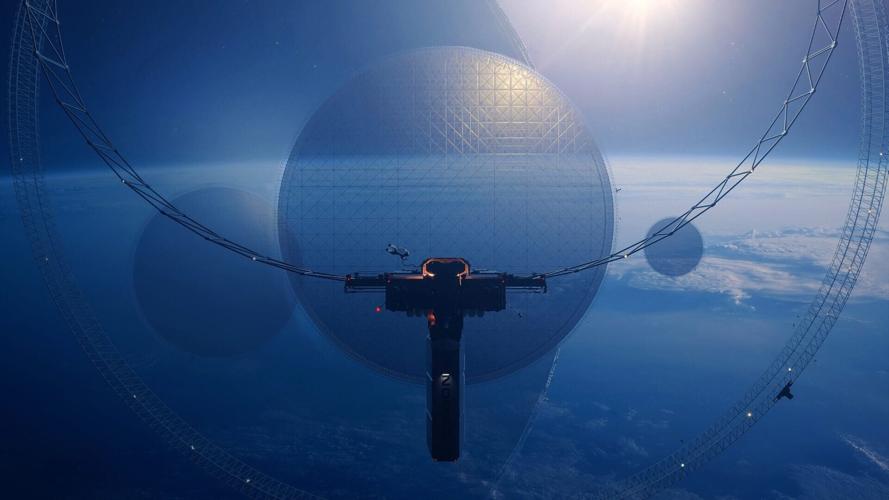
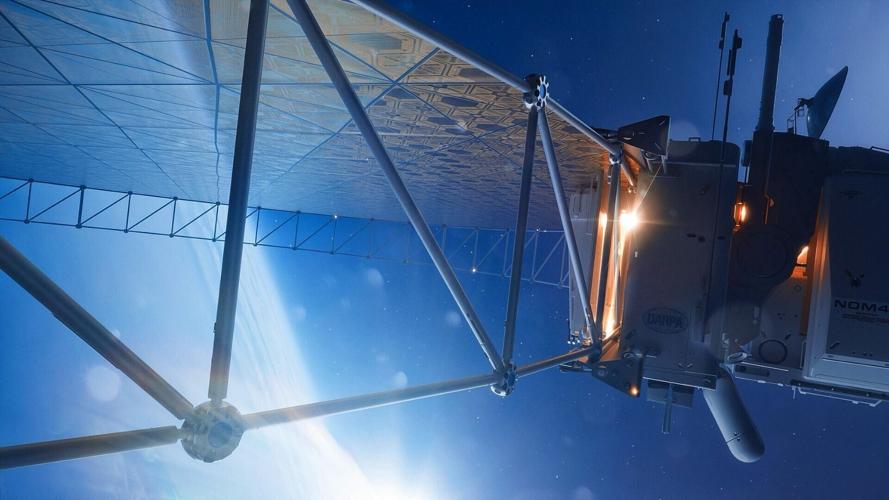
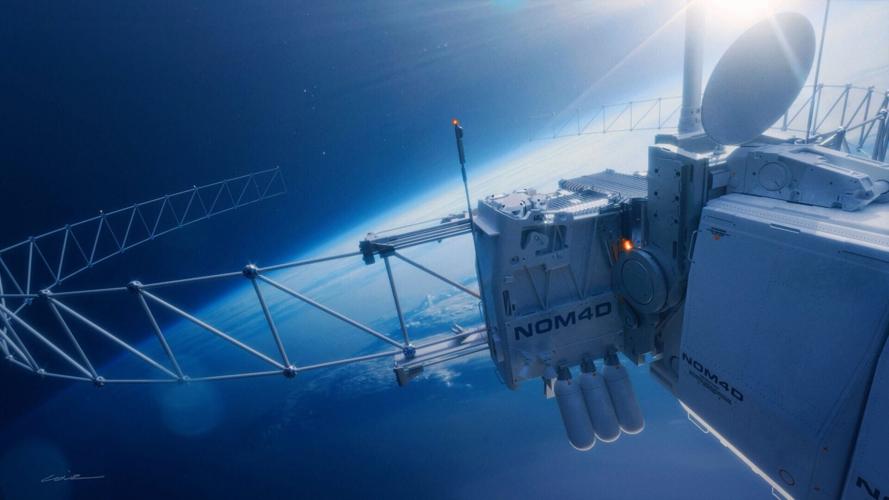

Concept art for how large space structures could someday be built and deployed by using capabilities demonstrated in the NOM4D program. (DARPA / Colie Wertz via SWNS)
By Dean Murray
A robot has built a structure in space for the first time, a milestone that could lead to constructing large-scale space systems.
The robotic truss builder worked to construct a 1.4-meter-diameter reflector antenna without the help of astronauts.
It could enable large-scale structures, such as huge reflector surfaces, to be built in space, able to harvest solar power and wirelessly transmit it to Earth’s surface.

Concept art for how large space structures could someday be built and deployed by using capabilities demonstrated in the NOM4D program. (DARPA / Colie Wertz via SWNS)
The robot was conceived, designed and built by Caltech researchers and funded by the U.S. Department of War’s Defense Advanced Research Projects Agency (DARPA).
The truss builder, part of DARPA’s Novel Orbital and Moon Manufacturing, Materials, and Mass-efficient Design (NOM4D) program, consists of an autonomous manipulator that picks up struts and joints held in nearby dispensers to repeatedly assemble identical sections, or bays, of a perimeter truss.
“This is the first time that a structure has been autonomously constructed in space,” says Sergio Pellegrino, team leader of Caltech’s Autonomous In-Space Tensioned Reflector Assembly (ASTRA) demonstration.

Concept art for how large space structures could someday be built and deployed by using capabilities demonstrated in the NOM4D program. (DARPA / Colie Wertz via SWNS)


ASTRA is a robotic builder that has spent the last six months in space, working to construct the reflector antenna from composite fiber tubes, aluminum joints and a Kapton reflective surface.
Caltech said: “According to DARPA, the autonomous robotic assembly is akin to piecing together a high-tech K’Nex or Tinkertoy structure. But the process of automating the build in space is nothing like child’s play.”

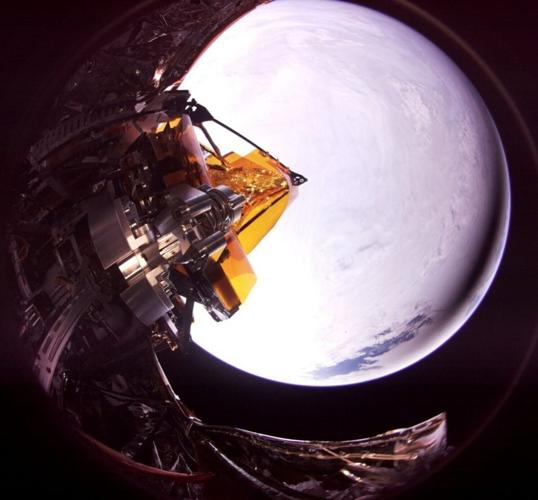
The ASTRA truss builder was able to construct a third bay of a truss structure in orbit. The space demonstration was funded by DARPA as part of its NOM4D program. (Caltech / Momentus via SWNS)
The space demonstration is the third phase of the DARPA project. In the first two phases, the ASTRA team developed the concept and design methodology and then showed that the concept worked in laboratory settings on Earth.
The space payload was completed, tested and delivered to the payload host, Momentus Inc., in less than 12 months.
“Developing a payload of this complexity on such a short timeline was an enormous undertaking for our small team,” says Pellegrino, who is also co-director of the Space Solar Power Project, which aims to harvest solar power in space and wirelessly transmit it to Earth’s surface. “As we wrap up the mission, we are finally able to start thinking about the new avenues of research opened by this demonstration.”

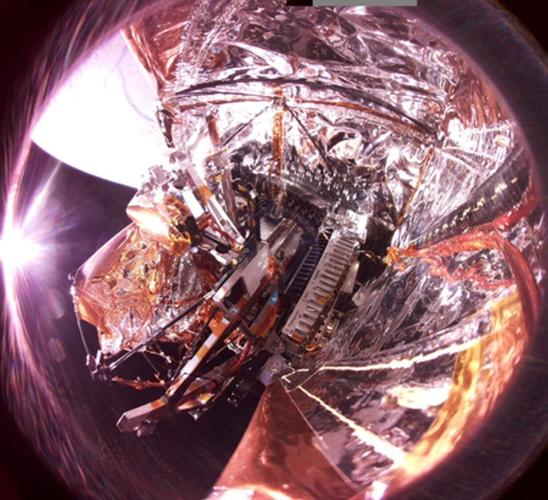
The ASTRA truss builder launched with two pre-built bays that were deployed during the demonstration and built a third bay in orbit. Additional composite fiber tubes and netlike reflective material are clearly visible in the photo captured in space by one of the payload's 11 cameras. (Caltech / Momentus via SWNS)
Caltech said: “Scientists would love the ability to deploy large-scale structures such as reflector surfaces in space. These could be used as enormous mirrors for powerful space telescopes, allowing astronomers to observe ever more distant objects; alternatively, these structures could form the aperture of large radio frequency antennas.”
“Once you get to the size limit where structures cannot be prebuilt on the ground and unfolded, you have to think about how to build them in space,” Pellegrino says. “So, this work could be useful not only for astronomy and astrophysics but also for communications and other areas, such as building very large solar arrays for space solar power.”


(0) comments
Welcome to the discussion.
Log In
Keep it Clean. Please avoid obscene, vulgar, lewd, racist or sexually-oriented language.
PLEASE TURN OFF YOUR CAPS LOCK.
Don't Threaten. Threats of harming another person will not be tolerated.
Be Truthful. Don't knowingly lie about anyone or anything.
Be Nice. No racism, sexism or any sort of -ism that is degrading to another person.
Be Proactive. Use the 'Report' link on each comment to let us know of abusive posts.
Share with Us. We'd love to hear eyewitness accounts, the history behind an article.