



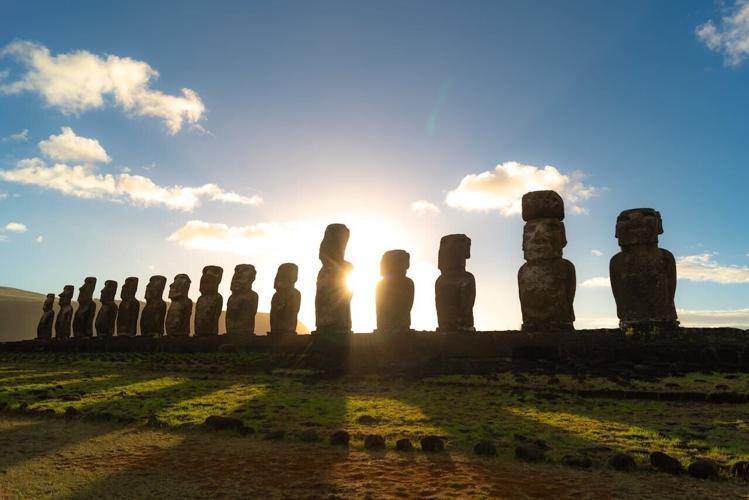
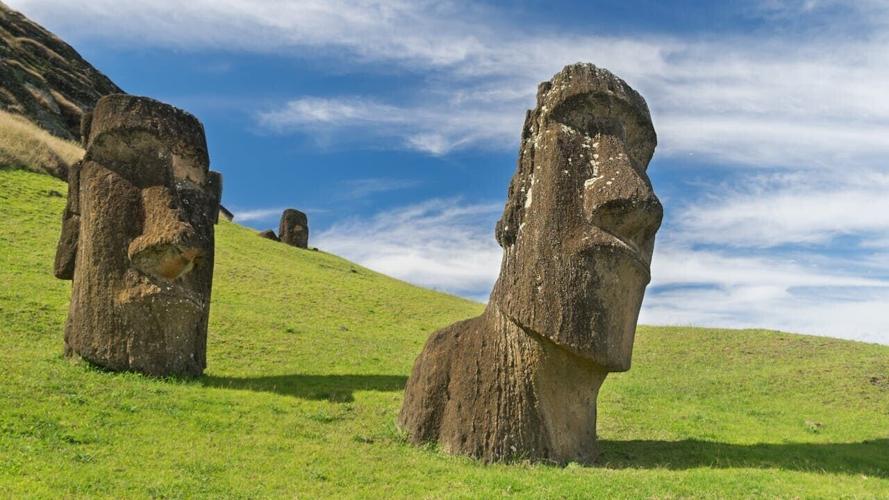

(Photo by Andrea Vera Sasso via Pexels)
By Stephen Beech
Easter Island's statues were made by different groups of people, according to new research.
The iconic monuments arose from numerous teams from different clans working independently of each other, suggests state of the art computer modeling.
Now the first-of-its-kind high-resolution 3D model lets people explore the famous Easter Island statues up close from the comfort of their own home.
Located in the middle of the South Pacific, thousands of miles from the nearest continent, Easter Island - also known by the indigenous Polynesian name of Rapa Nui - is one of the world's most remote inhabited places.
To visit it and marvel at the quarries where hundreds of the iconic moai statues were created is a luxury few get to experience.
But now people can explore Rano Raraku, one of the major quarries on Easter Island, without leaving home.
The stone statues, or moai, were carved by Polynesian communities starting in the 13th Century.
Archaeological evidence consistently suggests that Rapa Nui society was not politically unified, consisting instead of small and independent family groups.

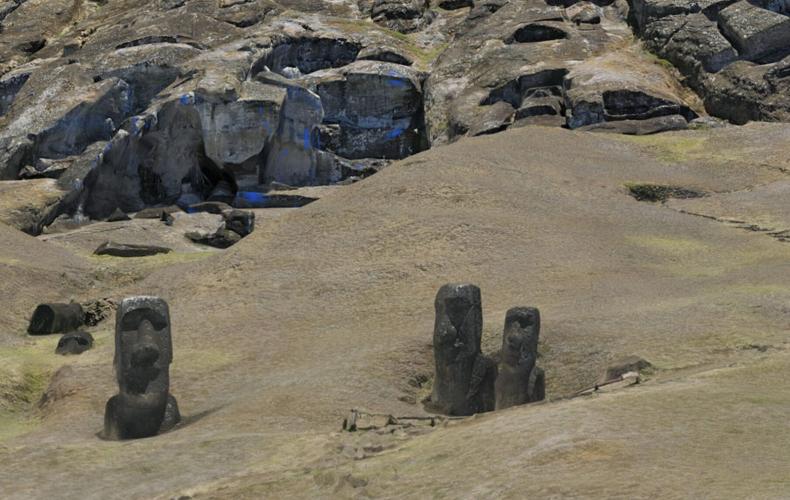
Screenshot from a three-dimensional model of Rano Raraku quarry produced through Structure-from-Motion photogrammetry. (ArcGIS via SWNS)
That raised questions of whether the construction of moai was similarly decentralized.
For the new study, published in the journal PLOS One, American and Chilean researchers collected more than 11,000 images of Rano Raraku to create a comprehensive 3D model of the quarry.
It included hundreds of moai preserved in various stages of completion.
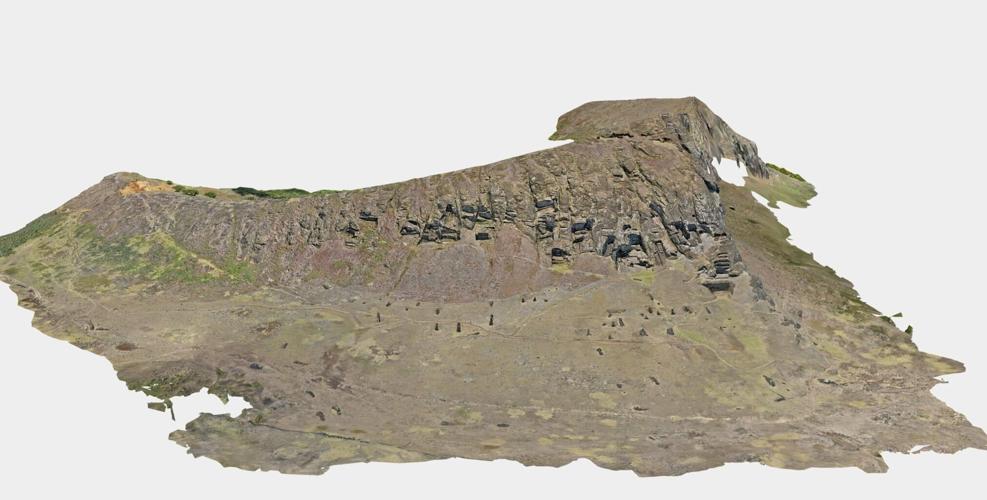
Detailed analysis of the model revealed 30 distinct centres of quarrying activity featuring a variety of carving techniques, suggesting multiple independent work areas.
Study lead author Professor Carl Lipo said: "There is also evidence for transport of moai out of the quarry in many different directions.
"These patterns suggest that moai construction, like broader Rapa Nui society, was not organised by central management.
"These findings challenge the common assumption that this scale of monument production requires hierarchical organisation.
"The similarities that do exist between moai seem to reflect cultural sharing of information rather than communities actually working together to carve the figures."
The quarry model created during the study also provides detailed data for future research and for cultural management of the UNESCO World Heritage site.
Lipo, of Binghamton University in New York, added: “As an archaeologist, the quarry is like the archaeological Disneyland.

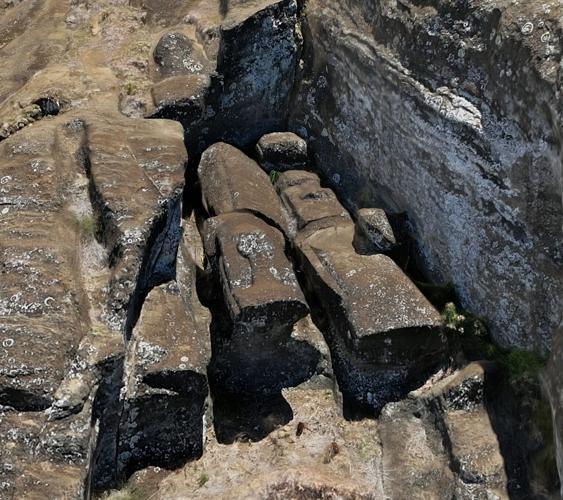
Unfinished moai attached to bedrock by keels along their backs demonstrate how carvers worked underneath from both sides until figures were separated from the source material. (Carl Lipo via SWNS)
“It has everything you can possibly imagine about moai construction, because that's where they did most of the construction.
"It’s always been this treasure of information and cultural heritage, but it's remarkably under-documented.”
The new model allows visitors to zoom in and pan across various features of the quarry, offering views that you wouldn’t be able to see even if you did make your way to Rapa Nui.


The quarry itself is located in a volcanic crater that is too steep and rugged to safely traverse.
Lipo said: “You can see things that you couldn't actually see on the ground.
"You can see tops and sides and all kinds of areas that just would never be able to walk to.
“We can say, 'Here, go look at it.’ If you want to see the different kinds of carving, fly around and see stuff there.
"So it's really exciting to bring these two things together.
"We're documenting something that really has needed to be documented, but in a way that's really comprehensive and shareable.”

Three-dimensional model of Rano Raraku quarry produced through Structure-from-Motion photogrammetry. This comprehensive digital documentation, derived from 11,686 UAV images, reveals the complex spatial organization of production activities distributed across multiple workshop areas. (Carl Lipo via SWNS)
In October 2023, a wildfire swept through the quarry, raising concerns about the site's future.
When Lipo and his team arrived to conduct research in January 2024, a community group on the island asked if the researchers could document the quarry in the event that it was permanently damaged.
The researchers conducted around 30 drone flights, snapping 22,000 photos of the quarry.
Using computer software, the images were stitched together into the resulting 3D model, a process that took months.
Team member Professor Thomas Pingel, of Binghamton’s geography department, said: "It’s amazing how far and how fast the technology has come.
“The quality of this model is far above what could be done even just a couple of years ago, and the ability to share such a detailed model in a way that is accessible from anyone’s desktop computer is remarkable."
Lipo added: “The project was of a scale of complexity that had never been attempted before.
“We see separate workshops that really align to different clan groups that are working intensively in their specific areas.
“You can really see graphically from the construction that there's a series of statues being made here, another series of statues here and that they're lined up next to each other. It's different workshops.”

(Photo by Diego Gonzalez via Pexels)
While the theory isn’t brand new, Lipo says that it’s nice to see the evidence baked into the quarry
He said: "When we look at the ability for people to move giant statues, it doesn't take that many people to do it, so that it really connects all the dots between the number of people it takes to move the statues, the number of places, the scale at which the quarrying is happening and then the scale of the communities."
Lipo added: “What we would really like to do is be able to say, ‘Go visit it yourself. Learn from it.’
"People on the island are afraid that if we build three-dimensional models that no one will go to the island.
"But I think this actually will inspire people to go there.
"Because otherwise, you're just seeing sort of snapshots of stuff.
"This is an incredible landscape of stuff that you could really go visit, that you'll want to see.”
The 3D model is available to view online.


(0) comments
Welcome to the discussion.
Log In
Keep it Clean. Please avoid obscene, vulgar, lewd, racist or sexually-oriented language.
PLEASE TURN OFF YOUR CAPS LOCK.
Don't Threaten. Threats of harming another person will not be tolerated.
Be Truthful. Don't knowingly lie about anyone or anything.
Be Nice. No racism, sexism or any sort of -ism that is degrading to another person.
Be Proactive. Use the 'Report' link on each comment to let us know of abusive posts.
Share with Us. We'd love to hear eyewitness accounts, the history behind an article.