



(ESA/Webb/NASA/CSA/A. Leroy via SWNS)
By Dean Murray
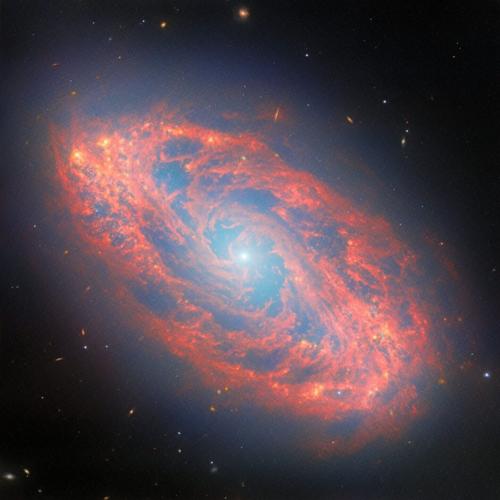
A galaxy whose light set out when Tyrannosaurus rex had just died out has been captured in striking detail by the James Webb Space Telescope.
Two instruments aboard the NASA/ESA/CSA observatory have created a jaw-dropping image revealing the structure of NGC 5134, a spiral galaxy 65 million lightâyears away in Virgo.
The light in the image, captured on February 20, set out just after the mass extinction event that wiped out the dinosaurs, offering a view from the deep past.


(NASA/ESA/STScI et al. via SWNS)
ESA said: "Though 65 million light-years may seem like a huge distance – the light that Webb collected to create this image has been journeying to us from NGC 5134 since soon after Tyrannosaurus rex went extinct – NGC 5134 is fairly close by as far as galaxies go."
Despite the distance, its relative proximity allows Webb to pick out fine detail in its tightly wound arms. Webb’s MIRI shows warm dust and complex molecules across the galaxy’s clouds, while NIRCam highlights the stars and clusters embedded within them.
Studying nearby galaxies like NGC 5134 helps astronomers understand far more distant systems that appear only as faint points of light.


(0) comments
Welcome to the discussion.
Log In
Keep it Clean. Please avoid obscene, vulgar, lewd, racist or sexually-oriented language.
PLEASE TURN OFF YOUR CAPS LOCK.
Don't Threaten. Threats of harming another person will not be tolerated.
Be Truthful. Don't knowingly lie about anyone or anything.
Be Nice. No racism, sexism or any sort of -ism that is degrading to another person.
Be Proactive. Use the 'Report' link on each comment to let us know of abusive posts.
Share with Us. We'd love to hear eyewitness accounts, the history behind an article.