


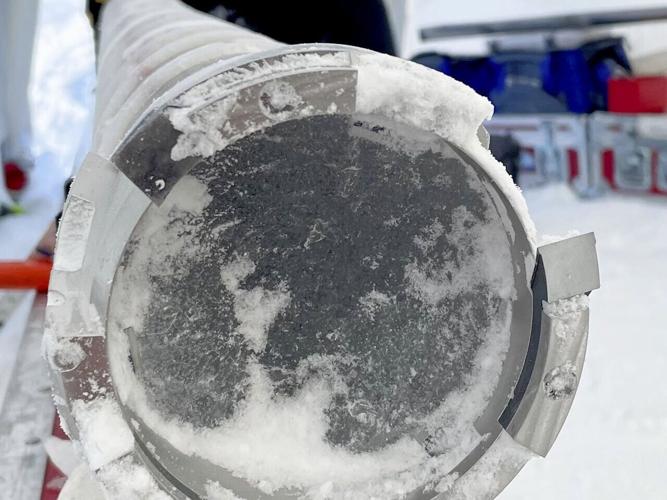
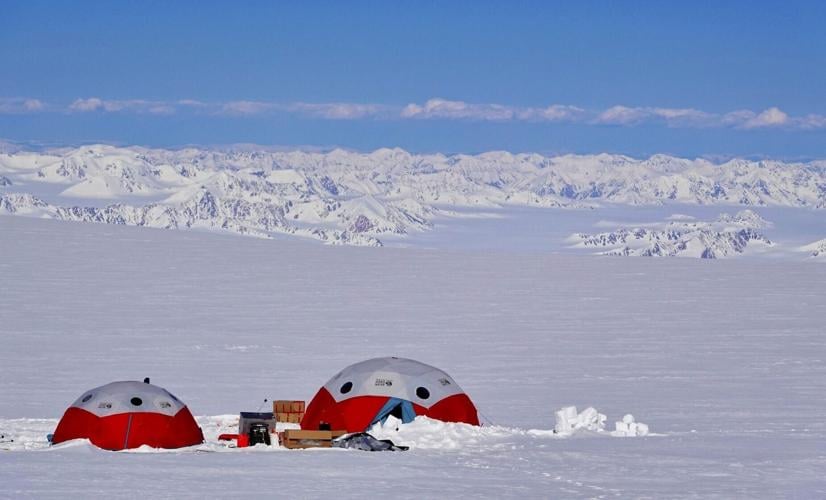
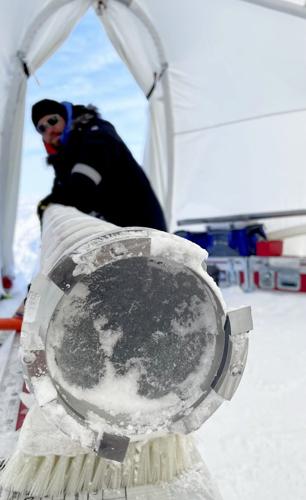

An expedition site in northern Canada for collecting ice cores. (Alison Criscitiello via SWNS)
By Stephen Beech
Evidence of widespread air pollution from early 20th century copper production has been revealed hidden in Arctic ice.
Delayed pollution controls at Montana’s Anaconda Copper Mine in the United States exposed more than half of Americans to years of air pollution linked to increased cancer risks and other health issues, say scientists.
They explained that the huge mine complex near Butte, Montana, was emitting “vast” amounts of air pollution into the atmosphere around 100 years ago.
As small particles of arsenic and other heavy metals were carried by winds over the Arctic, storms eventually helped pull them to the ground, where they joined layers of history embedded in the ice.
Now, scientists have analyzed ice cores — which they describe as “natural archives” — to help better understand the scope of just how much air pollution this mining and smelting operation sent over the continent, and who was most impacted.
A team from the Desert Research Institute (DRI) studied 10 different ice cores collected from Greenland, the Russian Arctic and northern Canada to reconstruct atmospheric levels of arsenic and other toxic heavy metals during the second Industrial Revolution.

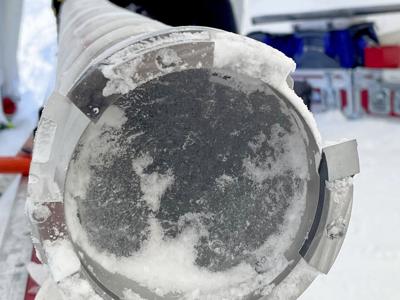
A member of the research team with a freshly drilled ice core during a field expedition to Greenland. (Joe McConnell / DRI via SWNS)
The peak pollution period, recorded in Arctic ice from about 1886 to 1918, saw increases in the toxins of around 15-fold that the team traced back to the Anaconda Copper Mine operations, one of the world’s largest producers of copper at the time.
By measuring the levels of these metals in the ice, combining the data with atmospheric modeling, and cross-referencing their findings with the mine’s own historical records, they estimate emissions of 11,000 tons of arsenic and 4,400 tons of lead per year during the mine’s two to three decades of peak production.
The findings, published in the journal Nature Sustainability, suggest that the pollution potentially led to widespread health impacts for 55% of Americans and around 11% of Canadians who lived downwind of the mine’s pollution plume at the time.
Study co-author Joe McConnell, of the DRI, said: “It’s pretty wild to think that a single, albeit massive source of pollution could have affected effectively the entire North American continent and western Greenland more than 4,000 kilometers or 2,500 miles away.”

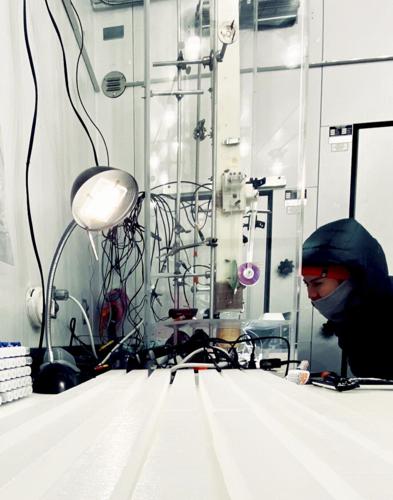
Study author Kira Holland analyzing ice cores in the DRI Ice Core Lab for this research. (Alison Criscitiello via SWNS)
By examining American and Canadian census data from 1910/1911 and overlapping them with their atmospheric models, the researchers found that around 50.5 million Americans and 600,000 Canadians were exposed to levels of arsenic pollution associated with higher risk for lung cancer and other serious conditions.
The people living closest to the mine in Montana and parts of Wyoming and Idaho were exposed for nearly 30 years to arsenic levels that meet or exceed the current maximum threshold for chronic exposure recommended by the World Health Organization (WHO).
Recent arsenic pollution levels in the U.S. and Europe range from 12 to 60 times lower.
The study also found that 1.4 million Americans and Canadians, including all Montana and Wyoming residents, were exposed to elevated lead pollution levels potentially linked to cognitive decline equivalent to an estimated reduction of 2.6 IQ points.

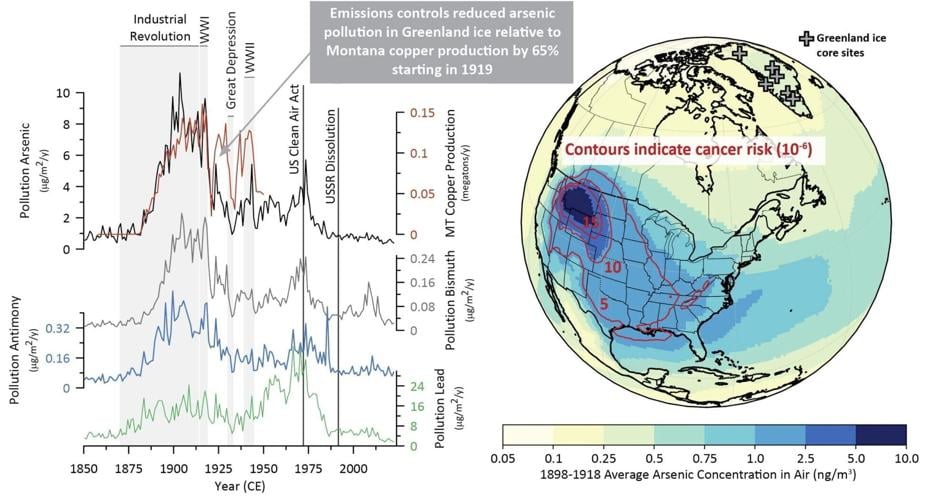
Left: A graph showing the rise and fall of arsenic, antimony, lead, and bismuth levels recorded in Arctic ice cores between 1850 and 2015. The red line shows copper production at the Anaconda Copper Mine. Although declines were delayed by nearly a decade due to lax government regulations, arsenic pollution was greatly reduced by the 1919-1923 phased installation of pollution controls. Right: An atmospheric circulation model demonstrating the spread of Anaconda MineÂs air pollution across North America and potential health implications. (DRI via SWNS)
Using multiple ice cores from across the Arctic region allowed the research team to look at how deposition patterns changed over time and space.
When combined with advanced atmospheric modeling techniques, they could pinpoint northern North America as the source of the emissions.


Heavy metals like arsenic and lead have fairly short “atmospheric lifetimes,” meaning they’re typically only carried by air for mere days before being deposited.
That made it important for the team to compare and contrast pollution levels from ice cores collected from Greenland, the Russian Arctic and northern Canada.
When McConnell compared the records from Anaconda to the arsenic pollution rates found in the ice, it was almost a perfect match.
Lead isotope records found in the ice were also consistent with Anaconda being the primary source of emissions.

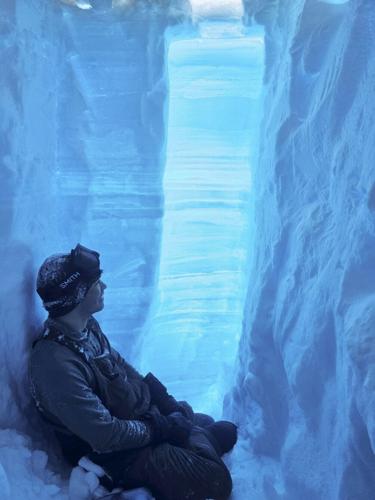
Researcher Derek Pickell admiring a backlit snowpit showing the layers of snow that compress into the Greenland ice sheet. These layers, which build up year after year and can be read back in time like tree rings, provide valuable information about past environmental processes such pollution, volcanism, and forest fires. (Nathan Chellman via SWNS)
McConnell said: “Everything points to Anaconda — an infamous source of arsenic pollution in this country.
“We can use atmospheric modeling and the deposition pattern of pollution to estimate the magnitude of the emissions.
“So we know where it’s coming from, and we know its magnitude.
“And with this information, we can then forward model how that pollution would have spread around North America.”
He says copper smelters are among the largest sources of arsenic pollution, and demand for copper and other metals surged in the late 19th and early 20th century during a period of rapid electrification.
In an ice core from central Greenland, the team found that arsenic levels rose slowly between 1850 and 1887, then rapidly to 1895, before peaking at around 15 times higher than pre-Industrial Revolution levels around the start of World War I in 1914.
They then fell rapidly following the end of the war to 1920, recovered slightly, and dropped again during the peak of the Great Depression between 1932 and 1934.

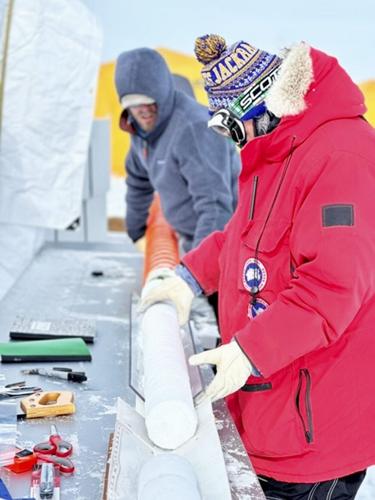
Study co-author Nathan Chellman and Jihong Cole-Dai (South Dakota State University) process a freshly drilled ice core during a Greenland expedition near Summit Station. (Derek Pickell via SWNS)
While arsenic levels increased again following the Great Depression, they remained well below the peak pollution rates of the World War I era through 2020.
The findings showed a “significant” drop in arsenic pollution levels in the years following 1919.
The researchers believe that is likely due to the installation of electrostatic precipitators at the massive Anaconda Smelter at the time, which as recorded in Arctic ice, reduced heavy metal emissions by around 65%.
They say air pollution controls 10 years earlier would have prevented an additional 60,000 tons of arsenic and 24,000 tons of lead pollution over much of North America.
McConnell added: “We hope this is not the end of the use of these data and conclusions about the health impacts.
“Our findings provide important insights into the public health impacts of air pollution that impacted millions of Americans and Canadians.
“The parents and grandparents of many Americans alive today were exposed to this heavy metal pollution, so the health impacts are quite recent and close to home.”


(0) comments
Welcome to the discussion.
Log In
Keep it Clean. Please avoid obscene, vulgar, lewd, racist or sexually-oriented language.
PLEASE TURN OFF YOUR CAPS LOCK.
Don't Threaten. Threats of harming another person will not be tolerated.
Be Truthful. Don't knowingly lie about anyone or anything.
Be Nice. No racism, sexism or any sort of -ism that is degrading to another person.
Be Proactive. Use the 'Report' link on each comment to let us know of abusive posts.
Share with Us. We'd love to hear eyewitness accounts, the history behind an article.