




AI education is creating new opportunities outside traditional tech hubs
Tech talent and startup activity are no longer geographically concentrated. AI's rapid adoption has dismantled the monopoly that regions like Silicon Valley once held, disrupting the traditional pipeline of opportunity and forcing regional economies to adapt. New data reveals the scale of this shift and what it means for careers, investments, and business models in the years ahead.
The geographic concentration of tech opportunity was a feature of the past decade, not an inevitable law. Silicon Valley and a handful of other innovation hubs attracted talent globally, draining emerging economies of skilled workers. But AI tools have fundamentally altered this equation. With accessible education and remote-first workflows, developers and founders can now build viable companies anywhere, turning this geographic shift from a policy concern into a business reality.
This isn't theoretical. MavGPT, an online AI resource hub, analyzed recent data to map exactly how this dispersal is playing out, where opportunities are emerging, and why the skills gap matters more than location.
The Smoking Gun of Startup Dispersal
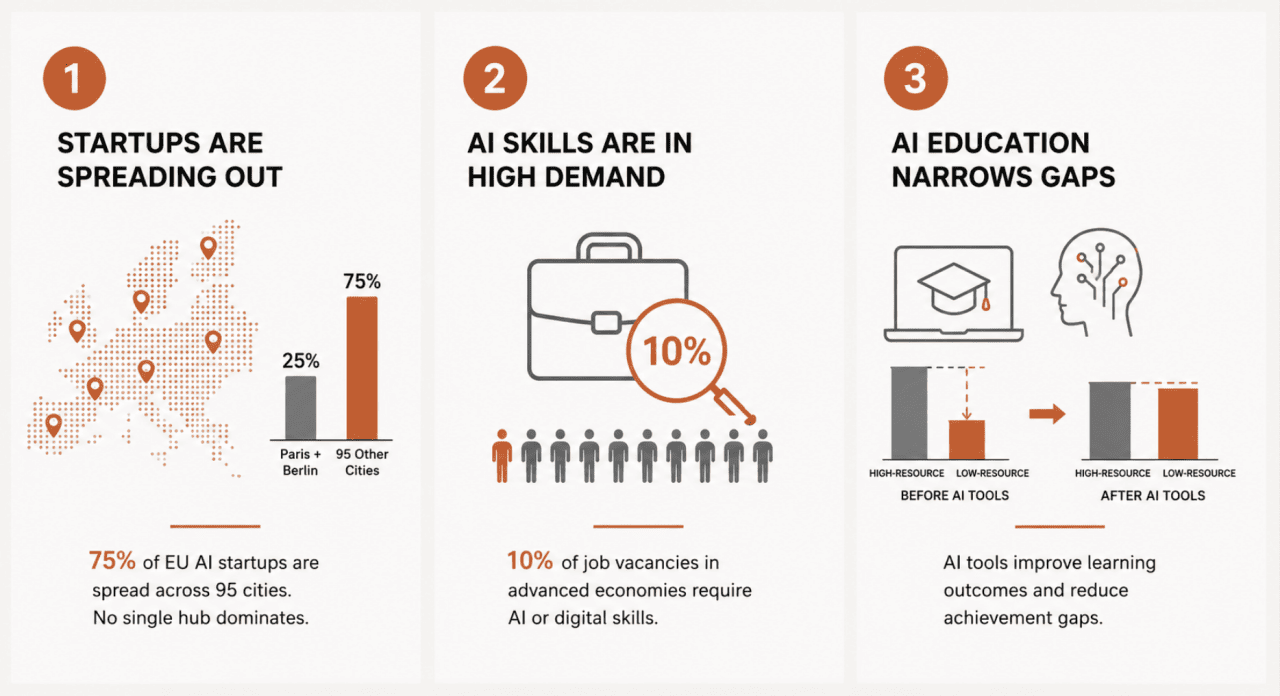
The first piece of data comes courtesy of Interface, which published an analysis in May 2026 that unpacks Dealroom.co figures to assess AI startups across the EU. The report’s authors found that 75% of all analyzed EU AI startups are spread across 95 different cities, with no single tech hub taking precedence. Traditional powerhouses, including Paris and Berlin, collectively account for only a quarter of the market.
Because generative AI and foundation models allow for hyperlocalized, specialized applications, whether that’s Munich specializing in supply chain AI or Barcelona in healthcare, developers and founders no longer need to migrate to specific hubs to build viable software.
Seeing startups dispersed far and wide indicates that AI education is changing where innovative tech companies can build their business and where prospective employees can find opportunities. Because AI skills can be acquired in modular, online formats, workers living in nontraditional tech regions are joining the global, remote freelance and corporate labor market, entirely bypassing previous systems that used to determine access to the industry.


This is further supported by data from the International Monetary Fund, which found 10% of job vacancies in advanced economies now explicitly demand at least one new digital or AI-specific skill. There’s an increasing need for existing professionals or students soon to enter the job market to upskill or reskill to meet employer expectations, regardless of where they’re based.
The Application in Traditional Work Settings
The benefits of AI education don’t only apply to tech-focused roles. That’s crucial for the deconstruction of traditional tech hub dominance, since people in positions and industries that aren’t historically reliant on digital tools can now embrace automation and use these skills to take advantage of new opportunities so long as they have access to the knowledge needed to harness it.
A January 2026 study from the National Bureau of Economic Research focuses on how AI is affecting the U.S. job market, specifically its potential to displace jobs and disrupt roles. Analysts found that out of 37.1 million American workers heavily exposed to AI, 26.5 million possess above-median adaptive capacity, meaning they are highly equipped to transition into higher-value roles rather than face displacement.
Learning to use AI allows workers to transition rather than face displacement. Artificial intelligence’s rapid uptake allows non-tech workers outside major cities to automate routine tasks and construct new, hybrid roles for themselves, enabling them to weather economic disruption caused by AI's rapid adoption.
The Democratization of Education
AI also has a significant influence on educational outcomes, with a Stanford University meta-analysis of various reports indicating advantages in narrowing gaps between students of different abilities and backgrounds. Causal studies covered in the report conclude that AI tools significantly improve student performance on programming, mathematics, and writing. The data notes that AI tools drastically reduce historic achievement gaps by providing high-quality, individualized, real-time tutoring to under-resourced districts.
AI allows greater access to users in an educational context, meaning that those going through school and college in less affluent places can compete more consistently with those in wealthier regions of the world. Because AI education itself is entirely democratic, with anyone able to get online and learn to use the available tools, this helps to perpetuate the importance of adoption for improved economic opportunity.
AI education creates opportunities for founders and employees, while also enabling the next generation to develop an understanding of automation and its potential before they enter a job market with increasing expectations for tech-savviness. How industry and political leaders make this information widely available, rather than limiting access to locations that have long benefited from the tech boom, remains to be seen.
This story was produced by MavGPT and reviewed and distributed by Stacker.





(0) comments
Welcome to the discussion.
Log In
Keep it Clean. Please avoid obscene, vulgar, lewd, racist or sexually-oriented language.
PLEASE TURN OFF YOUR CAPS LOCK.
Don't Threaten. Threats of harming another person will not be tolerated.
Be Truthful. Don't knowingly lie about anyone or anything.
Be Nice. No racism, sexism or any sort of -ism that is degrading to another person.
Be Proactive. Use the 'Report' link on each comment to let us know of abusive posts.
Share with Us. We'd love to hear eyewitness accounts, the history behind an article.