


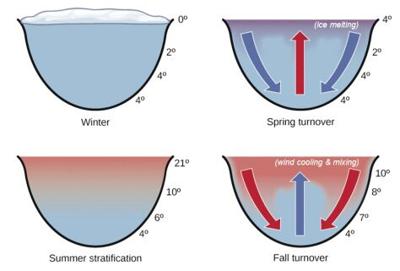
Have you ever jumped off a dock and felt an unexpected chill as the water quickly got colder the deeper you went, only to feel warmer again when you resurfaced? That’s an example of thermal stratification — a process where a lake divides into layers based on water temperature. As water warms up, it becomes less dense, creating these distinct layers that shift with the seasons. With fall approaching, we’re nearing what’s known as lake turnover.
Lake turnover is a crucial event for the health of the lake’s ecosystem. It helps replenish the oxygen levels at the bottom, which is vital for aquatic organisms. Let’s take a look at how Lake Winnipesaukee’s water layers change over the course of the year.
In the summer, the lake separates into three layers. The top layer, which is the warmest, is called the epilimnion. It holds the most dissolved oxygen because it is in direct contact with the air and absorbs sunlight. Although oxygen doesn’t control how these layers form, it’s still essential for the lake’s life forms.
The coldest and deepest layer is known as the hypolimnion, where the water stays around 4 degrees celsius, or 39 degrees fahrenheit, most of the year and doesn’t receive much sunlight or oxygen. The middle layer is called the metalimnion, where temperatures gradually rise as the water mixes between the warm surface and the cold bottom. The sharpest changes in temperature and density within the layers is known as the thermocline.
As the summer progresses, wind and wave action push the warm water deeper, causing the top layer to grow larger — sometimes extending up to 27 feet deep. Eventually, the temperature difference between the surface and the bottom becomes too great for mixing to continue.
When the weather cools in the fall, the surface water temperature drops and begins to sink, causing the layers to mix. As the top layer cools down, it pushes the warmer bottom layer of water upwards, causing what’s known as turnover. During this time, the temperatures and densities of the different layers even out, allowing wind and waves to mix the water more easily. Eventually, the lake becomes isothermal, meaning the temperature is consistent from top to bottom, allowing for full mixing of the water column.
This turnover process occurs twice a year in Lake Winnipesaukee — once in the spring and again in the fall — and it plays a critical role in maintaining the lake’s ecosystem. When the lake is isothermal, wind can easily circulate oxygen-rich water from the surface down to the bottom, which is important for fish and other organisms, especially when the lake freezes over in winter and fresh oxygen is cut off. The oxygen that is mixed into the water before winter must last until the ice thaws in the spring.
Understanding the importance of lake turnover is just the beginning. By supporting local organizations, reducing pollution, and being mindful of our impact on the environment, we can help to protect our lakes and ensure their continued health for generations to come.
•••
Bree Rossiter is the conservation program manager for the Lake Winnipesaukee Association. She manages the water quality monitoring program, cyanobacteria monitoring initiatives, the Winni Blue/LakeSmart program, and assists with watershed management planning efforts. Bree can be reached at brossiter@winnipesaukee.org. The Lake Winnipesaukee Association is a nonprofit dedicated to protecting the water quality and natural resources of the lake and its watershed. To learn more, visit winnipesaukee.org.


(0) comments
Welcome to the discussion.
Log In
Keep it Clean. Please avoid obscene, vulgar, lewd, racist or sexually-oriented language.
PLEASE TURN OFF YOUR CAPS LOCK.
Don't Threaten. Threats of harming another person will not be tolerated.
Be Truthful. Don't knowingly lie about anyone or anything.
Be Nice. No racism, sexism or any sort of -ism that is degrading to another person.
Be Proactive. Use the 'Report' link on each comment to let us know of abusive posts.
Share with Us. We'd love to hear eyewitness accounts, the history behind an article.