


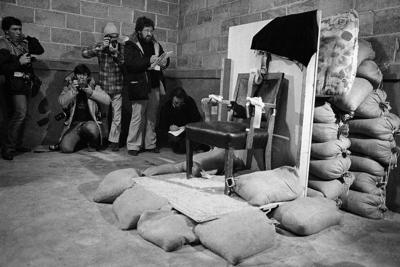
(AMHERST, MASS.) The U.S. Army is scheduled to execute Nidal Hasan on Dec. 3, 2026, after Hasan killed 12 soldiers and one civilian at Fort Hood, Texas, in 2009. Secretary of Defense Pete Hegseth got President Donald Trump’s approval to use the firing squad to put Hasan to death.
However, the U.S. military hasn’t used the firing squad since 1945. And the execution method has been minimally used outside the military, accounting for only six of 1,664 executions in the U.S. in the past 50 years. Since 1976, the firing squad has been used in only two states: South Carolina and Utah.
The infrequency of its use might seem surprising to many Americans. After all, the firing squad is the least complicated execution method ever used in the U.S. All that is needed are guns, bullets and marksmen.
Still, it has not caught on throughout America’s history. And as a scholar of execution methods, I know why. Firing squad executions are bloody and brutal, and the U.S. has been more comfortable using methods that appear more humane.
History of firing squads in the US
The first use of a firing squad in what eventually became the U.S. occurred in 1608 in the English settlement of Jamestown. George Kendal, a British naval officer, was tried, convicted and sentenced to death for mutiny and treason. He was shot rather than hanged because of his high social standing. It was thought of as a more honorable way to die.
In 1996, a group of archaeologists found the skeleton of a young man in the walls of the original Jamestown fort, in what is modern-day Virginia. The skeleton showed signs of several gunshot wounds, and the archaeologists suspected it was Kendall’s remains.
The firing squad was used in the American Revolution to punish desertion. During the Civil War, both sides used it to create a “public spectacle, a vision of terror” to discourage desertion.
The U.S. Supreme Court in 1878 upheld the constitutionality of firing squad executions. Firing squads, the court decided, would not bring the sort of “terror, pain and disgrace” that would violate the Eighth Amendment’s ban on cruel and unusual punishment.
Nonetheless, after the Civil War and into the early 20th century, the firing squad was used only in Utah and Nevada. In 1913, Nevada built a device that fired three guns by pulling strings. The move came after the state had trouble finding volunteers to serve on firing squads.
20th-century firing squad executions
In 1915, labor activist Joe Hill was put to death in Utah by firing squad after being convicted of murdering three people. Hill had been a very vocal critic of capitalism and what he called the “greedy master class.” Some of his sympathizers claimed he was murdered as much for his activism as for his crimes.
As The Salt Lake Tribune noted in 2015, “Joe Hill was tied to a chair. Blindfolded. A small target was pinned to his chest. ‘Let it go, fire,’ he yelled. Rifles protruding from the blacksmith shop at Utah’s state prison obliged. Three of the bullets pierced his heart. The fourth went a little wide.”
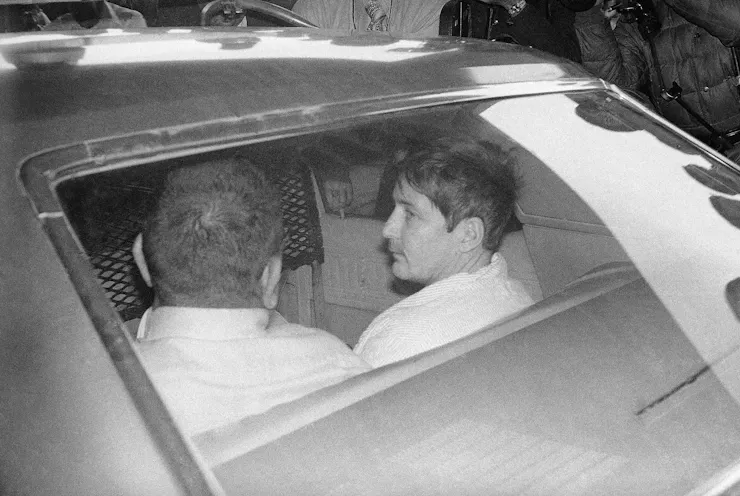
In 1951, a firing squad execution in Utah went awry when the state put Eliseo J. Mares to death. He had been sentenced for the 1946 murder of an Ohio sailor who was killed while traveling to California for his marriage. Two of the four bullets missed Mares’s heart. They hit his hip and abdomen. He did not die quickly.
In January 1977, Utah also killed Gary Gilmore by firing squad. Utah law allowed prisoners to choose hanging or firing squad as execution methods. Gilmore elected the latter, saying it would allow him to “die with dignity.”
Gilmore was the first person executed in the U.S. after the Supreme Court‘s 1976 ruling that the death penalty was not a cruel and unusual punishment.
As Time magazine reported, “His neck, waist, wrists and feet were loosely bound to the chair. Twenty-six feet away hung a sailcloth partition with five slits. Hidden behind the curtain stood five riflemen armed with .30-.30 deer rifles, four loaded with steel-jacketed shells, the fifth with a blank.”


Gilmore’s last words: “Let’s do it.”
Is the firing squad humane?
I believe the firing squad has not played a large role in America’s death penalty history because it’s offensive to this country’s evolving standards of decency.
As an anesthesiologist told The Associated Press in March 2023, “Inmates could remain conscious for up to 10 seconds after being shot depending on where bullets strike … and those seconds could be ‘severely painful, especially related to shattering of bone and damage to the spinal cord.’”
States abandoned the firing squad because it was thought to mimic the violence to which executions were responding.
But Hasan’s execution comes at a time of revived interest in firing squads as an execution method, aided by continuing problems with lethal injection. They are now legal in five states: Idaho, Mississippi, Oklahoma, South Carolina and Utah.

Idaho is the only state that designates the firing squad as its primary execution method. Idaho state Rep. Bruce Skaug has called the method “certain” and “quick.”
Others agree. In a 2017 opinion, Supreme Court Justice Sonia Sotomayor wrote, “In addition to being near instant, death by shooting may also be comparatively painless.”
And in October 2026, former federal appellate judge Alex Kozinski applauded Hegseth’s decision to execute Hasan by firing squad. He was reiterating a view he expressed in a 2014 dissenting opinion: “Eight or ten large-caliber rifle bullets fired at close range can inflict massive damage, causing instant death every time.”
“Sure,” Kozinski added, “firing squads can be messy, but if we are willing to carry out executions, we should not shield ourselves from the reality that we are shedding human blood. If we, as a society, cannot stomach the splatter from an execution carried out by firing squad, then we shouldn’t be carrying out executions at all.”
On Dec. 3, Americans will again have a chance to consider whether they can stomach an execution by firing squad or whether they should be carrying out executions at all.
This article is republished from The Conversation, a nonprofit, independent news organization bringing you facts and trustworthy analysis to help you make sense of our complex world. It was written by: Austin Sarat, Amherst College
Read more:
- Death by firing squad set to resume in the US – but no matter the method, all means of execution come with a troubling history
- Tony Carruthers recently survived a lethal injection attempt – the latest man to endure a failed execution
- In newly independent US, Americans debated whether public executions taught a lesson or just showed off the state’s power to destroy
Austin Sarat does not work for, consult, own shares in or receive funding from any company or organization that would benefit from this article, and has disclosed no relevant affiliations beyond their academic appointment.


(0) comments
Welcome to the discussion.
Log In
Keep it Clean. Please avoid obscene, vulgar, lewd, racist or sexually-oriented language.
PLEASE TURN OFF YOUR CAPS LOCK.
Don't Threaten. Threats of harming another person will not be tolerated.
Be Truthful. Don't knowingly lie about anyone or anything.
Be Nice. No racism, sexism or any sort of -ism that is degrading to another person.
Be Proactive. Use the 'Report' link on each comment to let us know of abusive posts.
Share with Us. We'd love to hear eyewitness accounts, the history behind an article.