


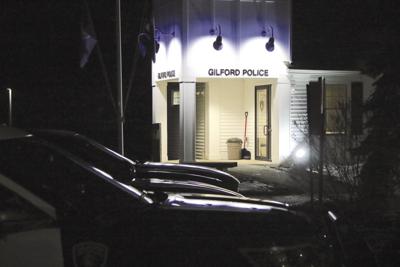
Less than one day into the new year, tragedy struck Gilford. Seventeen-year old Mischa Fay was shot and killed by a Gilford police officer responding to reports of a resident armed with a knife on Sunday night. Sometime after their arrival, the officers encountered Fay, who allegedly was armed. One officer fired a taser. The other fired his gun, killing Fay with a single gunshot.
The shooting is under investigation by the state's Major Crimes Unit, and both officers have been placed on administrative leave, as is protocol. The body camera footage from that night, along with the identities of the officers, their reports or phone call audio remain sealed until the investigation is complete.
What exactly transpired will remain unknown until those materials are made public, but one thing is clear. The Gilford police log listed that 9:52. p.m. call as a “mental person,” signifying a mental health crisis.
While Sunday's outcome is not how a majority of these interactions end, it is still far from an anomaly.
According to a 2021 article in The Concord Monitor, 60% of people killed by New Hampshire police in the past decade had a mental health problem. In the meantime, communities across the country are questioning if police should always be first on the scene for a mental health crisis, but many alternatives are expensive and out of reach for small municipalities.
Fay's death came at a time of year that can be a hot spot for mental health issues. Neither Gilford nor Laconia had recent statistics, but both Laconia Police Chief Matt Canfield and Gilford Lt. Adam VanSteensburg noted what feels like a seasonal spike in mental health calls in their respective communities.
“I've been a police officer 13, going on 14 years, and 100% the holidays seem to be an uptick in those types of calls,” VanSteensburg said. “It could be a mix of families getting together, or lack of family no has to get with. Definitely, the holidays are an uptick.”
For most small towns in America, police are often the first to respond when someone is going through a mental health crisis. In Laconia and Gilford, mental health calls are among the most common situations officers deal with.
“Mental health calls, domestic violence and drug-related issues are our top three" calls, Canfield said. “A lot of times, they're intertwined. We can have domestic violence fueled by mental health or drug addiction issues.”
“Those would be the [top] three things I would say hands down, and they are all intertwined,” agreed VanSteensburg, who added that there is a lack of funding for mental health personnel in general, meaning police, not social workers or psychologists, remain the primary method of response during a mental health crisis.
“We have to wear so many different hats, and dealing with mental health is a huge part of that,” VanSteensburg said. Gilford PD frequently trains officers in de-escalation tactics and other non-lethal means to respond to mental health calls.
“We assign officers on a monthly or bi-monthly basis specific training they have to go through,” VanSteensburg said. “They are tested on it, so they have to watch it. We mandate our guys to do that. A lot of those courses are specific to mental health.”
Franklin Police Chief David Goldstein said his department started Crisis Intervention Team training through the National Alliance on Mental Illness, or NAMI.
“We have one once a month or every two months where we bring first responders in,” said Goldstein, who helps instruct the course. “It's an ongoing initiative to understand more and more from a mental health point of view.”
“We’ve been working with law enforcement, state police and the Department of Safety for four years,” said NAMI New Hampshire Executive Director Susan Stearns. “We have a federal grant that allows us to provide Crisis Intervention Team training. It’s considered the gold standard.”
According to Stearns, the trainings are 40 hours long.
“It's a significant investment in terms of departments to send people,” Stearns said. “That initially started through the SAMSHA grant, three trainings for 25 first responders each year.” The Substance Abuse and Mental Health Services Administration is a branch of the U.S. Department of Health and Human Services.
Now, thanks to increased funding, Stearns says there will be 11 training sessions this year.
While the training for law enforcement officers and other first responders may be highly beneficial, at the end of the day, none of them are certified mental health experts.
“Sometimes no matter what good intentions we have, those situations can go south very quickly,” Goldstein said. “People have to realize we still have another function to fill in society that requires us to protect ourselves and other individuals, and that can lead up to incidents where lethal force has to be used if non-lethal doesn't work.”
Fatal police encounters involving people with mental illness or those in crisis have caused some communities to question if police officers are always the best tool for the job during a mental health crisis.
“We have a lot of work to do,” Stearns acknowledged. “We need to continue training law enforcement and first responders.”
Other cities across the country have taken to employing counselors and social workers within police departments to de-escalate mental health situations. This solution has not yet been widely adopted in New Hampshire, and there appears to be no such partnership in the Lakes Region.
“I’d like to have at least one if not more mental health workers assigned to the police department,” Goldstein said, if money weren't an issue.
Mental health cooperation in the local area is still evolving, including a recently created mobile crisis team that is routed through the 988 suicide hotline number.
Stearns says the team has had over 20,000 community interactions since its inception in 2021.
“We need to do it all, and I challenge anyone who says we can’t do things in New Hampshire,” Stearns said, calling the creation of the rapid response team “transformational,” especially during the pandemic.
While the rapid response team looks promising, both Stearns and Goldstein highlighted the need for more investment and support for local community mental health services as a preventative measure.
“I think this is social responsibility for everybody,” Goldstein asserted. “If we’re going to decry that mental health is that important and we should deal with these issues 24/7, we should find a way to support those working with those issues. We have mental health professionals willing to work for us. I’m going to put the onus back on the taxpayer.”
“We need to invest in more community mental health services upstream,” Stearns said. “We know the earlier you can get someone into treatment, the better the outcome.”
If you or a loved one is suffering a mental health crisis, you can call the state's rapid response team at 833-710-6477, or the national suicide hotline at 988. Those without a 603 area code should contact the rapid response team directly.


(3) comments
Remember David Donovan from Meredith. If you don't know GOOGLE IT
We don't need our police to play "therapist and friend". We all know they are not. What we NEED is for our local cops to STOP SHOOTING INNOCENT PEOPLE. A bullet is NOT equal punishment to a TEEN holding a knife.
Don't they teach you guys judo? Krav Maga? A drop kick?! Come on!!!
How about two tasers and no bullets.
Welcome to the discussion.
Log In
Keep it Clean. Please avoid obscene, vulgar, lewd, racist or sexually-oriented language.
PLEASE TURN OFF YOUR CAPS LOCK.
Don't Threaten. Threats of harming another person will not be tolerated.
Be Truthful. Don't knowingly lie about anyone or anything.
Be Nice. No racism, sexism or any sort of -ism that is degrading to another person.
Be Proactive. Use the 'Report' link on each comment to let us know of abusive posts.
Share with Us. We'd love to hear eyewitness accounts, the history behind an article.