


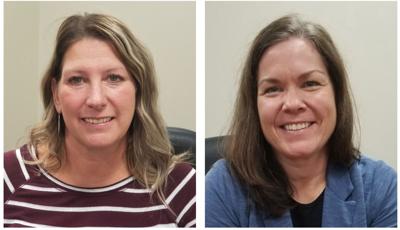
LACONIA — Candidates in Ward 1 say they’ll bring a mix of professional skills and experience, civility and caring to the Laconia School Board if elected to fill the position vacated by outgoing member Mal Murray.
Candace Knowlton, a registered nurse and professor of nursing at NHTI, is the mother of a recent Laconia High School graduate, a current high school junior and a current first grader. She served on the district’s "getting back to school" committee and on the Portrait of a Graduate committee, which defines goals and skills that high schoolers should acquire to prepare for college, career education or the world of work.
“I have a lot of different perspectives to offer, especially in the climate we’re in now,” said Knowlton, including an ability to make informed decisions about COVID policy. “Being a nurse offers a different perspective regarding evidence, data and keeping kids safe,” she said. “Keeping our kids in school five days a week as safely as possible, that should be our number one goal right now with COVID variants.”
Hybrid learning and pandemic disruptions were challenges for parents, teachers and children. “I hate calling it learning loss. I don’t think we can measure that. It’s important to meet the kids where they are now, and meet the educational needs for whatever they choose after secondary school,” Knowlton said.
She described herself as an open-minded person who likes to hear all sides of an issue, and someone who will bring more collaboration with parents and students to the school board. "I feel there’s not good communication and listening as well as a lot of divisiveness,” she said. She said it’s important to identify common ground and work through problems together.
Knowlton said she was frustrated last year when she went to her first school board meeting and wasn’t allowed to ask a question. The school board needs to look for a better way to communicate with parents that enables them to get answers.
Time limits on public comment are important, especially when a crowd of people want to speak. But a 20-minute limit on public remarks doesn’t allow for adequate community input on a first reading of a proposed school policy, Knowlton said.
She said negotiating a website to find answers to specific questions can be frustrating and fruitless in many situations.
“I know I can’t change the world, but I would hope to get parents the info they need and require,” said Knowlton. “That’s who we work for. More communication with constituents and more transparency will reduce their angst about not having questions answered and feeling like they’re not being heard.”
Concerns about what children are learning linger, especially when it comes to diversity and inclusion and programs through the Office of Student Wellness.
“I don’t know how transparent the curriculum is. I’ll do any research and do it 100 percent,” she said. “Hopefully that will make us feel less in the dark.”
Maintaining respectful meetings is also important. “I’m hoping I can bring a little calmness to what seems like a very divisive board. I don’t have an agenda,” said Knowlton. “I want to go in and listen to what people say and make the best decision for our students.”
Jennifer Ulrich, mother of a third-grader and a kindergartener, said it will be a tall order to fill the opening left by Mal Murray, a retired math teacher who first served in 2009.
But Ulrich, who holds a master’s degree in business administration from Boston University and works remotely for a health care technology company, said she’ll bring problem-solving experience and well-tuned listening and communication skills.
“I see this an an opportunity to volunteer my time and contribute to the important work the school board does,” said Ulrich, who has lived in Laconia since 2016. While attending school board meetings, she said she was “taken aback by the interaction between board members” at times, and there seemed little tolerance for dissenting options. Angry statements and accusations from the public resulted in stalemates, and less productive communication to and from the board.
“A lot of topics have been very polarizing, and a lot of comments have been difficult to hear. I understand the position of both sides. It’s intimidating to have these things said. One of the responsibilities and duties of the board is to listen to the input from community members,” said Ulrich.
Limits on speaking times are important to allow the board to conduct critical business, she said. Public input “doesn’t all have to culminate at the board meeting. There are other avenues for dialogue and understanding." Ulrich would like to open up more dialogue with constituents in Ward 1.
She also hopes to increase transparency, and share information the community requests. There’s a general distrust, said Ulrich – a problem plaguing school boards nationwide, which can be addressed by clear and complete communication. “When someone asks if CRT is being taught, there’s more to that question. What are the things they’re seeking to know?”
“Absolutely parents have a right to know what their children are being taught. We sometimes expect that to be delivered to us,” Ulrich said. “But we are empowered to ask.”
Preserving in-person learning and making up for any gaps in education that children may have experienced remain pressing school missions, she said. “As a parent it was hard having kids home and doing hybrid learning. It was a breaking point. It made me realize these teachers have an incredibly difficult job – and do an incredible job. We owe it to all children to give people a public education so they can thrive and be prepared."
Ulrich said her job in client services at Athena Health, an IT company based in Watertown, Massachusetts, requires honed interpersonal skills, immersion in problem solving, and collaboration to reach a joint solution.
For years, school board meetings were sparsely attended, and school board candidates ran unchallenged. But the volume and importance of board decisions has come to the forefront, and sparked more parent involvement.
“We’re not out of the pandemic yet. In-person education is the most critical issue right now. That means making sure students, faculty are safe. A lot of creative and thoughtful things are being done in schools to get children the support they need to close the gap” resulting from COVID. “If we can all get behind the goal of keeping children in school and healthy and not remote, that’s the most important thing we can do right now.”
Ulrich hopes that with school board turnover, the tenor of meetings will change. “You may not see eye to eye, but not speaking to another board member is not acceptable. That harms our children if you have board members who are so angry they can’t talk to each other. You have that now. They’re holding onto civility by a thread.”


(0) comments
Welcome to the discussion.
Log In
Keep it Clean. Please avoid obscene, vulgar, lewd, racist or sexually-oriented language.
PLEASE TURN OFF YOUR CAPS LOCK.
Don't Threaten. Threats of harming another person will not be tolerated.
Be Truthful. Don't knowingly lie about anyone or anything.
Be Nice. No racism, sexism or any sort of -ism that is degrading to another person.
Be Proactive. Use the 'Report' link on each comment to let us know of abusive posts.
Share with Us. We'd love to hear eyewitness accounts, the history behind an article.