


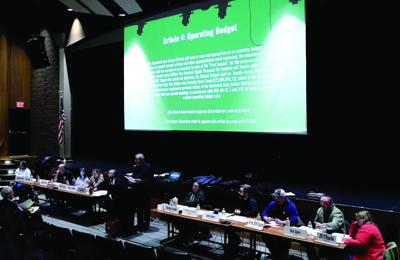
BRISTOL — Voters at the Newfound Area School District Jan. 31 deliberative session restored much of the funding cut to meet the 2% cap on tax assessments to district towns, but a technical error may require a special meeting.
The Newfound Area School District Budget Committee took the unusual step of not recommending the school board’s proposed budget of $27.3 million for 2026-27, which did not include funding for co-curricular activities, field trips, and other traditional programs, in order to keep the appropriation within what was allowed by the tax cap. The committee did not propose a budget of its own.
State law requires a budget committee to propose the budget which goes before district voters. Now, Newfound leaders are awaiting a ruling from the state Department of Revenue Administration on the matter.
Newfound serves the towns of Alexandria, Bristol, Danbury and New Hampton.
A similar problem occurred once before, according to School Board Chair Melissa Suckling, of Danbury, who reviewed the record of the Jan. 19, 2021, deliberative session. That year, neither the school board nor budget committee recommended the tax cap-compliant budget which went before the voters.
“The DRA said, 'No, you can’t do that,'” she told the school board on Feb. 9. “So then we had an emergency meeting, and it’s very hard to hear, because it’s a tape recording meeting, but what I can gather from that meeting is, what we had to do is change on the [budget report]. I believe we changed our budget recommendation on the MS 27 to a budget that ... we thought would be more appropriate ... and then the budget committee had to put in the budget.”
The situation is not exactly the same, since this year there was a school board budget for consideration at the meeting, and even in 2021, Suckling said, the state revenue department "didn’t really have a big to-do about it.”
Nonetheless, Superintendent Paul Hoiriis said, “We are waiting on word from the DRA on next steps. We’ve contacted our [legal] counsel as well.”
Regardless of the decision, the school district will need to hold a special meeting to address a missed deadline in submitting a required document to the state in January.
Amendments
At the beginning of the budget discussion on Jan. 31, members of the school board successfully amended the article to reduce the budget even further, to $26.9 million, removing money allocated for teacher raises. Leaving it in would have duplicated the funding listed in a separate warrant article seeking approval of the three-year teachers’ contract. That article also had to be amended because, as written, it did not spell out the annual amounts of the cost items in future years.
Budget committee member Rick Alpers, of Bristol, proposed an amendment to add back $1.4 million, bringing the total operating budget to $28.3 million. He noted the figure was a compromise to restoring the full $2.3 million trimmed from the administration’s proposed budget in order to remain within the tax cap.
“I arrived at this number of $1.4 million by working with the superintendent of schools to figure out, OK, what is needed to continue this educational service we’re providing for our students today and staff next year, right?” Alpers said. “It’s just what we’re doing today, we want to do again next year. There are no Cadillacs here, or wants or desires.”
He said that amount would completely fund athletics and other co-curricular programs, field trips, library books, and the summer competency program for the middle school. It also restores a few support staff positions, a high school French teacher, and special education case managers, and provides administrative raises eliminated in the effort to meet the tax cap. Additionally, it restores a teaching position at Danbury Elementary, so the principal would not have to take on teaching responsibilities; completely restores the facilities, maintenance, and equipment budget; and provides funding for an elementary information and communication technology position.
“I think, in truth, it’s sort of an olive branch to the taxpayers at the time that we’re in,” Alpers said. “Things are expensive.”
“Actually, in looking at it the second time, it was actually [a cut of] over $2.4 million,” Hoiriis noted.
Responding to questions raised about a staffing level that has not dropped significantly since three towns left the district, Hoiriis said Newfound has been able to fill several positions that were served by more expensive contracted services in the past — “especially around the area of special education, which includes paraprofessionals, school psychology, speech, OT, PT, all the special ed-related services.”
Bridgewater, Hebron and Groton formed the Pasquaney School District when they left Newfound.
While 23 Newfound staff members remained at the Bridgewater-Hebron Village School when it became part of Pasquaney schools, one paraprofessional transferred to Bristol Elementary to fill a contracted position, Hoiriis said.
“That was one less contract we had to do with an outside provider. We were able to hire an occupational therapist, a physical therapist, and certified occupational therapist assistant ... we were able to hire four new paras ... same with custodians ... and then we took on 10 food service workers, plus a food service director, that we were engaging with contracted services,” he said.
The district also obtained a Coalition for Youth grant, with a coordinator funded by that grant.
Alpers’ amendment easily passed, sending the $28.3 million budget to the ballot for a vote in March.
Other articles
Several articles dealt with leases for energy-saving measures for the high school: a rooftop solar array with a $1.2 million cost and a $94,824 first-year lease payment; LED lighting at a cost of $1.1 million, providing an estimated $56,000 in annual savings; and a $6.2 million lease for propane boilers and heating and cooling systems, providing an estimated $72,000 in annual savings.
Matt Smith of the consulting firm Energy Efficient Investments explained the anticipated savings, and answered questions about long-term maintenance, return on investment, and other concerns.
When one speaker asked about the cost of disposing of the solar material, former Business Manager Mike Limanni, of Gilford, who now serves as chief financial officer for the Dover School District, offered his experience with a similar lease.
“Right now, we have one of the largest solar arrays on a high school in the state, and this question has come up, because we’re at the point of being able to purchase it,” Limanni said. The buyout on the lease would be $1 million, he said.
“I am not going to pay that, and I’m going to have the company take it out of there,” he said. “They’re responsible for it. This is something that you might want to look into down the road.”
A lease, he said, is a good way to pay for such a project, “because you’re using energy savings to do it. But I’m in a similar situation that they didn’t think of when they initially put the solar array on the building. And so they had put, over time, a buyout where the district would then own it, and you’re right, you would be responsible for unloading it.”
School board member Dennis Fitton, of Alexandria, took issue with a speaker who referred to supposed energy savings as “peanuts.”
“You refer to it as 'peanuts,'” he said. “Any monies that are saved by the district is a reinvestment that we can put back into the school for the children every year. As we’re saving on electrical costs, it’s going back into what we need for the school district. It’s not, as you say, 'peanuts,' but every year my electric bill is twice what it was two years ago. This will just continue to defray that, and any savings is good.”
A motion to zero out the financial amounts was defeated after Moderator Ned Gordon recast the decision as a choice between allowing 200 people to kill the article by eliminating the funding, or letting the district as a whole decide whether to support the plan when it goes to a March ballot vote.
There were other questions about LED lighting, with one resident saying LED lights are harmful.
“They’re not good for the eyes, they’re not good for the brain. They’re not good for children,” they said. “It manipulates the brain, causes anxiety.
"It’s different than the incandescent way that it used to be. So I would just consider that before you go and vote, putting this mega thing into the school, that it’s basically not the best.”
School board member Joe Maloney, of Bristol, a member of the facilities committee, spoke in favor of the boiler and HVAC article, saying, “All three of these articles were all part of one big presentation by EEI, and we chose to kind of break them up ... just so there’d be a little bit more flexibility and choice. But this one in particular, you know, I feel the strongest about in terms of its need to pass, not just because of return on investment and stuff, but because, you know, in the last couple years alone, you know — and thank goodness for our maintenance trust fund — but 2024-2025, HVAC emergency expenditures were $17,000, unbudgeted. Just this year alone, so far, we’ve spent $24,484 over just the past seven months on these old units that are well past their life expectancy.”
One resident referred to the budget constraints, saying, “Our schools are going to suffer. We’re trying to introduce all this money, in what it seems to be like a back-alley Green New Deal, almost like, if you think about it.
"If we decide to do that, now we’ve got another $2 million on top of that. So, where I’m trying to get, where’s the balance?”
One resident proposed taking the first year’s lease payment of $492,735 from the district’s expendable trust fund for building maintenance, leading to a long debate about whether the fund could be used for anything other than an emergency.
Fitton argued that, with ongoing maintenance costs and the possibility of the heating system failing, the project fits the definition of an emergency. Alpers, however, said he was “conflicted” because, if the Department of Revenue Administration rules the amendment is illegal, the project would be scrapped.
An attorney serving as legal counsel said, “I would give to you, without seeing what the parameters of that fund are, is that you’re proposing to spend money from a maintenance fund for replacement, and in the wonderful world of leases, there’s a big distinction between maintenance repairs and replacement. And I’d say, unless that fund was meant to cover both, that you shouldn’t be amending the article that way.”
The amendment was defeated, and the article moved to the warrant as proposed.
Voters also forwarded an article allowing open enrollment to the ballot. The article allows the district to accept as many as 100 students from other school districts, but sets a limit of zero Newfound students leaving. Hoiriis noted the Legislature may eliminate the zero option in the future.
In discussion leading up to the vote, Alpers characterized the article as an effort to prevent the “poaching” of Newfound students.
“Just call a spade a spade,” Alpers said. “Paul mentioned that the [Pasquaney] School District wants to take 20 additional kids. Well, those kids aren’t coming from Plymouth. Those kids they want to poach are our kids. This article is to prevent the Pasquaney School District from poaching our kids into their school. It’s as simple as that. Under the current law, knowing that this law could change by next Thursday or the week after, but under current law, we’re just protecting our kids from being poached by Terry Murphy.”
Murphy is a Bridgewater selectboard member and commissioner of the Bridgewater-Hebron Village District.
Tax cap
Speaking on a petitioned article to eliminate the district’s tax cap, New Hampton resident Emily Gatehouse cited statistics on inflation, cost per pupil, and the tax override votes that have taken place since the cap was adopted.
“One, the tax cap does not allow school funding to keep pace with education, which has averaged 2.6% a year,” she said. “This year, it is at 2.7%.
“Two, a tax cap only hurts our future generations and their own community members.
"Fifty-one percent of people that are employed by Newfound schools also live in district. So the people that you guys are voting against their jobs are also your neighbors.
“The state of New Hampshire has been shifting public education costs onto local taxpayers and refusing to follow the state’s constitution for over 30 years. We need to stop allowing the State of New Hampshire to do this. We need to pressure the state to uphold their constitutional duty to our children ... if you guys are mad about spending at the local level, then you need to pressure the people at the state level to do what they are constitutionally responsible to do.”
Gatehouse noted that, over the last 12 years, the community has voted to override the tax cap seven times.
“None of these past examples, or today, include fluff,” she said. “This demonstrates that the tax cap isn’t curbing superfluous spending.”
The tax cap “sounds fine in theory, until you realize that, on average, since 2011, when the tax cap was voted in, the yearly inflation rate has been about 2.6% over 14 years. That’s an inflation rate of 43.1%,” she said. “There is zero room for accounting for the simple rate of inflation, let alone school needs.”
She argued that cost-per-pupil discussions are pointless.
“Think about your own household. Each month you pay your mortgage — $2,000; electricity, $200; heat, $300; water, $100. Take that number, $2,600, and divide it by the number of people living in your house: two parents, two kids, four people. That equals $650; that is your cost per resident. Now let’s say one of your kids heads off to college. You still have to pay $2,600 in household expenses. You still have your mortgage, still have your electric, still have your heat, you still have your water, which have not seen any major changes. However, only three people now live in that house. Your cost per resident is now $867. You haven’t gone on a spending spree. There are no extras. It simply reflects the number of people in the house against the cost of your monthly expenses. The same is true for cost per pupil. Losing some students doesn’t change your expenses, but it does impact your cost per pupil immensely, especially since losing some students doesn’t change the cost for maintaining the school’s infrastructure.
"When the 2% tax cap was voted on in 2011 to 2012, the cost per student of Newfound was $16,794.10.”
Adjusted for 43.1% inflation, she said, “We are actually spending roughly $2,000 less per student than we were in 2011.”
The petitioned article will round out the warrant for the ballot vote in March.


(0) comments
Welcome to the discussion.
Log In
Keep it Clean. Please avoid obscene, vulgar, lewd, racist or sexually-oriented language.
PLEASE TURN OFF YOUR CAPS LOCK.
Don't Threaten. Threats of harming another person will not be tolerated.
Be Truthful. Don't knowingly lie about anyone or anything.
Be Nice. No racism, sexism or any sort of -ism that is degrading to another person.
Be Proactive. Use the 'Report' link on each comment to let us know of abusive posts.
Share with Us. We'd love to hear eyewitness accounts, the history behind an article.