


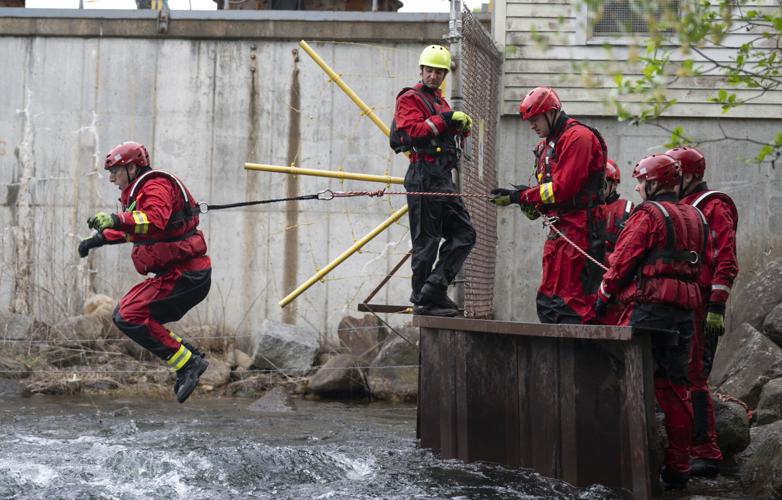
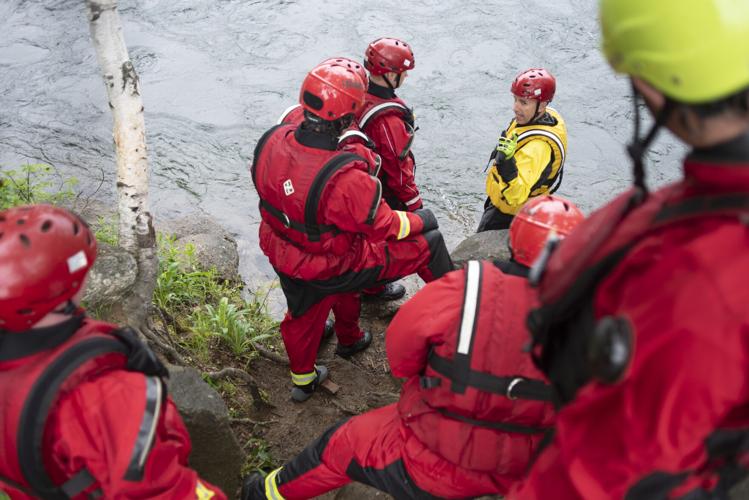
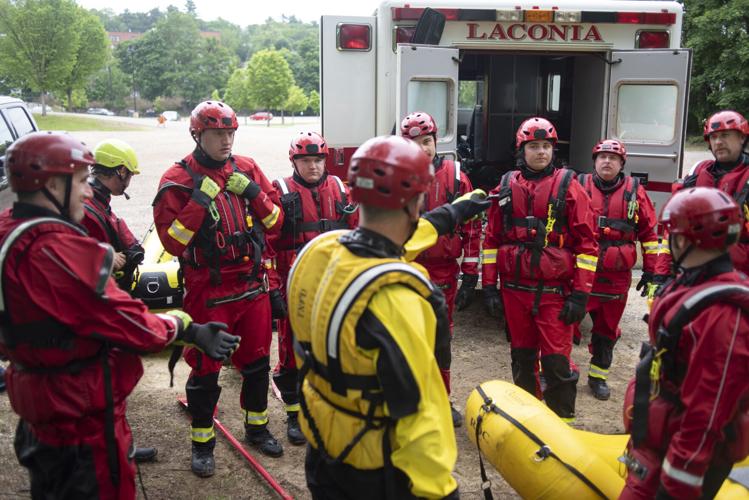
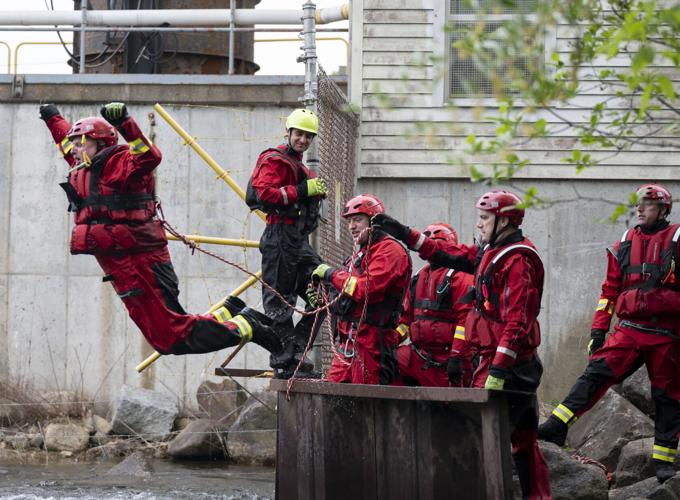
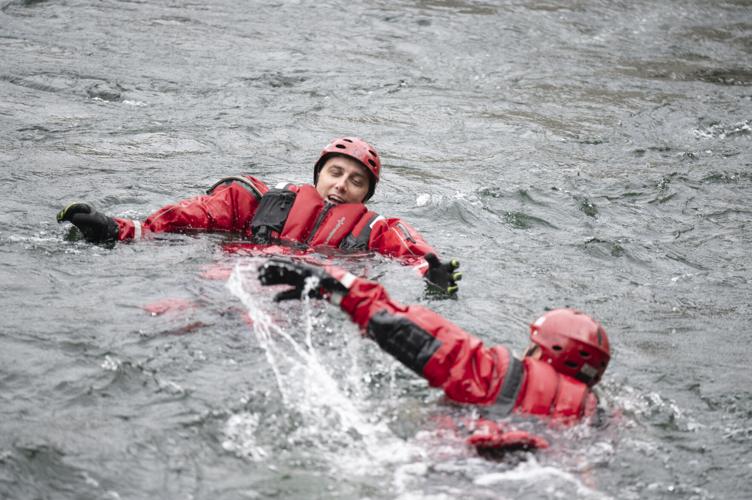
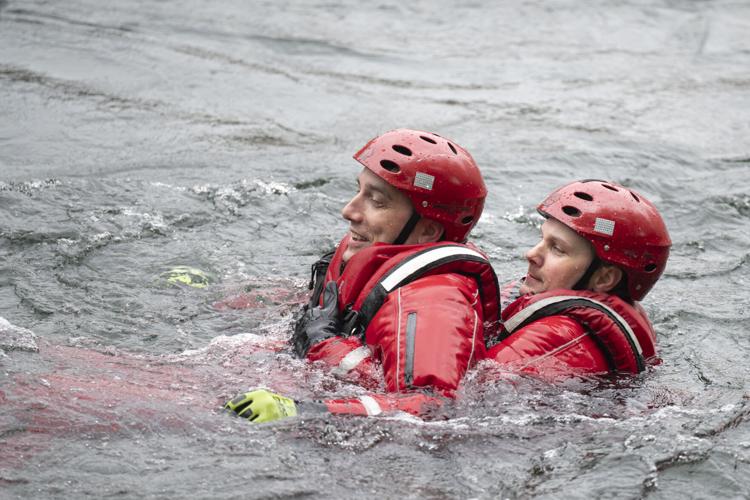
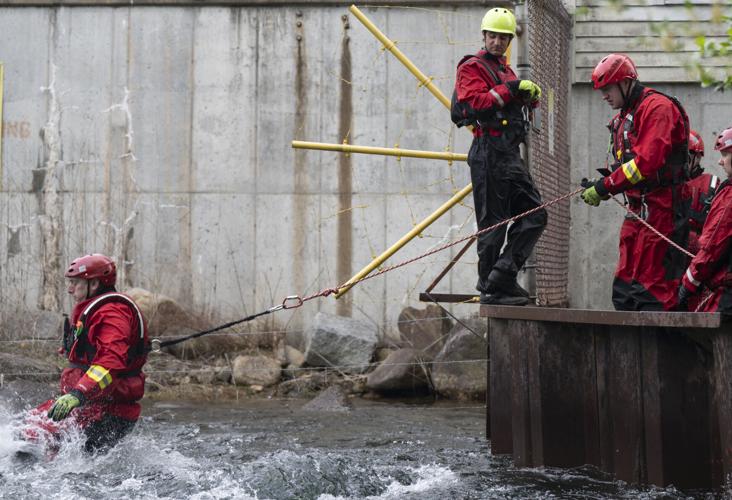
LACONIA — The Laconia Fire Department's annual swift water training allows firefighters to practice rescue operations in current speeds up to 5 miles per hour, preparing them for a busy summer of water recreation.
The training, held June 6, takes place mostly in flood waters and in rivers. Fire Chief Tim Joubert explained that in the Lakes Region, proper understanding of swift water rescue is essential for his staff.
“A lot of a lot of people like to get on the rivers, and they get the inner tubes, or they buy a kayak, or really aren't familiar with what the river is doing, how fast it's going, and that's where people can get in trouble,” Joubert said. “It's always important that those people understand the conditions that they're getting themselves into when they decide to get on that river.”
During such rescue operations, if the current is flowing at 6 miles per hour or faster, firefighters would rely on shore-based rescue maneuvers, as well as rescue boats.
Firefighters are also required to wear safety equipment, including a swift water personal flotation device like a life vest, a whistle, a helmet, a throw bag, outer and underwear appropriate for the climate including a wetsuit, and a radio.
Swift water rescue training has been held in the area since the early 2000s, when Tilton-Northfield Fire Department and the Franklin Fire Department began their own training and teams. Franklin Deputy Fire Chief David Hall said the training was in response to a few rescue incidents for which the department was not prepared.
“They quickly realized, 'Look, we don't know what we're doing here.' And they were instrumental in starting and getting some certification, getting some gear, and then sort of getting the ball rolling even in the state,” he said.
He said former Fire Chief Kevin LaChapelle helped organize early swift water training programs. Now, municipalities all over the state can get certified training through the national or New Hampshire Fire Academy. Joubert said that, with no pun intended, the trainings “flooded” the state, which is good, because unlike fire, water cannot be controlled.
“At a fire call, we can put water on it, we can make it better. We can remove the fuel, we can remove the oxygen. We can do all kinds of things to make it better. But we can't do that in this type of incident, so the training is really, really critical,” Joubert said. “I think the academy has done a great job in the state in general."
Historically, fire departments have not had their own swift water rescue teams. After a 2005 flood in Alstead — which killed four people, damaged over 100 homes and buildings, and miles of roads — concern spread across the state about how to properly respond to floods. With other flooding and rescue incidents in the Lakes Region around that time, the Three Rivers Water Extrication Team (WET) was created in 2006. The team included firefighters from Franklin, Tilton-Northfield, Sanbornton and Belmont. Then in 2010, the Pemi WET was created, which included Ashland, New Hampton, Holderness, Plymouth, Campton and Thornton. It wasn’t until 2012 when the teams combined into a broader Lakes Region WET. Eventually, fire departments adopted their own certified teams, and the WET was replaced by what is called a run card.
“Like any type of emergency that we have, we have run cards,” Joubert said. “Let's say, for example, we have a fire, and we ask for a specific alarm, it's going to bring us, maybe Gilford and Meredith and Belmont to come assist. We now do that with swift water calls.”
Franklin was at the forefront of developing the training, due to their own swift water incidents in the ‘90s and early 2000s. Franklin sits at the intersection of three rivers, where the Winnipesaukee and the Pemigewasset form the Merrimack River. Now, with Mill City Park bringing kayakers to the city for whitewater activity, it would seem this training is needed more than ever. But Hall explained there have not been an influx of emergency calls from the park, only occasional reports of people losing their kayaks.
“The features that they're putting in are somewhat safer, because they’re designed to create a current that brings people to the side, where they can get out easier,” he said.
Laconia Fire Department pays for the training through their Life Saving Fund, which was established to remember Lt. Mark Miller, who died in 2004, during a dive training. Joubert said Miller was a huge advocate for water rescue training.
“Mark was super passionate about water rescue,” Joubert said. “The Life Saving Fund is a nonprofit fund that benefits the department when it comes to training, education and equipment, specifically water rescue.”


(0) comments
Welcome to the discussion.
Log In
Keep it Clean. Please avoid obscene, vulgar, lewd, racist or sexually-oriented language.
PLEASE TURN OFF YOUR CAPS LOCK.
Don't Threaten. Threats of harming another person will not be tolerated.
Be Truthful. Don't knowingly lie about anyone or anything.
Be Nice. No racism, sexism or any sort of -ism that is degrading to another person.
Be Proactive. Use the 'Report' link on each comment to let us know of abusive posts.
Share with Us. We'd love to hear eyewitness accounts, the history behind an article.