


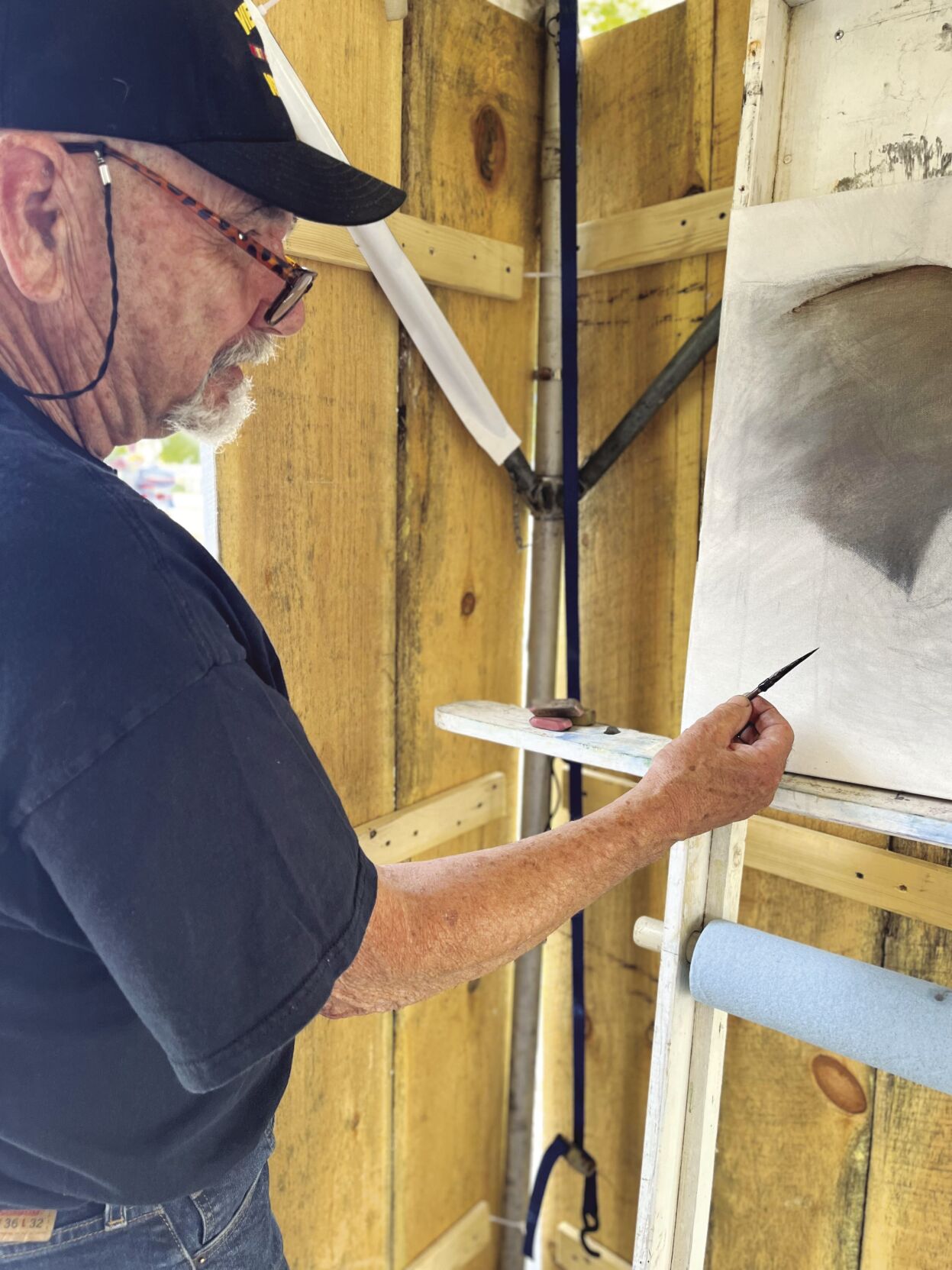
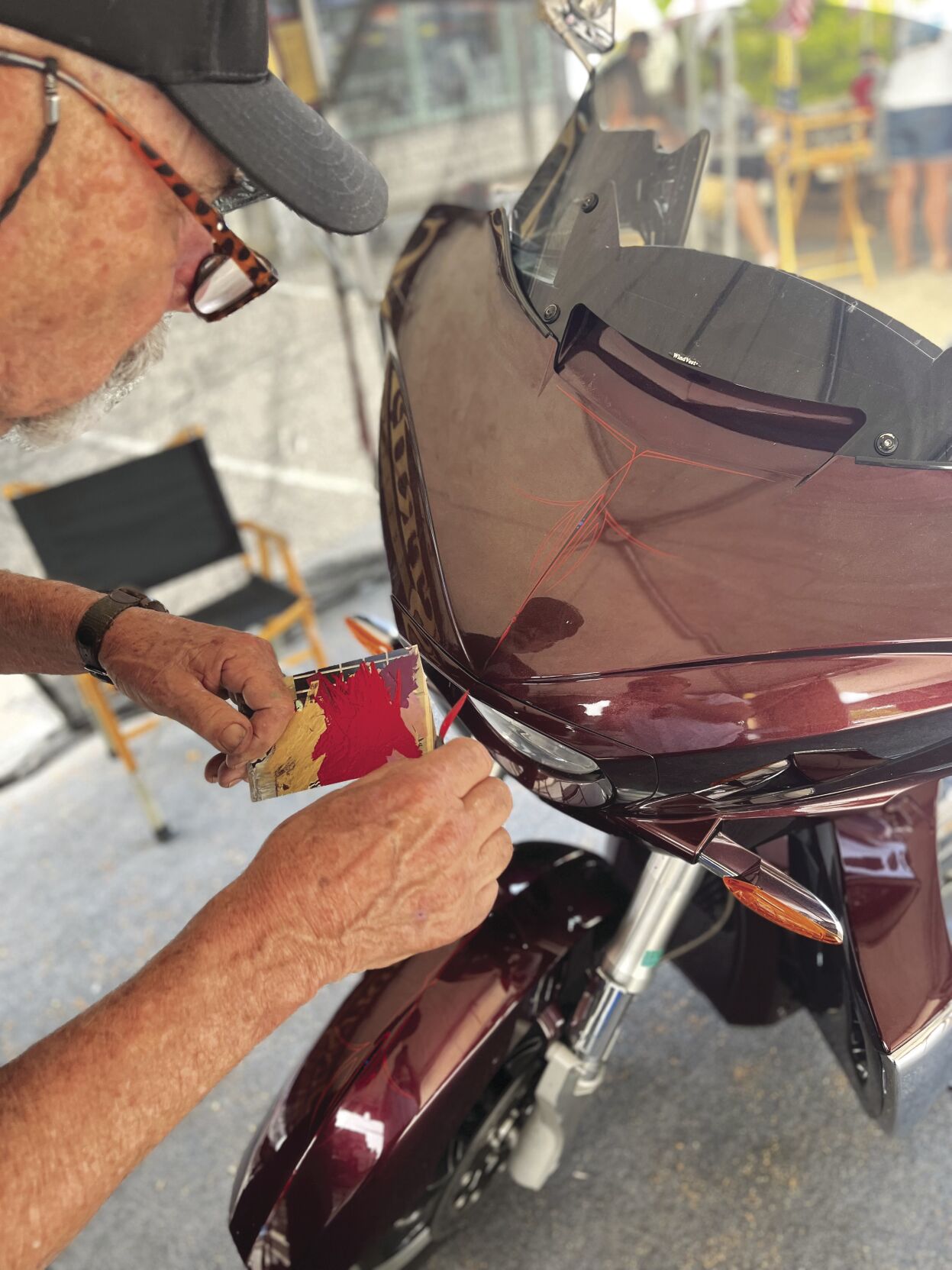
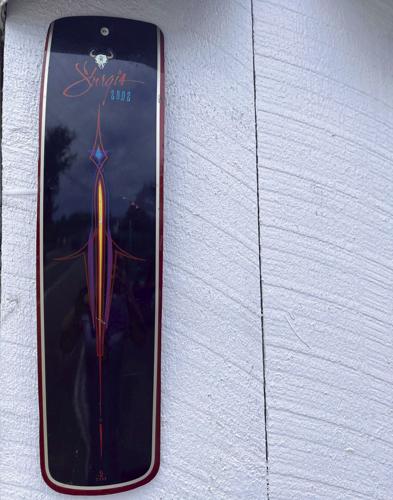
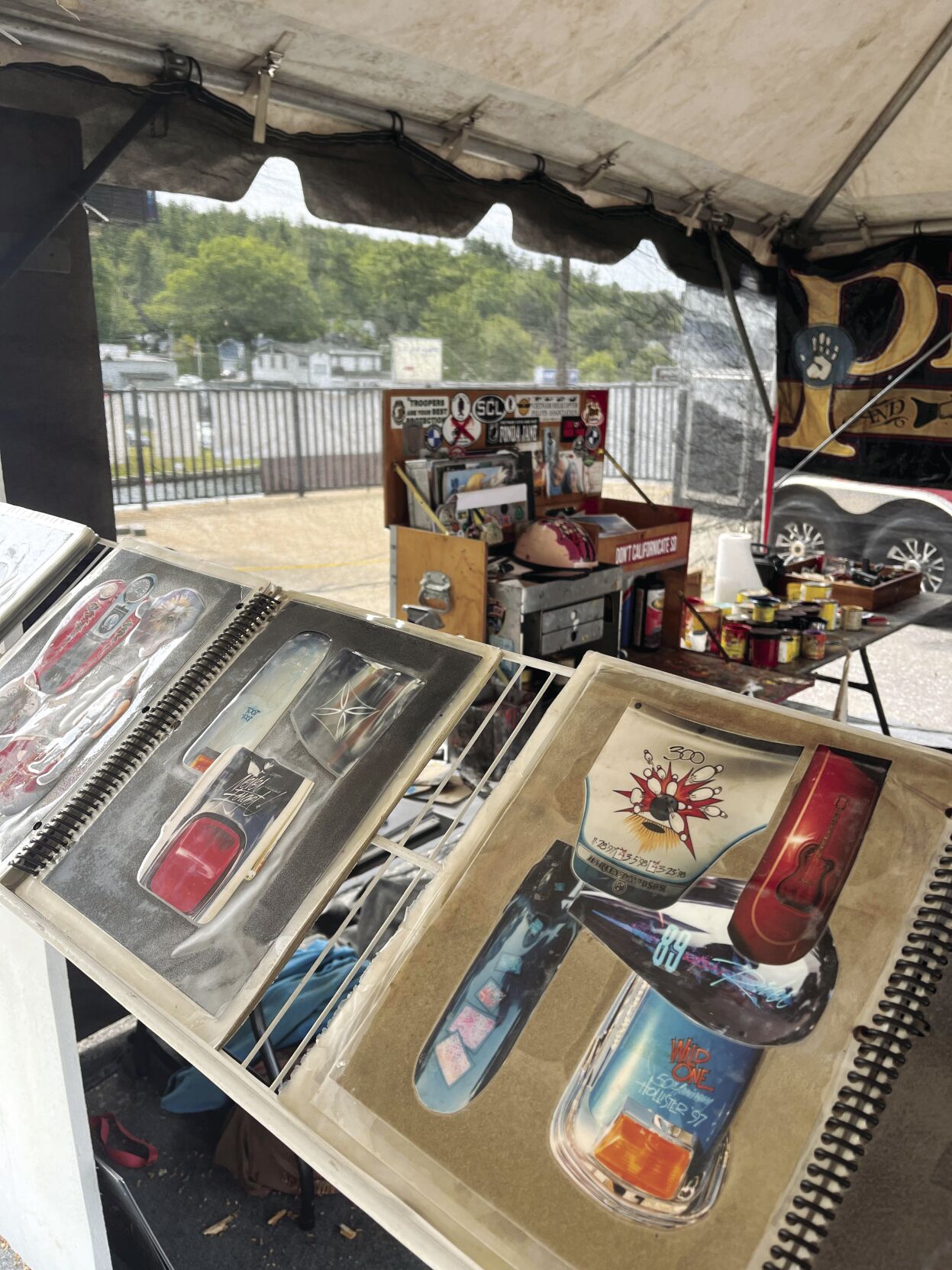
LACONIA — Russ Mowry has always had steady hands. He’s used them to fly combat helicopters in Vietnam, paint portraits, and pinstripe countless motorcycles at rallies across the country.
The 78-year-old Mowry has been coming to Laconia Motorcycle Week, as well as Sturgis and Americade in Lake George, New York, for decades as a pinstriper, someone who paints personalized designs on people’s motorcycles, cars and accessories.
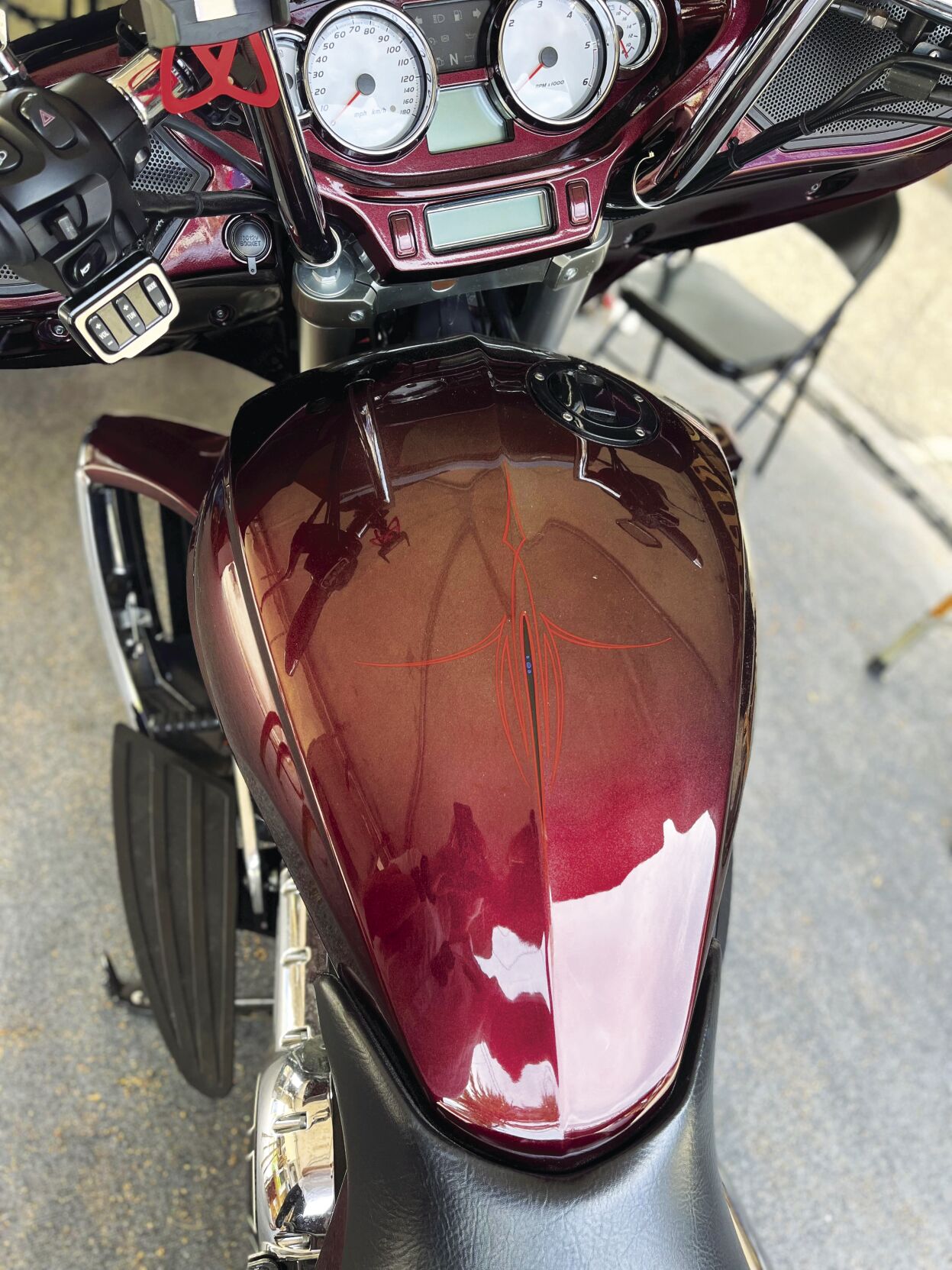
Mowry considers pinstriping to be American folk art, as opposed to fine art, but that does not mean he finds any less beauty and personal fulfillment in his designs.
“Less is more with pinstriping, it’s very delicate,” Mowry said. “I always tell people that I work in ounces, not pounds.” Pinstriping is one way that riders can add personal flair to their vehicle and is as old as bike culture itself.
“On a bike, pinstriping whispers, whereas chrome and stuff like that, it shouts.”
Mowry began pinstriping at age 14 in 1958. Already seeing himself as “an art guy” because of his talent for painting, drawing and doodling in class, Mowry was inspired by pictures of pinstriped cars and bikes in magazines to take on the craft.
Pinstripers use a specialized, fine-tip brush, and once Mowry got ahold of one secondhand he began practicing. Before long he was pinstriping cars and bikes in his family driveway for five or ten dollars each.
Mowry attended art school for a few years before enlisting in the army in 1967 with the hope of becoming a field or combat photographer. Instead, Mowry found himself training to become a combat helicopter pilot.
“In ten months, I went from being a whacked-out art student to flying military helicopters,” Mowry said.
Mowry’s skills led him to a career as a corporate helicopter pilot after finishing a degree in education at the University of Vermont. But he continued his pinstriping work on the side.
Mowry said it saddened him to see Laconia Motorcycle Week, as he put it, in decline.
“This used to be a real biker rally,” Mowry said. “It was the best in the country because of its energy – it just had an energy to it.”
That energy, along with attendance, has dropped sharply in the last decade, Mowry said. He believes this change is due to generational differences, as the generation of riders he knew ages out of the lifestyle and younger generations do not take it up. This change has affected Mowry not just financially but emotionally as well.
“I have to adjust my expectations and learn to accept change,” Mowry said, looking out at the Weirs Bridge. “Because I’m so attached to how it was, that’s hard for me. I can close my eyes and see it exactly how it used to be, like it’s 1990.”
As someone who has met bikers from all swaths of the country, and as a rider himself, Mowry cautions locals against stereotyping Motorcycle Week attendees.
“Every person who comes in my tent, I ask them where they are from, what they do, and what they do for fun,” Mowry said. “One thing I have learned doing this is that, when you meet a biker, you never know who you’re talking to.”
As part of biker culture, people take on a look, and often a persona, but everyone has a unique and complex other life. Mowry encouraged people to see riders as people who want to, for periods of time, leave their lives behind and be a different person.
“They are more authentic in their biker persona than in their regular lives,” Mowry said. “They’re just people who want to experience life, and they are the most generous, interesting, and engaging people you will ever meet. ”
Mowry continues his work, even as it becomes harder to break even at Laconia and Daytona, because he genuinely enjoys the work and his talent for steady hands has not diminished.
“I try just as hard when I’m doing a bike at 5 p.m. here to keep a steady hand as I did in ’68 to lift those helicopters smoothly off the ground. I try just as hard,” Mowry said.
“It’s a zen thing,” Mowry said. “It’s the activity of it, the idea of it, the execution of it,” that gives him fulfillment and releases personal tension.
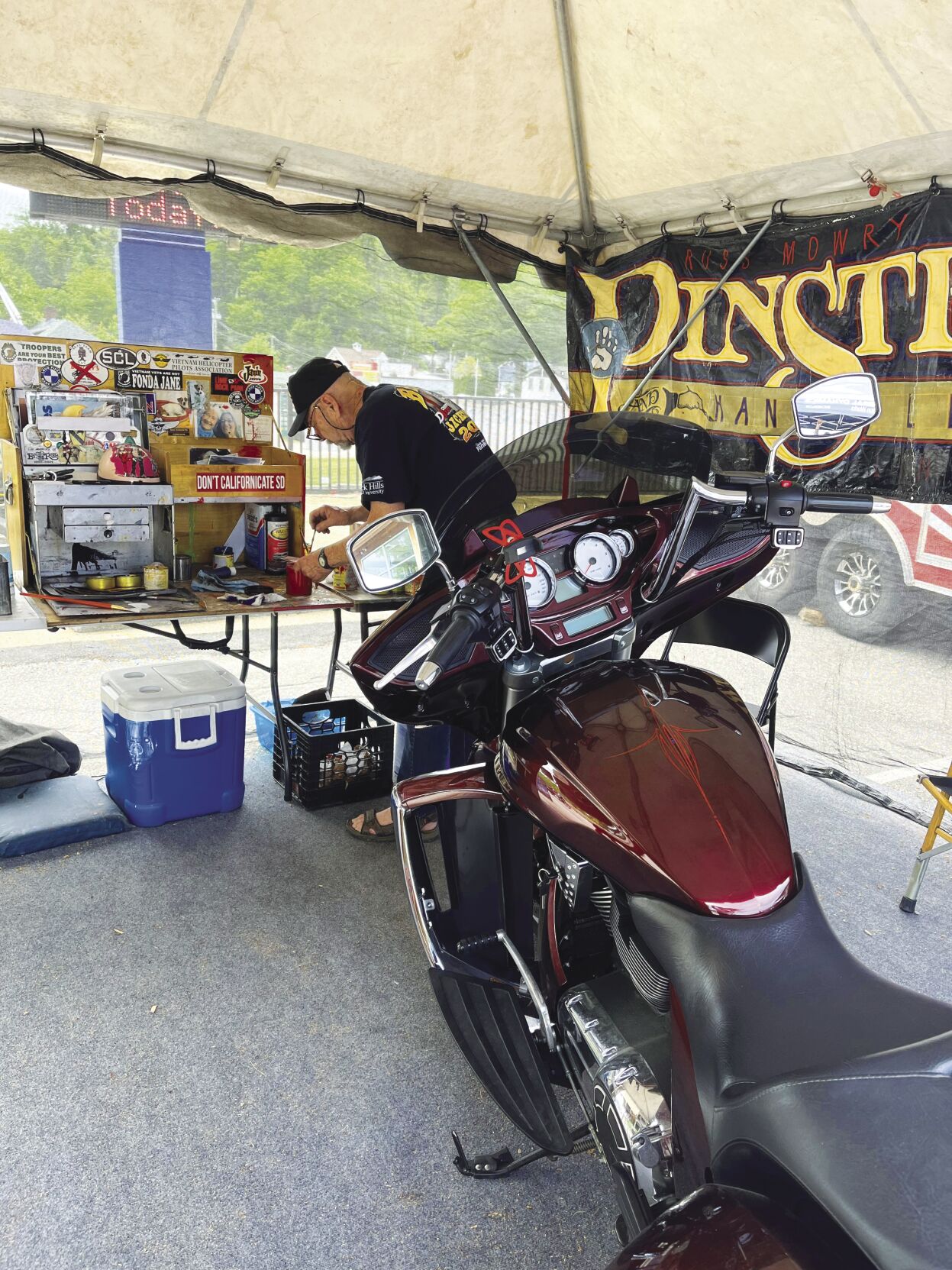
“And it’s theater, really. When I’m at Sturgis working on a bike, I’ll have 20 people watching me. Because people don’t just buy my art, they buy that experience, getting to watch me dance all around the bike.”
In 2013, Mowry was awarded the Pinstripe Legends Lifetime Achievement Award. Honorees are selected by a panel of their professional pinstriping peers, and this, on top of being given the award by Willie G. Davidson, of Harley-Davidson fame, made it the pinnacle of his career.
Mowry was born in Plymouth and, even after his family moved to New Jersey, he returned to Meredith for a week every summer.
After retirement from piloting, Mowry bought a house in Candia and renovated its barn into an art studio. Mowry used the studio to jumpstart his late-in-life fine art career and became a docent at the Currier Museum of Art, reconnecting full-time with his creative passions.
Mowry still travels across the country for rallies and other art connections, though he no longer rides. He’s a self-described “canyon-carver” which means he prefers winding, even “twisty” back roads to straightaways and, even though his favorite bikes to pinstripe are Harleys, he always rode European motorcycles.
Since his childhood, Mowry has been in love with New England and New Hampshire. “I have stepped off the road in every state, and I still think New England is the most beautiful place.”
Mowry's pinstriping business, called Graybeard Designs, Sturgis Pinstriping & Brushfire Design, is located at North Water Marine throughout Motorcycle Week.


(0) comments
Welcome to the discussion.
Log In
Keep it Clean. Please avoid obscene, vulgar, lewd, racist or sexually-oriented language.
PLEASE TURN OFF YOUR CAPS LOCK.
Don't Threaten. Threats of harming another person will not be tolerated.
Be Truthful. Don't knowingly lie about anyone or anything.
Be Nice. No racism, sexism or any sort of -ism that is degrading to another person.
Be Proactive. Use the 'Report' link on each comment to let us know of abusive posts.
Share with Us. We'd love to hear eyewitness accounts, the history behind an article.