


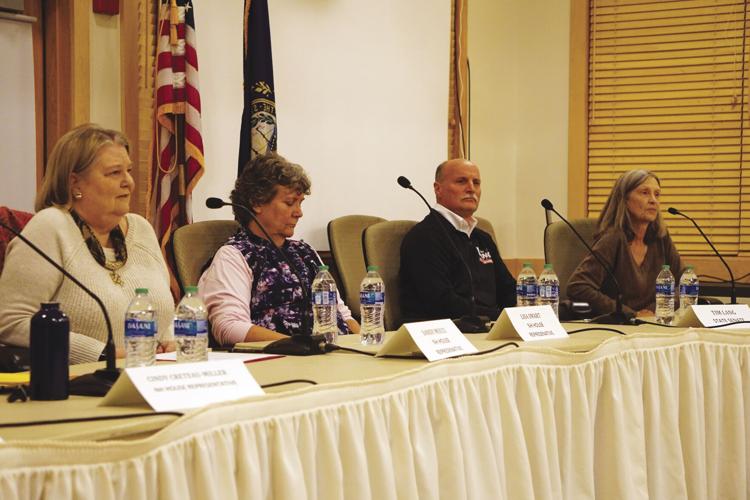
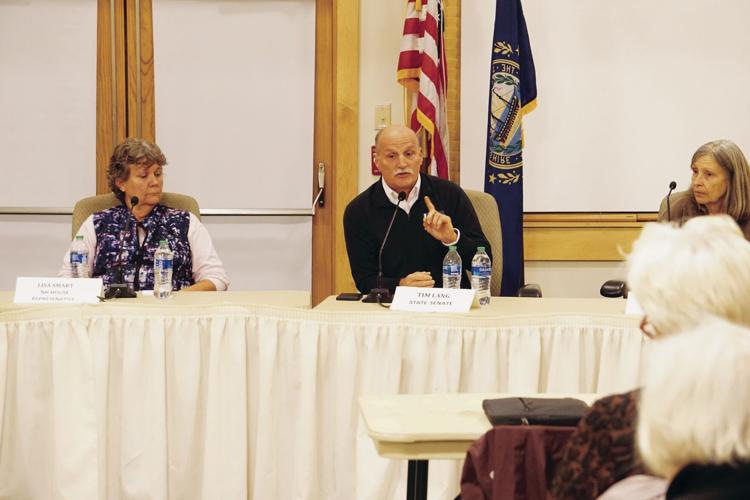
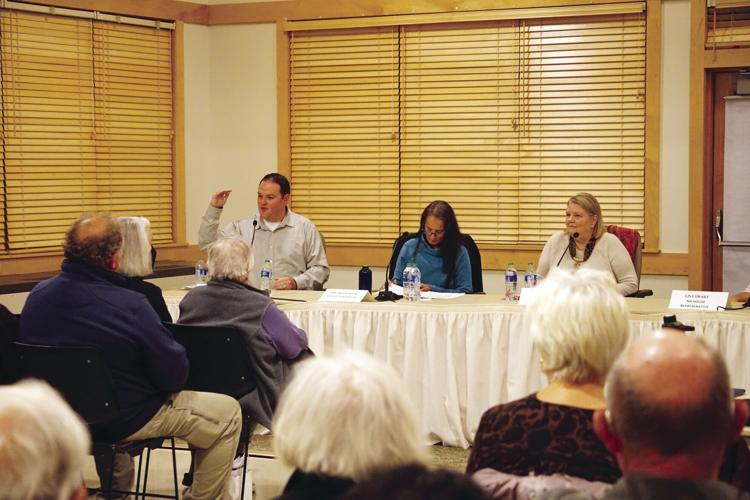
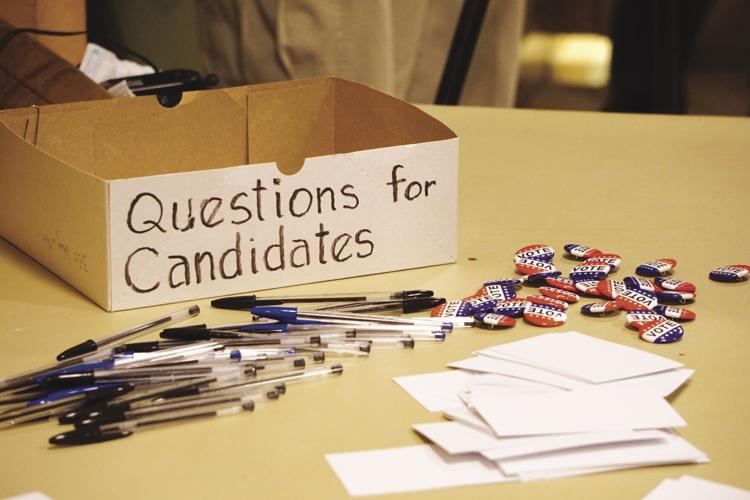
MEREDITH — Candidates for state House and Senate put their policy agenda and speaking skills on display for a room of about 50 voters Monday night, as the League of Women Voters of New Hampshire brought its series of candidate forums to Meredith.
In attendance were Rep. Tim Lang (R-Sanbornton) and former state Rep. Kate Miller, a Democrat, facing off for the newly redistricted Senate District 2 seat, as well as two Republicans, Cindy Creteau-Miller and Lisa Smart, and two Democrats, Matt Coker and Sandra Mucci, vying for Meredith’s two seats in House District 2.
In some policy areas, such as reproductive rights, candidates professed largely similar views; in others, such as the state’s Education Freedom Accounts program, they took a spectrum of stances. The overall atmosphere was jovial: several candidates made — and laughed at one another's — jokes, there were few comments made from the audience and disagreements were purely policy-based.
The opening question sparked a discussion of the environment and energy policy — because of energy cost spikes in New Hampshire, these topics have become nearly synonymous throughout the campaign.
Candidates were generally supportive of increased use of renewable energy, with the exception of Creteau-Miller, who was skeptical about the cost of transitioning away from fossil fuels.
Coker — who, in his opening statement, described himself as “a pretty moderate guy” and “a natural bridge-builder” — spoke in favor of a gradual but decisive diversification of state energy sources. Smart echoed this, but also expressed skeptic reluctance to step away from fossil fuels altogether. Lang highlighted his work on local solar net metering projects and efforts to write and pass clean energy legislation.
Mucci and Miller blamed Gov. Chris Sununu for driving up energy costs beyond the rates of regional neighbors by failing to diversify state energy sources to include renewables.
Whether they knew it or not, the candidates across races and parties professed highly similar views on the issue of abortion — which, in local and statewide races across the country, Democrats have attempted to make a campaign-defining issue.
Moderators asked candidates if they would make any changes to the state’s current law. Creteau-Miller, describing herself as a pro-choice Republican, and Lang said they supported the state law as it is now. Mucci stated that she believes New Hampshire should codify Roe v. Wade. There are few differences between those two outcomes.
Roe protected women's right to abortion up until fetal viability, the point where a fetus could survive outside the womb, cited in the decision as between 24 and 28 weeks of pregnancy. Roe mandated exemptions in cases of the health of the mother. The state’s new abortion law, passed in 2021 and amended earlier this year, bans the procedure after 24 weeks of pregnancy. Exceptions for fatal fetal anomalies and the life of the mother were added, and the requirement for an ultrasound at every abortion visit was stricken, when the law was changed this year — Lang stated that “we made a mistake on the first bill.”
Coker and Miller supported the addition of exceptions in cases of the health of the mother to the state law to protect doctors from fear of prosecution. Mucci expressed support for Roe v. Wade as well as for removing governmental restrictions on abortion. Smart described herself as pro-choice but said that voters should decide on the issue.
All candidates were against any sales or income tax, or other tax increases. The idea of recreational cannabis legalization and taxation was offered by Creteau-Miller, and seconded by Mucci and Coker, as a way to raise state revenues and increase drug safety through regulation. Miller and Smart were against legalization. Lang said the state, already seeing multimillion-dollar surpluses, doesn't need revenue increases and did not address his stance on cannabis. His responses to candidate surveys indicate he is against legalization.
When asked about the state’s Education Freedom Accounts voucher program, candidates fell on a spectrum of support. Miller and Mucci were against the program, and both stated that taxpayer funds should be used for public education.
“If we’ve got that kind of extra money, let’s put it into the schools,” Mucci said.
Coker stated he was in favor of the program with modifications, such as increased means-testing and tighter restrictions on what types of schools and programs qualify students for a voucher. Lang voted in favor of the bill and emphasized that the state can afford the program, which ran nearly $15 million over budget this year. He argued that the state has an obligation to fund the education of each child, not of each school building.
“The question you have to ask yourself is, ‘Does the state have an obligation to fund the education for every child or ... to fund education buildings?’” Lang posed. “I believe it belongs to every child.”
Discussion of affordable housing and the minimum wage were intertwined as candidates discussed the ability of businesses, and the state broadly, to retain and attract a workforce.
Miller was the strongest advocate for increasing New Hampshire’s minimum wage, currently set at the federal minimum of $7.25 per hour.
Coker, again falling in the middle of the issue, stated that he believed an increase, eventually, would be necessary but that, because of inflation and the existing leverage of employees, it wasn’t the right time. Lang agreed and went further to criticize his opponent's stance.
“It’s a nice sound bite, a feel-good measure,” he said. “But the reality is that I don’t know any employer that’s paying $7.25 an hour” right now.
When candidates were asked about local political action committee Citizens for Belknap, Smart was the only candidate who stated she did not support the group. Coker was the only one to disclose a financial connection to the PAC — he made a $100 donation during the spring — and praised the group’s county-level watchdog spirit.
In the final targeted question, candidates were asked whether they would support an independent redistricting commission in the state. New Hampshire’s state and congressional maps were the subject of much contention among the lawmakers charged with drawing and approving them. Coker, Mucci, Lang and Miller — who noted that the district she and Lang were running in appeared gerrymandered — were vocally in favor.
Meredith resident and event organizer Lindsay Weiner said she “couldn’t have asked for more” from the event.
“All of the candidates showed up, we had a packed house and there were lots of questions from the public,” Weiner continued in an email to The Daily Sun. “The candidates were all respectful to each other and graciously answered every question asked within their allotted time limits.”
Weiner was also impressed by the earnest and friendly attitude among attendees. After the election, she hopes to organize a quarterly town hall where Meredith’s elected legislators can connect with voters.
A recording of the entire forum is available for viewing online from Lakes Region Region Public Access TV at vod.lrpa.org. The general election is Tuesday, Nov. 8.


(0) comments
Welcome to the discussion.
Log In
Keep it Clean. Please avoid obscene, vulgar, lewd, racist or sexually-oriented language.
PLEASE TURN OFF YOUR CAPS LOCK.
Don't Threaten. Threats of harming another person will not be tolerated.
Be Truthful. Don't knowingly lie about anyone or anything.
Be Nice. No racism, sexism or any sort of -ism that is degrading to another person.
Be Proactive. Use the 'Report' link on each comment to let us know of abusive posts.
Share with Us. We'd love to hear eyewitness accounts, the history behind an article.