


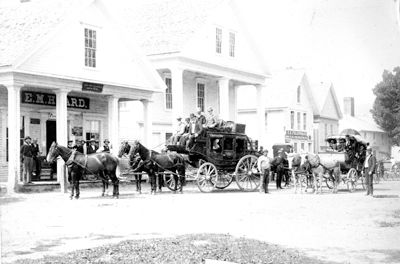
Extensive collection of historic photographs will be on display this weekend
By ROGER AMSDEN, LACONIA DAILY SUN
SANDWICH — Few small towns have such a complete record of their own history as does this town, which this year marks the 100th anniversary of the founding of the Sandwich Historical Society.
Abby Hambrook, director of the Sandwich Historical Society Museum, said that among the many historical items at the museum is a copy of famed author LeGrand Cannon Jr.'s “Look to the Mountain” which he donated.
Cannon, who lived in nearby Tamworth, said of Sandwich residents and their sense of history, “No town is better served by people preserving its history than Sandwich.”
To mark the 100th anniversary of the society's founding there will be an opening reception from 4 p.m. to 8 p.m. Friday at the Craft Building at the Sandwich Fairgrounds of a photo exhibit of Joan Cook's collection of old photos. They will also be available for viewing on Saturday from 10 a.m. to 4 p.m. and Sunday from 11 a.m. to 4 p.m.
Cook started her collection many years ago, and it has grown to approximately 5,000 photographs with many new ones that have never been shared. Approximately 1,000 photographs will be on display, and the rest are available in albums, categorized by subject.
On Sunday from 10 a.m. to 1 p.m. Fred Lavigne will lead a guided hike in Lower Corner to what was once the Red Hill River Brickyard.
The historical society will hold its annual picnic on Sunday, Aug. 13, the last day of Old Home Week, at which H. Boone Potter, Bruce Montgomery and John Taylor will be guest speakers.
Chartered in 1763 by Colonial Governor Benning Wentworth, the land was considered so inaccessible that the grant was enlarged, making Sandwich one of the largest towns in the state. It was named in honor of John Montagu, 4th Earl of Sandwich, said to be the inventor of the sandwich.
The earliest European settlers arrived in 1767. By 1830 Sandwich had grown to a population of 2,700, roughly double the current population of 1,360. At that time the town contained farms, stores, mills, churches, schools, carpenters, blacksmiths and wheelwrights.
By the end of the 1800s much of the population had left Sandwich to live in cities to the west. Sandwich began to be an attraction for visitors, summer residents and artists, which continues to this day.
The League of New Hampshire Craftsmen began in Sandwich as "Sandwich Home Industries" in 1920, and continues statewide today. Each fall the town hosts the Sandwich Fair. The Durgin Bridge, built in 1864, is a covered bridge in the eastern section of town.
Mabel Greeley Merrill Beede was the first to conceive of the idea of “preserving some of the early local furnishings, equipment for home and farm, records, and so forth, which were of historical interest to the town, things we were troubled to see being neglected, destroyed, taken away from Sandwich." Acting on her suggestion, a meeting was called on Aug. 24, 1917 by Carl G. Beede of those interested in the formation of a historical society. Col. Charles B. Hoyt was chosen chairman of the meeting and a committee was formed to nominate officers and prepare bylaws. At a meeting five days later, the Sandwich Historical Society was organized. Col. Hoyt was elected president, bylaws were adopted, and twenty charter members began their work.
In 1920, the society rented the Mary Smith cottage at $25 per year. This little old building, one story with a basement (torn down in 1936), was directly across from the Town Hall. The house, though previously used as a shoe cutting shop and offices for a lawyer and the Selectmen of the town, was in poor condition. After diligent work the shop was ready to open in October of 1920. The Society gathered items gradually and it was soon realized the two rooms in this building were not adequate for holding and displaying the collection.
Also in that year, the Society held a picnic at the home of Moses Hall in Sandwich Notch. About 20 markers were placed along the way by Carl Beede marking the sites of homes or schools with details about those who lived there. Encouraged by the good attendance at the picnic, it was decided to make it an annual event. Mr. and Mrs. Alfred Moorhouse generously contributed a printed account of the first excursion and thus began an annual tradition of unique historical bulletins which have been indexed from 1920 to date.
At the annual meeting in August 1927 it was announced that the Emma F. Gilman property, formerly the Elisha Marston place, could be purchased for $2,000 and that $1,200 had already been pledged. In order to legally hold property, the Society became a corporation on September 28, 1927. The arrangements made at purchase allowed Mrs. Gilman to live in three rooms and be the caretaker of the property.
Soon after the mortgage was paid off in 1936, the house committee opened the attached barn for an exhibit of collections of tools, herbs, and weaving. In 1941, Herbert Warner constructed a replica of a small country store in the converted woodshed from items he had been collecting for years.
In 1972, funded by a bequest from the estate of Joseph Wentworth, an addition was constructed onto the museum. It opened in 1973 with a large exhibit room downstairs and library and meeting room upstairs.
Sandwich Main Street around 1905. (Courtesy photo)




(0) comments
Welcome to the discussion.
Log In
Keep it Clean. Please avoid obscene, vulgar, lewd, racist or sexually-oriented language.
PLEASE TURN OFF YOUR CAPS LOCK.
Don't Threaten. Threats of harming another person will not be tolerated.
Be Truthful. Don't knowingly lie about anyone or anything.
Be Nice. No racism, sexism or any sort of -ism that is degrading to another person.
Be Proactive. Use the 'Report' link on each comment to let us know of abusive posts.
Share with Us. We'd love to hear eyewitness accounts, the history behind an article.