


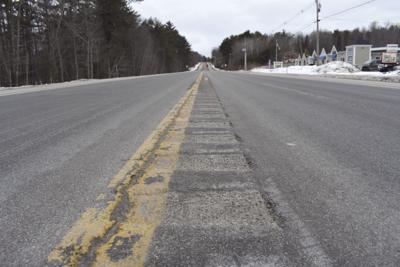
BELMONT — Sections of New Hampshire Route 106, where traffic accidents killed nine people over the last two years, and Route 107, where a motorist died last week, will be considered for rumble strips, state Highway Safety Engineer Mike Dugas said Monday.
Route 106 gets much more traffic than Route 107 and is therefore a more likely candidate for the strips of uneven pavement intended to alert drivers when they are drifting out of lane. A new type of strip is designed to be quieter and less disruptive to nearby neighborhoods.
“One of the main concerns raised by opponents is the noise,” Dugas said.
Rep. Charlie St. Clair, D-Laconia, a member of the New Hampshire House of Representatives Transportation Committee, said rumble strips save lives. He would like to see them installed on both highways.
“They should be put on all two-lane state roads because they work,” he said.
On June 21, a truck crossed the centerline on Route 2 in Randolph and collided with a group of motorcyclists, killing seven.
“If there were rumble strips on Route 2, that would have alerted the driver he was crossing the centerline, giving him time to rectify the situation and not get in that crash,” St. Clair said.
St. Clair said he has spoken with Bill Cass, the Transportation Department’s assistant commissioner and chief engineer, and came away with the understanding they would be installed on Route 106.
Route 106 in Belmont gets 12,000 vehicles per day, compared to 1,500 per day on Route 107 in Gilmanton.
Dugas said some sections of Route 107 would be too narrow for installation of rumble strips, but added that’s not the case where the recent fatal accident occurred.
He said a screening process will determine which two highways will get the rumble strips this year. A public comment period will precede construction, which would start in mid-summer.
Like many of the accidents on Route 106, the fatal crash on Route 107 on Jan. 21 was a head-on collision that occurred after a car went across the centerline and into oncoming traffic.
Killed in that accident was Jackson Brulotte, 19, of Gilmanton Iron Works. He was driving a 2003 Honda Civic and was not wearing a seatbelt.
Injured in the crash was Timothy Stevens, 18, of Gilmanton, a Gilford High School student, who was driving a 1997 Honda CR-V and was wearing a seatbelt.
Both drivers were believed to be observing the 40 mph speed limit. The sun was likely in Brulotte’s eyes when he crossed the centerline, police said.
In July, two people were transported to a hospital after a fiery head-on crash on Route 107 in Belmont.
Routes 106 and 107 are undivided, two-lane roads with curves, hills and side streets that create dangers for anyone who isn’t paying full attention to the road.
Dugas said it’s often hard to put a finger on why there is an uptick of fatal accidents on a particular stretch of road.
“Very often, you don’t know why,” he said. “It could be terrain, distraction, curvature of the road, sunlight.”
Belmont Police Chief Mark Lewandoski urged drivers to pay close attention to the road.
“Rumble strips serve a purpose, but if your speed is up and you’re not paying enough attention, you can still drift and it’s only a matter of seconds before a crash could occur,” he said.
Traffic fatalities in New Hampshire spiked to a 10-year high of 147 in 2018, before dropping to 99 last year, according to government reports, which site speed, impairment and unrestrained occupants as key factors in these deaths.
The reports show the number of fatalities in Belknap County as four in 2014, six in 2015, eight in 2016, 11 in 2017 and 13 in 2018, the last year for which county statistics were available.
Of those 13, 10 involved roadway departures – crashes when a vehicle crosses an edge line or a center line.
In 2018, Belknap County had a fatality rate of 21.30 per 100,000 population, which was the highest in the state. The median rate for all U.S. counties was 17.


(0) comments
Welcome to the discussion.
Log In
Keep it Clean. Please avoid obscene, vulgar, lewd, racist or sexually-oriented language.
PLEASE TURN OFF YOUR CAPS LOCK.
Don't Threaten. Threats of harming another person will not be tolerated.
Be Truthful. Don't knowingly lie about anyone or anything.
Be Nice. No racism, sexism or any sort of -ism that is degrading to another person.
Be Proactive. Use the 'Report' link on each comment to let us know of abusive posts.
Share with Us. We'd love to hear eyewitness accounts, the history behind an article.