


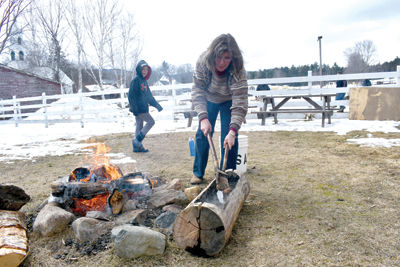
June O'Donal, museum educator at Remuc Country Doctor Museum and Farm, demonstrates how Native Americans made maple sugar by dropping hot stones into a hollowed log filled with sap. Maple sugar has been an important product for people living in New England since long before the Colonial era, but that tradition might come to an end due to climate change. (Adam Drapcho/Laconia Daily Sun)
By THOMAS P. CALDWELL, LACONIA DAILY SUN
PLYMOUTH — Eric Kelsey’s announcement that it was another down year in which there was “zero” maple syrup production from Mount Washington brought a few chuckles, but for most of those attending the fifth annual Climate and Pancake Breakfast at Plymouth State University, the possibility of a decline in maple syrup production was no laughing matter.
Kelsey, a research assistant professor at PSU and director of research at the Mount Washington Observatory, was one of several speakers attending the conference co-sponsored by the Sierra Club, Union of Concerned Scientists, League of Conservation Voters, and Moms Clean Air New Hampshire.
Brad Presby, a fifth-generation sugar-maker in Bethlehem who impressed the audience by sipping from a glass of pure maple syrup as he spoke, said it has become harder and harder to predict maple season. Having learned the business from his grandfather more than 50 years ago, he said maple producers used to tap trees right after town meeting, or the third week in March. In recent years, that date has been occurring earlier and earlier.
Meticulous record-keepers, maple producers have data going back 100 years, and Presby said his show a change in the last decade, when the sap began running on March 9 in 1998, March 7 in 2016, and Feb. 28 this year. It also changes on the other end of the season. He said 80-degree temperatures early in 2012 brought the maple season to an abrupt end.
#savenhsyrup
Catherine Corkery, chapter director of the Sierra Club, said, “Maple syrup is one of the canaries in our climate coal mine.”
Acting as master of ceremonies for the event, Corkery said the sugar content of maple trees is going down, and that climate change is a big reason for that.
She urged people familiar with the use of hashtags to use #savenhsyrup in their communications.
Lisa Doner, an associate professor of Environmental Science and Policy and the Center for the Environment at PSU, said that, for years, she believed the observed climate changes were within the normal range predicted by historical data. It was not until she looked at the pollution in China and Istanbul and other areas of the world that she realized the impact of man-made pollution on the climate.
“It’s like what the U.S. looked like before the EPA stepped in,” she said. “We have become complacent because of the cleanup, and I always said, ‘I don’t see it.’ We have plenty of open space and trees.
“But since then, all the things the models predicted are coming true — the storms, the extreme temperatures. New England needs the temperature fluctuations for maple syrup production, and the timing is changing, and the variability is predicted to increase.”
She said maples are susceptible to drought, and last year was particularly bad. It not only affects syrup production, but also the fall colors that tourists come to see. When it warms early and seedlings develop, then a frost comes, it kills the seedlings.
“The old trees may be the only ones we see in a while,” she said.
Kelsey offered a different perspective, saying research at the Hubbard Brook Experimental Forest in Woodstock and Thornton demonstrated that maples are quite resilient, and said they should fare well for many years to come. However, climate change poses an unknown risk that could add to the stresses from acid rain, drought and calcium loss.
Doubter
Commissioner of Agriculture Shawn Jasper said he had stumbled upon a 1941 USDA report, “Climate and Man,” that predicted current ice melts and sea-level changes based on the earth’s history of warming and cooling.
“We’re in a mini-Ice Age … and things will happen rapidly,” he said. “Then we’ll return to normal times. As a layman, I’m not discounting mankind’s role, but 77 years ago, they predicted this.”
Doner said that report was done prior to the exploration of the oceans, atmosphere, and planets after World War II.
“We now understand that there were 22 ice ages,” she said. “Ice is the dominant condition. We’re in an interglacial period where we should be cooling back to another ice age. The earth has been cooling since 5,000 years ago, but now we are at the point where the cooling has halted and reversed.”
Sea ice in the arctic is at its lowest level ever recorded, she said, and Greenland’s ice cap is melting rapidly.
“The anticipated sea level impact is understated in every report published to date,” she said. “This year, the winter has been exceedingly warm everywhere except here. The temperature in Anchorage, Alaska, has been the same as in Florida.”
Keynote
The keynote speaker was Alexandra Dapolito Dunn, the Environmental Protection Agency’s Region I administrator for New England.
A former environmental attorney and teacher, Dunn praised the Trump Administration’s focus on allowing many decisions to return to the local level.
She said certain things, such as addressing clean air, rightfully belong to the federal government, but other things are better addressed at the local level by people such as those in the room.
“We’re struggling with that in our country,” she said, calling it the principal of subsidiary. “What level should be making the decision? All local or all national? The answer is somewhere in between.”
She provided an example after Sheila Oranch of Hebron asked about the possibility of dealing with homes washed away in flood-prone areas by forcing people to rebuild further back. That sort of regulation is a local issue, Dunn said, but if a town wants to relocate such homes, the federal government might do a reimbursement that encourages people to rebuild in a safer area.
“It’s an example of cooperative federalism, a balance of where the federal government has to step in and where the localities should manage things,” she said.
She encourage innovation “to make decisions in the here and now for the then and there.” Forward-looking citizens should be willing to pay for improvements that will benefit future generations, she said.
“There are brilliant minds and brilliant researchers in New England,” she said, “and we’re not afraid to talk about climate change. We need to look for true New England solutions. … I am truly passionate about New England’s environment, and where we don’t have authority, we need to make things happen at the local and state level.”
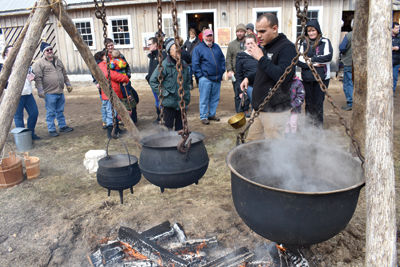
Andrew Walker, museum educator at the Remick Country Doctor Museum and Farm, in Tamworth, demonstrates how Colonists turned maple sap into syrup. The raw sap would be poured into the largest pot, then, when it boils, it is ladled into the middle pot. When that sap is half-way reduced, it is ladled into the third pot, where it boils until it reaches the desired thickness. (Adam Drapcho/Laconia Daily Sun)


(0) comments
Welcome to the discussion.
Log In
Keep it Clean. Please avoid obscene, vulgar, lewd, racist or sexually-oriented language.
PLEASE TURN OFF YOUR CAPS LOCK.
Don't Threaten. Threats of harming another person will not be tolerated.
Be Truthful. Don't knowingly lie about anyone or anything.
Be Nice. No racism, sexism or any sort of -ism that is degrading to another person.
Be Proactive. Use the 'Report' link on each comment to let us know of abusive posts.
Share with Us. We'd love to hear eyewitness accounts, the history behind an article.