


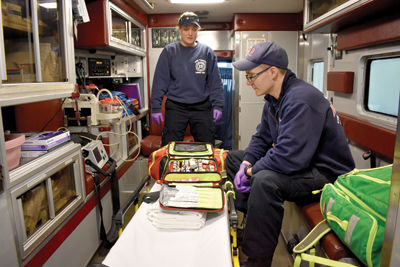
Laconia firefighter/EMT Heidi Beaulac and firefighter/paramedic Travis Clark conduct a weekly inventory of one of the three ambulances in the city's fleet. LRGHealthcare had been providing financial support for the city's emergency medical services, that deal will end on June 1. (Adam Drapcho/Laconia Daily Sun)
Chief predicts public won’t notice ambulance service change
By RICK GREEN, LACONIA DAILY SUN
LACONIA — Although LRGHealthcare plans to end financial support for city ambulance services, including the salaries of five firefighters, the public will likely not notice any change in the emergency system, Fire Chief Ken Erickson said.
He’s drawn up a budget for the service to continue without the health system’s support and without additional costs for the city. No firefighter layoffs are expected.
Erickson said the changeover likely will be largely cosmetic. The LRGH badge will be removed from the three ambulances. Instead of LRGH billing for ambulance services, the city will probably hire a collection company to send out these bills.
The city will see if any private company could provide ambulance services as effectively and economically as the fire department, but this effort is being characterized mainly as due diligence.
Councilor Bruce Cheney said the possibility of privatizing the service should be looked at, even though he acknowledges such a change is not likely.
“I suspect in the end run it’s more of a long shot, but I do think we should ask those questions, to see if anybody would make a proposal that would be attractive and appropriate,” he said.
“I wouldn’t race to find a private contractor, but I don’t see how the council could, without checking, make a decision to do one thing without seeing what else is available.”
Medical calls
Most of the fire department’s emergency runs are for medical calls rather than fires, so if a private company provides this service, fewer city firefighters would be required.
But that would also mean there wouldn’t be as many firefighters to respond to a large blaze.
“The fire risk doesn’t go away,” Chief Erickson said. “There are still the big buildings, multi-family dwellings, hospitals and industrial buildings. Right now, the city gets a two-for-one because every firefighter is either an advanced emergency medical technician or a paramedic. We can put three ambulances on the road at a second’s notice and guarantee two of them will have paramedics.”
Cost structure
Also, a private company might not be able to provide the service at a cost the city could afford.
Laconia has an aging population, with many people on Medicare or Medicaid, which pays only a portion of the cost of an ambulance run. The patient can’t be billed for the remainder. There are also people without any form of insurance who also can’t pay for the ambulance run.
Twenty percent of the city’s population is over 60 years old and three-quarters of those who use ambulances have Medicare or Medicaid.
Erickson said Laconia has the highest per capita rate of emergency medical calls of 12 cities he surveyed across the state.
Private ambulance
Private ambulances serve areas such as Manchester and Meredith.
Meredith, with a population of about 6,300, has a volunteer fire department and uses Stewart’s Ambulance Service. Laconia has a population of about 16,000.
Meredith Selectman Ray Moritz said the town pays Stewart’s about $300,000 a year.
“We’ve had a contract with them for quite a few years and to the best of my knowledge, we’ve been satisfied with the service. I’ve not heard a single complaint,” he said.
Justin Van Etten, board chairman for Stewart’s, said private ambulance service probably wouldn’t make sense for Laconia.
“Laconia is better served by its full-time fire department handling medical calls rather than a private provider,” said Van Etten, whose company operates in towns with volunteer fire departments.
He said it would be hard for a private company to provide staffing similar to that of a full-time fire department. He also said the payer mix in Laconia, particularly people without any medical coverage, would be disadvantageous to a private company.
New budget
By ending its financial participation in the ambulance service, LRGH is avoiding uncompensated costs that have run as high as $200,000 a year, although this is expected to drop to about $125,000 after an ambulance rate hike last summer.
The health system’s overall costs for the ambulance service is about $1 million a year and it receives compensation for most of these costs through billing.
Erickson said he has drawn up a budget showing improved ambulance fee collection would allow the city to avoid incurring additional costs after LRGH pulls out.
Also, Fire Department Deputy Chief Shawn Riley, whose salary is currently covered by LRGH, could generate some city revenue by charging for the emergency medical training instruction he now provides for other departments at no charge.
In addition to Riley’s pay, the salaries of the department’s four highest paid certified paramedics are also covered by LRGH, which plans to end all support for the ambulance service, including these labor costs, on June 30.
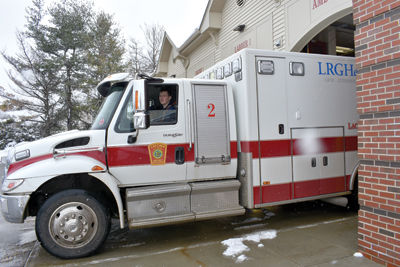
Laconia firefighter Nice Preece backs an ambulance into the fire station on Wednesday afternoon. LRGHealthcare has been supporting the city's emergency medical services for 20 years, that deal will end on June 1. (Adam Drapcho/Laconia Daily Sun)


(0) comments
Welcome to the discussion.
Log In
Keep it Clean. Please avoid obscene, vulgar, lewd, racist or sexually-oriented language.
PLEASE TURN OFF YOUR CAPS LOCK.
Don't Threaten. Threats of harming another person will not be tolerated.
Be Truthful. Don't knowingly lie about anyone or anything.
Be Nice. No racism, sexism or any sort of -ism that is degrading to another person.
Be Proactive. Use the 'Report' link on each comment to let us know of abusive posts.
Share with Us. We'd love to hear eyewitness accounts, the history behind an article.