


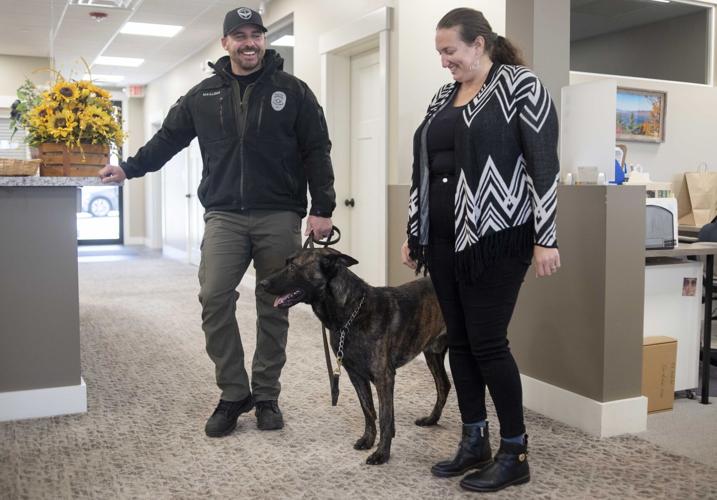
GILFORD — Curtis Mailloux, a sergeant with the Gilford Police Department, recalls vividly the first time he and his K-9 partner Kai were called to assist. Mailloux wanted to be a dog handler for years; he spent two months in North Carolina learning how to work with his new partner, then more intense training back home, and then they were finally ready to put all that preparation into real-world work.
“It was a lot of emotions,” Mailloux said. “It was so rewarding.”
In all the training, the human handlers are in control of the animal, setting up the scenarios and providing the inputs. But that’s only practice. In a real call, the circumstances and inputs are unpredictable, and the handler’s only job is to give the command, hang on to the end of the leash and trust in the dog.
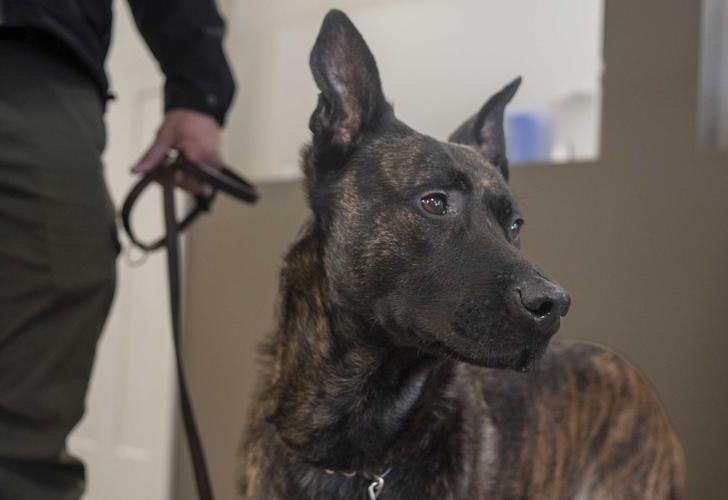
Kai, now 7 years old, has been serving with Gilford PD for five years, and has participated in between 150 and 200 calls, by Mailloux’s estimation. This year, Mailloux is engaging in a different kind of trust, trusting that medical intervention can stop the cancer discovered in Kai so the pair can continue doing what they’ve trained so hard to do.
B-cell lymphoma
Kai, a Dutch shepherd, was first discovered to be ill in March. Mailloux said he was playing with him at home, and noticed his lymph nodes seemed to be swollen. He took him in to the vet, and a biopsy concluded Kai had lymphoma, a type of cancer that, untreated, would spell the end of the dog’s life. With prompt treatment, though, the cancer could be sent into remission, perhaps never to return.
Mailloux was able to get Kai into a treatment program at Portland Veterinary Emergency and Specialty Care in Maine. Kai responded well to the chemotherapy. He lost a little bit of weight, but didn’t experience some of the more disruptive side effects. He was able to return to work after the first two weeks of treatment, and after the full round of chemo was over, there were no more signs of lymphoma.
Until a few months later.
“He was three months without any chemo at all,” Mailloux said. But then, around the beginning of October, he noticed the dog’s lymph nodes were again enlarged, and tests confirmed a return of the cancer.
More treatment was necessary, but it isn’t cheap. The town has insurance to cover the dog’s veterinary care, but it hit its limit for the year in the first round of chemo. Another round would cost between $12,000 and $15,000.
The Gilford Police Relief Association put out a call to the community, on social media, the evening of Oct. 11. Before the next day was over, they received enough donations that the fundraising campaign was quickly called off.
Mailloux said he and Kai continue to work, despite taking every-other-week trips to Portland for chemotherapy, a treatment plan they’ll follow for the next four to six months. On Thursday, they were due to join the Belknap Region Special Operations Group for training — both Mailloux and Kai are part of the local SWAT team — and then work a full shift at Gilford PD.
“Right now, he’s receiving the chemo and all of his lymph nodes have returned to a normal size, his blood tests look good,” said Mailloux, adding that he’s “optimistic that this second round will put him into remission for a longer period of time.”
Finding the lost, or the fled
“I’ve always been a dog person. Ever since I was a kid, I’ve always had dogs in my family,” Mailloux said. Then, when he became part of the Gilford Police Department, he saw how the previous K-9 handler, Lt. Adam VanSteensburg, worked with his dog to help resolve challenging circumstances.
“A lot of the time, we use dogs for their nose,” Mailloux explained. Kai is trained with a dual purpose. He is trained to sniff out illegal drugs, such as cocaine, heroin and methamphetamine, and he is also trained to assist with “patrol” duties, such as following a human scent, or coercing a person who isn’t inclined to comply with the dog’s human partners.
While Kai’s narcotics training will be used a few times each year, it’s primarily his patrol training that is useful to the department.
Kai’s services won’t be required every day, or even every week. On average, he’ll be needed a couple of times each month. But, when he’s needed, he’s invaluable.
As VanSteensburg said, “It’s always a hot call when the dogs go.”
Mailloux recalls one call when a man, suspected of attempted murder, fled into the woods after dark. It could be very dangerous for individual officers to search the woods for a suspect, thought to be violent and likely in a desperate state of mind. But Kai was able to lead Mailloux on a straight path through the woods, then stopped abruptly and looked back at his handler.
“I looked up, and he was standing right there,” he said of the suspect. Seeing the dog, the man surrendered.
Another call involved a group of kindergarteners who slipped away from the schoolyard during a mid-November recess. By the time he and Kai got onto the scene, the search had been going on for more than an hour, and panic was starting to set in.
“They had searched, searched and searched,” Mailloux said. Kai found their trail immediately, and when they located the missing children, they were on the side of a mountain near the school, and were heading deeper into the woods and farther from the other searchers.
“They were crying, freezing, they were out there for two or three hours,” Mailloux said, but they all ended up home and safe that night, thanks to Kai’s nose.
“When you need the dog, it’s for those touch calls, we really rely on them,” said VanSteensburg. “They’re absolutely amazing tools.”
Kai is the third dog for Gilford. The town’s K-9 program was started by Capt. Dustin Parent, who worked with Agbar for 10 years. VanSteensburg and Ike were next. After Kai, VanSteensburg said, the plan is for the department to continue to have a K-9 unit, but with a slightly different mission.
With the presence of BankNH Pavilion, the region’s largest performance venue, in town, there’s been a growing need for explosives detection. What used to be a once-in-a-while request by artists to have the venue swept for bombs has now turned into a routine part of the facility’s operation. The next dog will continue to have patrol training, but will have explosives detection skills instead of narcotics.
'Invaluable'
According to VanSteensburg, the dogs bring a different kind of value that’s harder to quantify. The K-9s are perennially the crowd favorite portion of any police demonstration, and can be as effective with public relations as they are at intimidating hostile subjects.
They are also an important member of the department’s staff, VanSteensburg said.
“When Curtis [Mailloux] is working, he’ll bring the dog through. We love the dog just like the public loves the dog,” VanSteensurg said. “We have no intention of not having a dog after Kai. It’s part of our makeup.”
Dale Channing Eddy, chair of the town’s selectboard, agreed, calling the K-9 program “pretty much invaluable. Let’s face it, K-9 officers can do things that their humans can’t.”
The cost of adding a dog to the department is far less than adding another human officer, yet the K-9s can bring capabilities that no two-legged officer could.
“We get a lot of bang for the buck,” when it comes to K-9s, Channing Eddy said. “History has shown that a K-9 officer can make the difference between a safe outcome and an unsafe outcome. ... I think it makes our department — it makes any department — more effective.”


(0) comments
Welcome to the discussion.
Log In
Keep it Clean. Please avoid obscene, vulgar, lewd, racist or sexually-oriented language.
PLEASE TURN OFF YOUR CAPS LOCK.
Don't Threaten. Threats of harming another person will not be tolerated.
Be Truthful. Don't knowingly lie about anyone or anything.
Be Nice. No racism, sexism or any sort of -ism that is degrading to another person.
Be Proactive. Use the 'Report' link on each comment to let us know of abusive posts.
Share with Us. We'd love to hear eyewitness accounts, the history behind an article.