




LACONIA – Gail Drucker, now 60 and the children’s librarian at the Laconia Public Library, said finding child care for her children was a challenge three decades ago. She and her husband were living on a shoestring budget, working several jobs each to try to support their growing family. They couldn’t afford licensed child care, so they relied on their network of friends to care for their children while they worked.
“We were really piece-mealing it together,” Drucker said. “It was very difficult for us, family of five, we were a one-car family, two very low incomes.” After a few years of struggling, they were able to get their youngest into the Whole Child Center in Tilton.
In the years since, the problem has only gotten worse. Child care for working families is likely their largest single expense, and that’s if they can find a licensed facility within a reasonable distance that has room for their child.
High Cost
So, just how expensive is child care?
“In many cases, it’s as expensive as college,” said Michael Kalinowski, a retired professor who produced the 2018 New Hampshire Child Care Market Rate Report. His report found that the mean cost for an infant to attend a licensed child care center in New Hampshire cost $237.47 per week, which increased 5 percent since 2016. Over the course of a year, that would cost $12,348. For comparison, the full-time tuition at Plymouth State University is $13,128 for in-state students.
Infant care is the most expensive, primarily because state licensing requires a ratio of one teacher for every four infants. Licensing rules allow for more students per teacher, but the reduction in the mean cost is moderate as children get older. Kalinowski’s survey found that the weekly full-time cost for 1-year-olds was $221 in 2018, 2-year-olds cost $215 and 3- and 4-year-olds cost $197 per week. All of those figures had increased between 3.5 percent and 6.5 percent since 2016.
What do those prices mean for a family’s budget?
According to ChildCare Aware of New Hampshire – which makes child-care referrals across the state and tracks the market – the cost of child care for a family of two working parents and one child is likely 10-percent of the family income. If the family has two children in licensed child care, the cost rises to 21-percent of total household income.
And that’s for a family making the median state income. If a two-parent family living at the poverty line has two children, the cost of child care would eat up more than 90 percent of their income.
ChildCare Aware’s analysis found that families with two young children are likely spending more on child care than they are for housing, and more than their transportation and food combined. And that’s for the families lucky enough to find licensed child care.
Shrinking supply
“There has been a continual, gradual decline in the number of licensed NH programs over the last 15 years,” the Child Care Market Rate Report found. In 2001, there were 1,207 licensed programs in the state, but just 834 in 2018 – a decrease of 31 percent.“The trend of fewer and fewer licensed programs significantly reduces access for families,” the report said.
Meanwhile, the types of programs available in the state have shifted. Large, center-based programs, which made up a third of all programs in 2001, now make up half of the total. Smaller, owner-operated centers have started closing. Fewer larger programs means that parents have fewer options, and might have to travel further to find child care. Overall licensed child care capacity has declined in the state.
The decline in capacity has resulted in what ChildCare Aware refers to as “Child Care Deserts,” geographic regions with limited or no access to licensed child care. The organization compiled data from the U.S. Census to find the number of families with working parents and children under the age of six, then compared that to the list of licensed child care facilities throughout the state.
That analysis found there there was a gap. Total capacity at child care facilities in the state stood at 30,877, but 53,000 children needed child care.
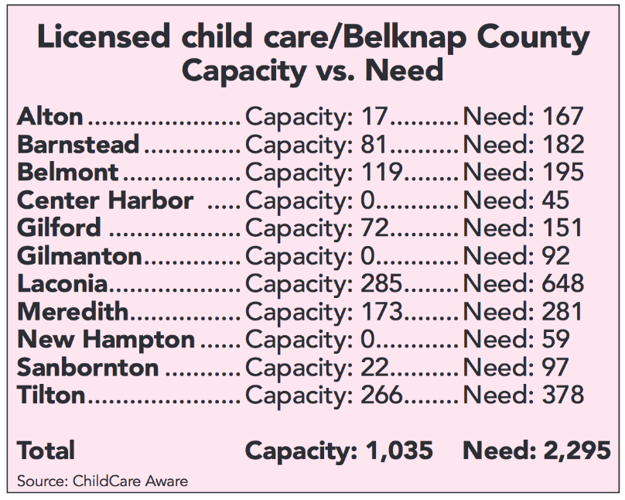
In Belknap County, according to the ChildCare Aware map, there are no communities with close to enough capacity. In fact, the county as a whole has a need to care for 2,295 children, but only 1,035 licensed slots exist. (See accompanying chart for a breakdown by community.)
Even that reported capacity might not actually represent how many children a center can serve. Marti Ilg, executive director of Lakes Region Child Care Services – which operates centers in Laconia and Belmont – said their licensed capacity is based on the square footage of their facility. However, another practical limit is staffing, since a child-care operation is required to have a minimum number of staff present for a given number of children. A couple of years ago, Ilg said she had difficulty recruiting enough staff, so she couldn’t enroll as many children as her center was licensed for. LRCCS is now fully-staffed, she said, but is still unable to serve as many families as Ilg would like to.
“We have quite a large wait list,” Ilg said. If a parent called tomorrow to be put on LRCCS’s wait list, it would probably take three months before a spot would open for that child. Where do those parents turn?
“A lot of times, they’re in unlicensed care,” Ilg said. Parents might find a friend or relative to watch the child while they’re at work, and while everyone might have the best interest of the child at heart, whoever is providing that care likely doesn’t have the training, expertise or resources that the child would encounter at a licensed facility.
“I worry about that, because kids aren’t getting what they really need,” Ilg said.
Erin Pettengill, vice president of the Family Resource Center in Laconia, said that for families trying to find a way out of poverty, child care is “definitely an identifiable struggle for them.”
“It means that working is a struggle. If you’re a two-parent home, two kids, and both parents are working, they are faced with an issue of, 'Does one of us have to not go to work? Does one of us have to quit our jobs?' It’s a mess.”
It’s a mess for that family, and for those who take a broader view of the state’s economic fortunes. Taylor Caswell, commissioner of the New Hampshire Department of Business and Economic Affairs, said the lack of accessible child care presents a roadblock for development of regional economies.
“It’s probably more of an issue for companies that are trying to retain a workforce, particularly in rural areas. At the same time, we’re trying to make the case that these are great places to relocate to and raise a family,” Caswell said. “In terms of growing an economy that is sustainable, and having a workforce that we need, a younger workforce, the whole issue of child care plays directly into that.”


(1) comment
Sorry, but I disagree. I was licensed for a few years in mass to do daycare out of my home. And it was great! You don’t have to have all these CREDITS and TILTLES to watch kids! CPR yes, but not what you guys have and that’s your problem. Anyone can color and read to a child, anyone. So get people LICENSED and WATCH them as Mass did and you will open up more doors than you close up here. Berating ‘family ‘ and ‘friend’ care is just petty, your not Harvard !
Welcome to the discussion.
Log In
Keep it Clean. Please avoid obscene, vulgar, lewd, racist or sexually-oriented language.
PLEASE TURN OFF YOUR CAPS LOCK.
Don't Threaten. Threats of harming another person will not be tolerated.
Be Truthful. Don't knowingly lie about anyone or anything.
Be Nice. No racism, sexism or any sort of -ism that is degrading to another person.
Be Proactive. Use the 'Report' link on each comment to let us know of abusive posts.
Share with Us. We'd love to hear eyewitness accounts, the history behind an article.