


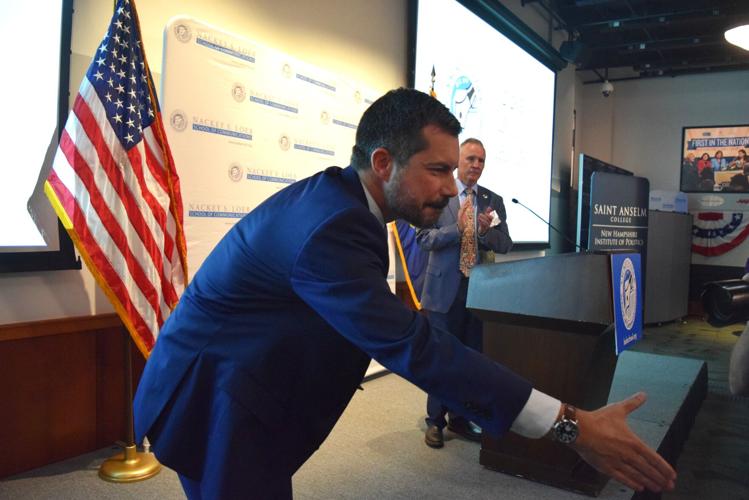
MANCHESTER — Former Transportation Secretary Pete Buttigieg said freedom of speech is under attack, telling the audience at the 2026 First Amendment Award Celebration it's a nonpartisan issue every American should find concerning.
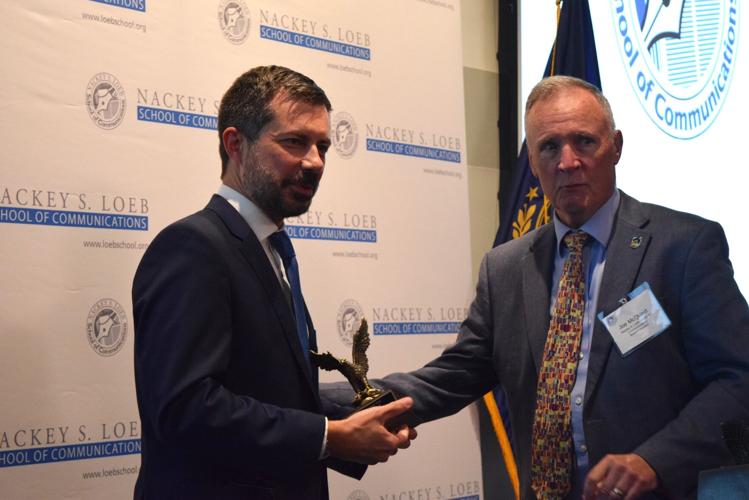
It was only fitting Buttigieg was the keynote speaker at the event, hosted by the Nackey S. Loeb School of Communications, where Eva Castillo and Howard Brodsky were honored for the work they’ve put in toward bolstering the ability to speak out openly and freely. All three spoke about work that needed to be done to keep free speech alive and safe. Buttigieg noted this has been an ongoing fight.
“We mention the First Amendment all the time without noting the blindingly obvious fact that is contained in its name: it was an amendment,” Buttigieg told the crowd at Saint Anselm College's New Hampshire Institute of Politics Monday night. “An amendment. That means by definition that when the Constitution was enacted, it wasn’t in there at all.”
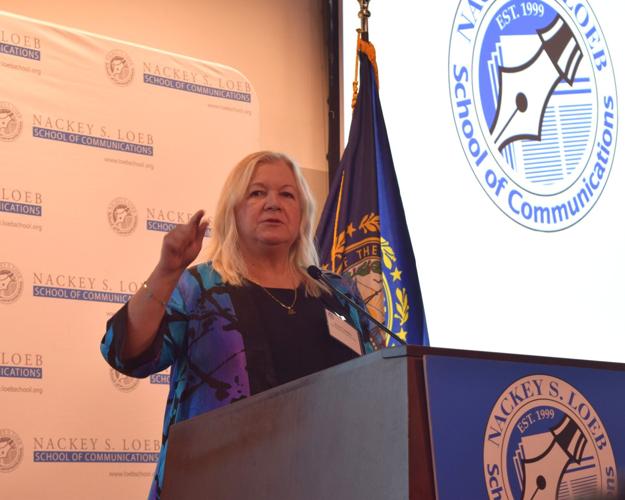
Eva Castillo
Castillo is the 2026 recipient of the First Amendment Award for her decades advocating for the Granite State’s immigrant and refugee communities.
Castillo is founder of the New Hampshire Alliance for Immigrants and Refugees, which she led for about 20 years. She is also founder of Welcoming New Hampshire, which promotes inclusion and understanding between immigrants and their home communities.
A video highlighted Castillo's efforts. Letizia Ortiz, a friend of Castillo for about two decades and a former neighbor, spoke about how Castillo always shows up, and listens. She said Castillo doesn’t hide, and isn’t afraid to speak up, and go for bat for people.
Judges Melanie Plenda, who earned Quill & Ink honors last year, and Annmarie Timmins, senior reporter for NHPR, presented Castillo with the award. She received a standing ovation before taking the podium, where she gave a spirited speech about the rights of citizens to speak their minds.
An immigrant from Venezuela, Castillo spoke sternly about what her people are going through daily.
“I am happy and honored that they gave me this award, especially now when my community is under such attack,” Castillo said.
Just a day before the event, a Venezuelan immigrant working as a DoorDash driver was shot in the back by an Immigration and Customs Enforcement officer during a traffic stop. The driver was identified as 28-year-old Wilber Rafael Garcés Pérez, and he told new outlets he was taken to the South Texas ICE Processing Center with the bullet still in his back.
The award also comes in the wake of the White House decision to shut out various news outlets.
“These are not easy times,” Castillo said. “Our First Amendment is under attack. And you’ve seen what happened a couple days ago. I come from a country where they started by closing the radio stations and the TV stations, and the newspapers that did not agree with the government, and look where we are now.”
Referring to the Constitution, she said that piece of paper isn’t worth anything unless it is put into practice.
Castillo looked out into the audience, saying she was surrounded by friends and people she's worked alongside. Advocacy, she said, is not a one-person show, but rather a network.
“I see so many people, and so many organizations, that have joined their voices to speak up against the terror that ICE is given in our community, against the deportations and the violations, the blatant violations of the civil rights of my people,” she said.
Castillo called for the defense of immigrants, saying it's ridiculous there are 88,000 foreign-born people in all of New Hampshire, but there are 29 police departments deputized by ICE.
A voice in the crowd exclaimed, “that’s not right.”
“I need all your voices to say 'no,' to put a stop to this,” Castillo said. “We need to hold our representatives in D.C. accountable for finally doing something. We benefit from the hard labor of immigrants, yet we refuse to give them status. So, we have a subclass of people here in this country. Modern day slavery.”
Castillo said the labor of undocumented people is taken for granted, and they are refused citizenship. She said she's had enough of the U.S. touting how perfect they are to the world, when so many people are suffering.
“We’re all members of this community,” Castillo said. “We all chose this country to be part of it. We all deserve a seat at the table, and if you don’t invite me, I’ll bring my own chair.”
Castillo called for everyone to “practice what we preach,” and stressed the need for immigration reform.
“Abolish ICE,” Castillo put bluntly to end her remarks.
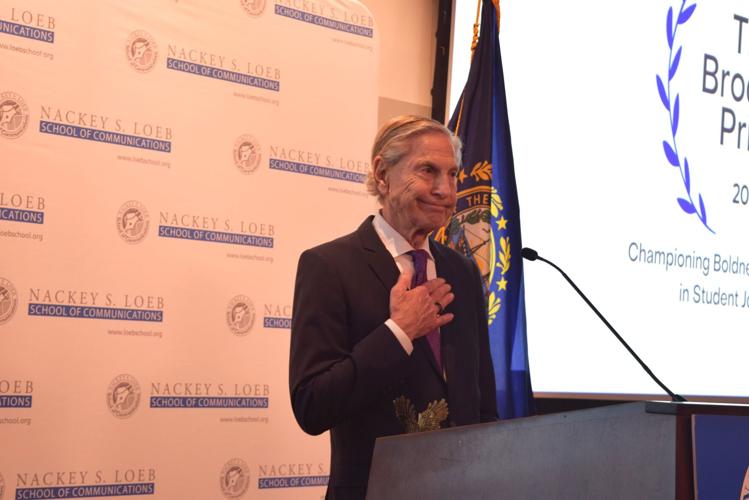
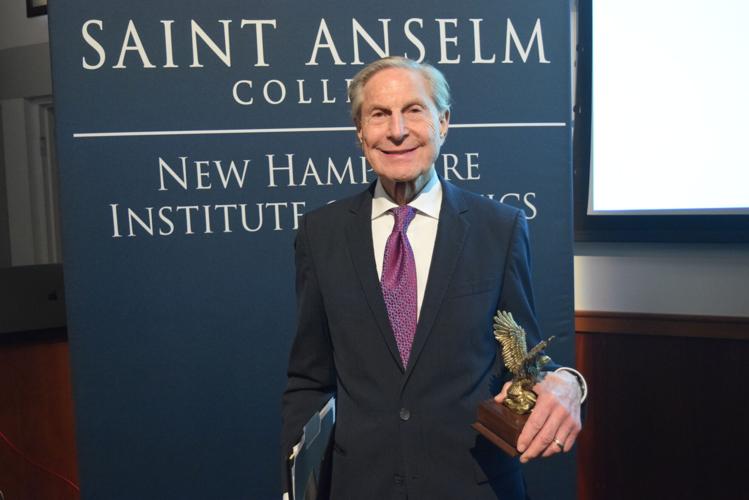
Howard Brodsky
Brodsky is this year’s recipient of the Quill & Ink Award, for his work co-founding The Brodsky Prize for Excellence in Student Journalism. He is chair and co-founder of CCA Global, as well. Liz Hitchcock, of The Bookery, introduced him.
A video played before Brodsky received the award.
In the video, Brodsky said the Brodsky Prize tries to identify “aspiring young journalists in high school” who made an impact and think outside the box. He spoke about his late son Jeffrey, and his time as a high school student journalist with Manchester Central’s Little Green newspaper.
He said the duty of the free press is to ask questions, investigate and report in a way that can sometimes challenge power. Jeffrey was co-editor of the award-winning newspaper, which was publishing school election results. The school principal refused to give the vote count in the election, and Jeffrey said he didn’t understand why, in an “open and free society.”
Jeffrey wrote an editorial challenging the school. Brodsky said the principal took great offense, and called on his son to apologize to the school of thousands of students.
While the paper did apologize, despite not believing they did anything wrong, the principal asked them to do it a second time, otherwise the school newspaper would be shut down. They declined, and the newspaper was shut down, making national news. This pressured the principal to reopen the newspaper, teaching Jeffrey the power of investigating, reporting, and challenging authority.
“He learned more in that journey of his in high school than any time in his life,” Brodsky said in the video.
After developing an aggressive form of Parkinson’s disease, Brodsky’s son said the best thing to leave behind as a legacy would be a prize for aspiring New Hampshire journalists. Thus, the Brodsky Prize was born.
“We hope with the Brodsky Prize, it shows that everybody doesn’t have to think alike, that you can challenge authority,” he said. “And it’s very important to question when something doesn’t seem right, to ask that question why.”
Brodsky was proud of winning the award, but most of all, he was proud of his son. He said his son knew how important democracy was, and that power shouldn’t push people down to the ground.
“Journalism is incredibly important, and today it’s probably never been more important,” Brodsky said. “I think young journalists today, I think we have to encourage them, and feed them.”
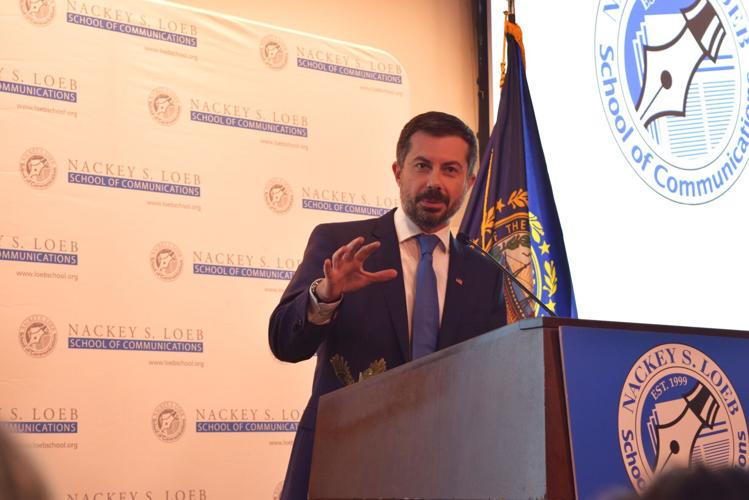
Pete Buttigieg
Buttigieg was honored to be there in the company of Castillo and Brodsky. He related to Brodsky’s story about Jeffrey. He said when he was 18, he entered a writing competition sponsored by the John F. Kennedy Library which changed his life.
He praised Castillo’s “life’s work” in supporting and defending immigrants and refugees.
Buttigieg reflected on the mission of the Loeb School in advancing a “free and informed society.” He spoke about the “shocking” developments of life of America, with politicians saying they will lock up opponents for speaking publicly, and reporters excluded and even threatened with jail time for publishing “unflattering coverage.” He said respected commentators are investigated for writing pieces that embarrass the president, legal residents are deported for speaking out, and Americans have been intimidated while peacefully protesting.
“I’m speaking, of course, of the conditions in America in 1798,” Buttigieg said. “That is when Congress passed the notorious Alien and Sedition acts, making it a crime to criticize the president, or to oppose any federal law at all.”
The circumstances of the time were unique, but he said so are the circumstances of today’s world. He said what seems unprecedented may not be.
In today’s world, there are no longer just three news outlets everyone watches, giving the nation a shared account of the facts, even if it left people to disagree on how to handle them.
“The broadcast has increasingly been replaced by the narrowcast, the algorithm, the string, the beat,” he said. “You’ve likely heard the lament that there’s no longer a Walter Cronkite to tell us all on the evening news that ‘that’s the way it is.’ You know when else there wasn’t a Walter Cronkite? Any time before Walter Cronkite.”
Buttigieg said the norm of mass media giving everyone the same picture is the exception in American history, and a feature of the last 80 years. Now, as artificial intelligence is generating videos and images, there is risk of not being able to even rely on photographic evidence to determine fact or fiction.
He said people “rightly lament” others getting information from partisan sources, which they do because it is psychologically easier. While the means are new, he said the experience of a newspaper reader in the 19th century was not so different, when many newspapers were highly ideological and partisan.
“The problems we face are not completely novel,” Buttigieg said. “We face a novel version. A novel combination of them, sure, but it’s our turn to strive to make our society more free and informed. And in doing so, we can learn from history, because all throughout history, Americans have faced fragmentation, polarization, misinformation and have adapted.”
Buttigieg, who was a candidate for president in 2020, said there is a need to support, recognize, and elect leaders who respect America’s tradition of freedom, and to hold them accountable.
“I’m choosing my words carefully, because this is not a partisan occasion, but also, that is not a partisan statement,” he said.
Buttigieg said he takes a “dim view” on the White House ejecting news organizations, as well as late night television and even the Smithsonian coming under attack, because they haven’t conformed with political ideology.
“That should outrage Americans right, left and center,” Buttigieg said. “If we mean it when we say that we are a freedom-loving people, we can show it when we choose our leaders, by making respect for freedom a serious criteria in how we evaluate it.”


(0) comments
Welcome to the discussion.
Log In
Keep it Clean. Please avoid obscene, vulgar, lewd, racist or sexually-oriented language.
PLEASE TURN OFF YOUR CAPS LOCK.
Don't Threaten. Threats of harming another person will not be tolerated.
Be Truthful. Don't knowingly lie about anyone or anything.
Be Nice. No racism, sexism or any sort of -ism that is degrading to another person.
Be Proactive. Use the 'Report' link on each comment to let us know of abusive posts.
Share with Us. We'd love to hear eyewitness accounts, the history behind an article.