


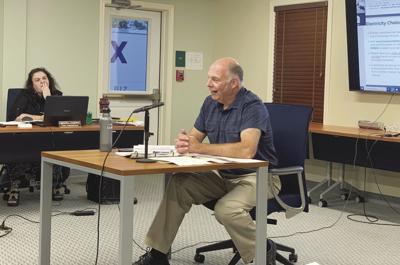
BRISTOL — The selectboard is considering entering into a joint agreement with the Community Power Coalition of New Hampshire to secure cheaper electricity for residents through the purchasing power of the multi-town nonprofit organization. Thirty-nine communities have joined the coalition, with Loudon and Somersworth as the most recent.
Andrew Hatch, the coalition’s outreach coordinator, appeared before the selectboard on Sept. 7 to expand upon the information the Bristol Energy Committee had previously provided about the potential savings that membership in the coalition brings.
The 12 communities that have approved membership at town meeting and gone on to launch their programs are now paying 10.9 cents per kilowatt-hour. By comparison, the base rate for Eversource customers is 12.582 cents, Hatch said.
Signing the joint agreement does not obligate a town to take part in the service; it only indicates an interest and makes the resources available for the town to formulate its own plan for how it would like to proceed. It also gives the town a voice on the coalition.
A special committee — in Bristol’s case, the energy committee already established — would prepare information for voters to consider at the next town meeting. Should the article pass, the town would formalize its plans and launch its program.
Among the things for a town to consider is the mix of energy sources it wants to tap. While the coalition’s main focus is lower-cost energy, towns with a strong interest in promoting green energy may want to offer options for purchasing wind or solar power, even if such energy were to be more expensive than that generated by fossil fuels. Customers then would be able to make their own choices: only the cheapest source, the source that most matches their environmental perspectives, or something in between.
Selectboard Member Carroll Brown, who opposes the idea of the government providing incentives to achieve particular goals, questioned Hatch about whether the coalition would be promoting wind farms, which the Newfound Region has overwhelmingly opposed along its ridge lines. Joining him in his concerns was Selectboard Member Bob Glassett, who asked, “Is there any intention to this to try and bring wind power to this area?”
Hatch said each community would develop its own guidelines, and a community in another part of the state might want to purchase locally generated power. Community Power of New Hampshire has no desire to be an energy producer, he said.
“The intention is to be a bankable entity, where a developer who wants — if you’re familiar with the concept of an offtake agreement — they’re looking for an organization who is financially secure enough that they are comfortable with writing a 10-, 15-, 20-year offtake agreement at a particular rate,” Hatch said.
Residents of towns that join the coalition will be automatically enrolled if they are Eversource customers. Those currently purchasing power through third-party agreements or who are members of the New Hampshire Electric Cooperative would have the option of taking part in the coalition pricing, but they would have to opt in.
Automatic enrollment is a controversial subject, and one that Eversource lobbied against during testimony before the original legislation allowing community power agreements passed. Opting in failed to generate high enough numbers to be effective in negotiations for lower rates, so the legislature later made it an opt-out policy, where people are enrolled unless they ask not to be.
Hatch went over the details of adopting community power, saying Town Meeting approval is the next step after the initial joint agreement.
“There are a number of launch steps that are very important,” he said. “They have to be done with due notice [to customers].
“[The] enrollment process is very important, and it drives the launch date.”
Thirty days before the program launches, everyone in the town would get a notification that explains what the electric rates would be and what their options are, depending on whether they are automatic enrollees or those who have to choose to join.
Hatch noted that the joint powers agreement and the coalition’s rules dictate that towns will not face any significant costs in offering the program. The coalition will provide notification forms that towns will customize with their own logos and options, as well as promotional material.
Also important to note, he said, is that anyone enrolling in the program is free to leave and return to their original supplier at any time.
Whatever option people choose, their electric bills would still include transmission costs from Eversource or whoever delivers the electricity to their homes, as they do now. It would simply include the coalition in a separate line for the energy cost.





(0) comments
Welcome to the discussion.
Log In
Keep it Clean. Please avoid obscene, vulgar, lewd, racist or sexually-oriented language.
PLEASE TURN OFF YOUR CAPS LOCK.
Don't Threaten. Threats of harming another person will not be tolerated.
Be Truthful. Don't knowingly lie about anyone or anything.
Be Nice. No racism, sexism or any sort of -ism that is degrading to another person.
Be Proactive. Use the 'Report' link on each comment to let us know of abusive posts.
Share with Us. We'd love to hear eyewitness accounts, the history behind an article.