


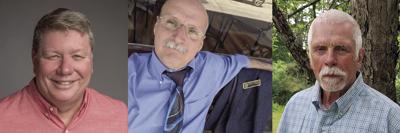
LACONIA — When Sen. Bob Giuda shared notice of his retirement in May 2022, he left his District 2 seat up for the taking. After the last round of redistricting, Laconia, Belmont and Gilford are now a part of District 2, which has pulled in three Republicans to run for Giuda's now-empty seat.
Rep. Tim Lang of Sanbornton, former Commerce Committee member John Plumer of Belmont, as well as local business owner and former Belknap County Commissioner Dave DeVoy of Sanbornton are all strong contenders for Giuda's empty seat, each bringing decades of experience in government to the table.
In his retirement notice, Giuda endorsed Lang, a six-year veteran of the House of Representatives.
“I have a long history of community service,” Lang said, citing his experience in law enforcement, on the school board and town budget committee, and his sibling's military service. “Now I'm looking to serve a larger community. I pride myself on constituent service.”
DeVoy likewise served in the armed forces with four years of active duty and 26 years in the reserves, before retiring as a colonel. DeVoy highlighted his service on the Belknap County Board of Commissioners, particularly his work on the county jail and improving the nursing home while maintaining a strong budget.
“There was an option to build a very large jail for $42 million,” DeVoy recalled. “Me and my fellow commissioners looked to Sullivan County. They built a community correction center, so we built one for $6 million.”
Plumer, an environmental scientist, traces his family's tradition of community service 10 generations all the way to New Hampshire's 1813 Gov. William Plumer.
Plumer himself served in the military federal service for 34 years in Washington, D.C., and was a captain in the U.S. Army Chemical Corps.
“I was the Army's executive agent for federal programs,” Plumer said, “I felt that I have federal service, I've had small business experience, D.C. experience, political experience in a relevant committee, that being the Commerce Committee.”
“I had no intention of running until just before the end of the sign up period,” Plumer said. “I took a look at the crushing bills and increasing expenses about to hit the state and said 'my God, if I can make a difference and try to mitigate some of these issues, than I should'.”
For this race, and most others across the nation, the state of the economy is at the forefront of voters' and candidates' minds.
“People are concerned about rising inflation, the cost of gas,” Lang said. “Getting to and from work is getting more expensive and salaries aren't keeping pace with the cost of gas, so those are the everyday things people are talking about. I didn't hear about education, roads, abortion. None of those topics came up.”
For DeVoy, one of the top issues, in addition to the economy, is election integrity.
“Just reading the paper last week in Laconia, votes not being counted, or being double counted, and in Windham there was problems,” DeVoy said. “I think in general we need to have a system where Democrats and Republicans want to know that it's right and so everyone feels comfortable.”
DeVoy also shared that voters had expressed a stronger desire for school choice since the pandemic and concerns about political ideologies in the classroom.
“I think we need to focus more on math and science,” DeVoy said of New Hampshire schools.
Third on DeVoy's platform was addressing the state's economic woes.
"When everything is getting too expensive, you can't find employees, the economy is getting ready to falter," DeVoy said, citing a need for economic and political unity to tackle the nation's problems.
“All of these issues with my particular demographics as a senior, how are people on a fixed income going to handle this literally $5,000-$10,000 additional cost per year just to survive as they did the year before?” Plumer said of the economy. “I believe that are opportunities within the state budget that can help mitigate these issues. The two greatest issues in the state right now are affordable living and affordable living for its current residents and specifically for that third of the population that's on a fixed income or start-up income. The over 65s, and the 20- to 29-year-olds.”
The current economic crunch has applied additional strain on a long-standing New Hampshire issue: housing availability and affordability.
DeVoy, who owns three convenience stores, agrees that workforce housing is an essential issue.
“We need to change some zoning laws,” DeVoy said. “We need to allow cluster development. Some communities they're very 'you can't build anything unless it's five acres and it's a single family home.' We need to allow businesses to build small clusters or units together that people can afford to take care of that issue.”
Plummer eluded to the idea of building multi-generational or communal dwellings, where one family could build multiple houses on a lot to house relatives to ensure greater chances of economic survival.
“One thing we could look at is some common sense look at current land use,” Plumer said of the housing issue. “Sixty percent of the population live below the notches. A third lives from just north of Plymouth all the way to the Canadian border so there's a lot of land that is just not close by to work. Current land use affects the ability to build.”
For Lang, the solution isn't necessarily more direct government involvement in housing, but instead streamlining some development processes. Lang was also quick to point out an 8% decrease in housing prices.
“You have to balance the power,” Lang said. “How much should the state get into housing? I think Gov. [Chris] Sununu did a good job. He created that $110 million fund to help with affordable housing programs, give incentives to programs to be able to create some housing and a certain portion has to fall into the confines of affordable housing. There are some opportunities where we can offer incentives, but do I think the state should build developments on it's own for housing? Absolutely not. That is not a place I want the state to step into.”
Lang referenced the Housing Appeals Board as part of a solution to the housing issue, which he helped pass into existence last term. The board allows developers to appeal directly instead of going through local court processes to bypass municipal zoning ordinances and planning boards that they feel are too restrictive or unfair.
“There's some reasonable restrictions and public health and safety concerns like septic and parking, and egress into the roadway,” Lang said. “We have reasonable restrictions for those things because they work, but those should be reasonable, but they shouldn't be so restrictive.”
DeVoy was quick to point out the issue of material and labor related to building affordable housing. “You can change all the rules to make it easier to build houses, but if you have to wait for six months for supplies and finding people to do what you need to do, that's really hard. Labor is an issue and supply chain is a big issue.”
Despite the current challenges, Lang pointed to New Hampshire's economic strength.
“The New Hampshire economy is great right now. We're tied for the lowest unemployment rate in the entire country at 2%,” Lang said, calling it a 'great employee's market'. “What we can do [to help] is help with where people get hit the hardest, which is taxes. The state itself doesn't have a lot of places where it taxes every single citizen. There's only two places. Meals and rooms, and our statewide education property tax. The second place we can help towns is distribution of state funds.”
“The state needs to stop downshifting,” DeVoy said. “Right now we have a surplus of $400 million, and I think they need to start returning that to the communities and having policies that help us out.”
Plumer also agreed that the state's surplus funds could be better used to provide for New Hampshire voters this coming winter.
“There are opportunities to utilize these funds to provide relief for at least this year, and what is the best way to do it?" Plumer asked. “I firmly believe there needs to be a study at the governor's and financial council's level with input from the Senate on how we best use those.”
The state primary is Sept. 13 and the general election is Nov. 8.


(0) comments
Welcome to the discussion.
Log In
Keep it Clean. Please avoid obscene, vulgar, lewd, racist or sexually-oriented language.
PLEASE TURN OFF YOUR CAPS LOCK.
Don't Threaten. Threats of harming another person will not be tolerated.
Be Truthful. Don't knowingly lie about anyone or anything.
Be Nice. No racism, sexism or any sort of -ism that is degrading to another person.
Be Proactive. Use the 'Report' link on each comment to let us know of abusive posts.
Share with Us. We'd love to hear eyewitness accounts, the history behind an article.