


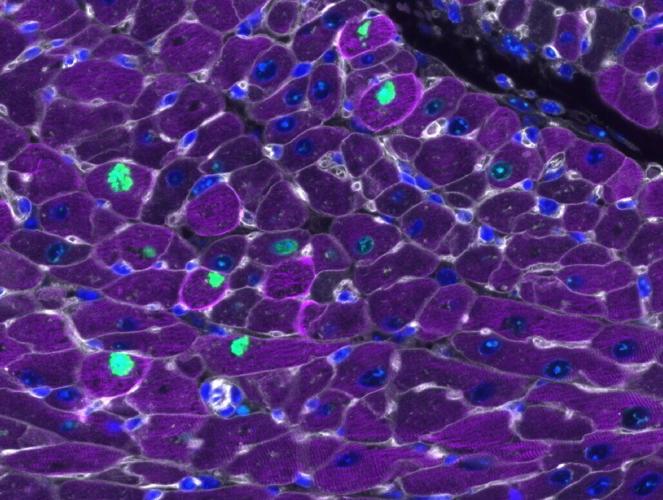
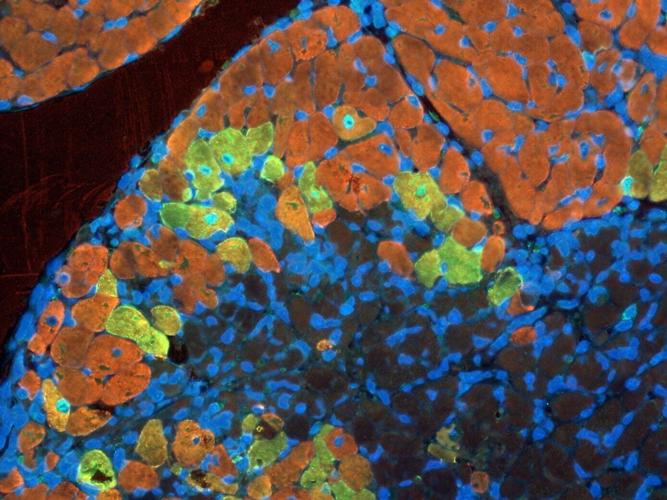

Mouse heart in which Myc and Cyclin T1 are expressed, causing proliferation of heart muscle cells. (Cambridge University via SWNS)
By Stephen Beech
Scientists have developed a treatment that “reawakens” heart muscle cells so they start to divide and help repair damaged muscle.
A new experimental treatment has shown “promise” in regenerating muscles damaged during a heart attack.
Cambridge University scientists have developed the “exciting” method that promotes the repair of damaged heart muscle following a cardiac arrest.
The treatment has shown promising results in mice, according to a study published in the journal Nature Cardiovascular Research.
Since adult heart cells can’t repair themselves once damaged, the research team says the breakthrough represents an important step towards a potential curative treatment for heart disease.
They explained that the treatment “reawakens” heart muscle cells so they start to divide and help repair damaged muscle.

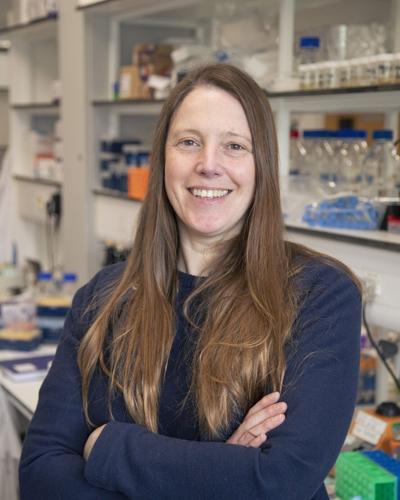
Dr. Catherine Wilson was a co-senior author of the study. (Cambridge University via SWNS)
In a study in mice, it produced a stronger heartbeat and increased the amount of blood pumped through the heart with each heartbeat by around 10%, compared with mice that received a mock treatment, following a heart attack.
While it is not a full cure, the Cambridge team says even small improvements to heart function have been linked to lower mortality in patients and a better ability to carry out daily activities.
The treatment uses mRNA therapy to temporarily activate two proteins inside heart cells, called Myc and Cyclin T1, promoting repair of heart tissue.
The researchers say it has the potential to be used to treat patients with heart failure.
Around 200,000 people in the U.K. are diagnosed with heart failure each year and while current treatments can reduce symptoms and slow the progression of heart disease, they can’t regenerate heart muscle that has already been lost.

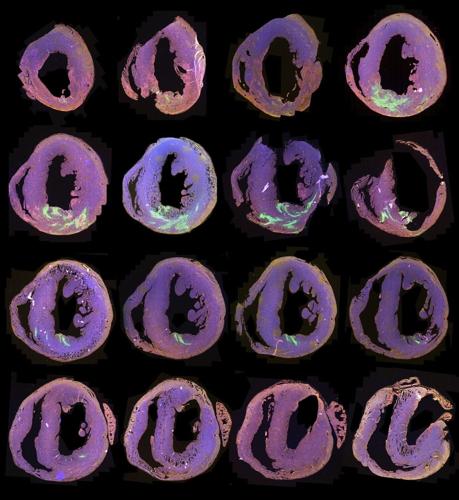
Cross sections of a whole mouse heart, following injection with the mRNA therapy modified to glow green. (Cambridge University via SWNS)
Study co-senior author Catherine Wilson said: “These are really exciting results.
“There’s no cure for heart failure, and our treatment could potentially have a meaningful impact on the quality of life of millions of people around the world.”
She added: “We’re not just treating the symptoms of heart failure — this approach could help the heart to repair itself.”


Following a heart attack, the mRNA therapy was injected into the hearts of the mice and its effectiveness assessed by looking at the hearts with an echocardiogram, similar to looking at a baby inside the womb.
Since the treatment is short-lived and localized, it is not expected to cause any permanent modification to the heart cells — designed to reduce the risk of overgrowth, and no adverse effects were seen in the mice.
Reassessing the mice after 28 days and after 12 weeks showed that the improvement in heart function is long-lasting.
After a heart attack, an adult human heart can lose up to one billion heart muscle cells.

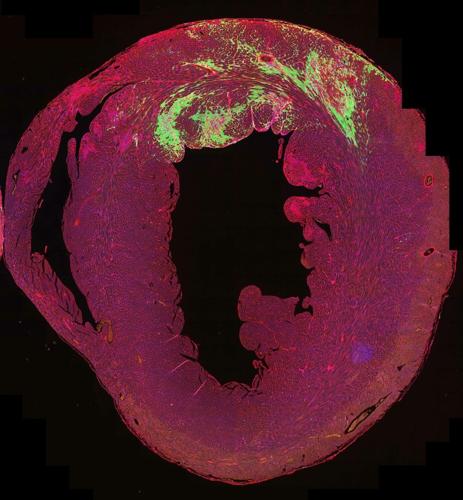
Cross section of a whole mouse heart, following injection with the mRNA therapy. (Cambridge University via SWNS)
Unlike many other organs in the body, the adult heart can’t regenerate itself, so lost cells are never replaced.
Their loss reduces the strength of the heart and can lead to scar formation, heart failure and ultimately death.
As the world’s population grows and the prevalence of heart failure increases, the cost of patient care is anticipated to increase dramatically.
The Cambridge team believes that reawakening heart muscle cells is a promising approach to treating heart failure patients.
The team is now working to refine the treatment and has received funding from the British Heart Foundation (BHF) to continue the work.

Heart close up - the part lacking the cardiomyocytes (dark and blue only) has been damaged. (Cambridge University via SWNS)
Further trials in larger animal models, and then in humans, are needed to fully establish its safety and effectiveness.
Professor Bryan Williams, chief scientific and medical officer at the BHF, said: “Getting the human heart to repair itself is the holy grail for cardiologists.
“The heart is easily repaired when we are babies in the womb, but our heart muscle cells lose the ability to regenerate and fix the heart shortly after we are born.
“That makes it exciting when studies like this are able to reignite regeneration in heart muscle cells.”
He added: “The gene therapy used by the researchers shows clear potential for heart patients.
“While the research is in mice, and still at an early stage, it is an important step forward towards therapies which could help repair the damage to the heart following a heart attack.”


(0) comments
Welcome to the discussion.
Log In
Keep it Clean. Please avoid obscene, vulgar, lewd, racist or sexually-oriented language.
PLEASE TURN OFF YOUR CAPS LOCK.
Don't Threaten. Threats of harming another person will not be tolerated.
Be Truthful. Don't knowingly lie about anyone or anything.
Be Nice. No racism, sexism or any sort of -ism that is degrading to another person.
Be Proactive. Use the 'Report' link on each comment to let us know of abusive posts.
Share with Us. We'd love to hear eyewitness accounts, the history behind an article.