





(Photo by cottonbro studio via Pexels)
By Stephen Beech
Blinking powers a new eye-tracking system to enable wheelchair-bound people to control their movement.
The state of the art self-powered eye tracker harnesses energy from simply blinking - and is as comfortable as everyday glasses, say scientists.
Assistive devices that enable those who can no longer move their bodies to control wheelchairs or communicate by moving only their eyes function by using eye-tracking technology.
But the technology often has limitations due to its size and weight.
Now Chinese researchers have developed a lightweight, self-powered eye-tracking system that runs off the energy generated through the friction between the eyelids and eyes - while simply blinking.
Study author Professor Yun-Ze Long said: “We’ve developed a self-powered eye-tracking system that harvests energy from blinking and can be used to detect eye movements with high precision.

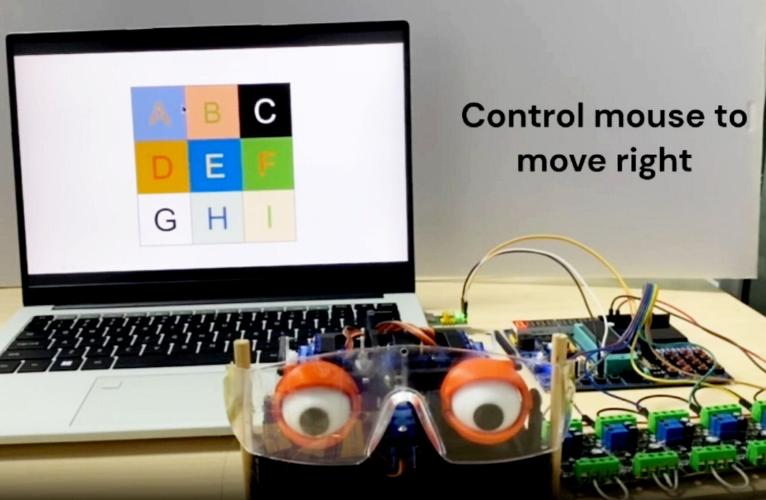
Eye tracking system controlled by eye model. (Wu et al. via SWNS)
“The system works in the dark, requires no external power source, and is as lightweight and comfortable as everyday glasses and contact lenses.”
The Chinese research team sought to improve on current eye-tracking technologies, which are bulky, rely on external power, can’t function in low light, and can cause eye strain with prolonged use.


Their goal was to create a more sustainable, wearable, and user-friendly alternative to assist people with mobility impairments including amyotrophic lateral sclerosis (ALS).
To do so, they created a system based on the principles of "triboelectric nanogenerators"- which rely on electrification and electrostatic induction to convert mechanical energy into electric power and can harvest energy from low-frequency sources such as blinking.
Their system not only harvests enough energy to power itself but also detects eye movements as small as two degrees with 99% precision.

marianne bos
Long, head of research at Qingdao University in China, said: “We were particularly surprised by how well the friction layer retained its charge in a biological setting on a rabbit’s eye.
“We were also impressed by the system’s ability to maintain high accuracy even in noisy electromagnetic environments.”
The findings, published in the journal Cell Reports Physical Science, show that it’s possible to harvest energy from subtle body movements.
The researchers envision a future in which similar technology is incorporated not only in healthcare and virtual reality applications but also in other areas - including smart driving and space exploration - for which hands-free operation is essential.
Long added: “Our system turns something as simple as a blink into a source of power and control.
“It’s designed to be lightweight, comfortable, and helpful- especially for those who rely on eye movements to communicate or interact with the world.
"It’s an example of how technology can empower people and make daily life more accessible.”


(0) comments
Welcome to the discussion.
Log In
Keep it Clean. Please avoid obscene, vulgar, lewd, racist or sexually-oriented language.
PLEASE TURN OFF YOUR CAPS LOCK.
Don't Threaten. Threats of harming another person will not be tolerated.
Be Truthful. Don't knowingly lie about anyone or anything.
Be Nice. No racism, sexism or any sort of -ism that is degrading to another person.
Be Proactive. Use the 'Report' link on each comment to let us know of abusive posts.
Share with Us. We'd love to hear eyewitness accounts, the history behind an article.