


When I was about eight years old my father and uncle would take me fishing deep into the woods of the Adirondack Mountains. My family spent many vacations on Raquette Lake where my aunt and uncle lived. On one of these summer vacations my father grabbed my brother and me by the arm and with great enthusiasm said, “Let’s head to the upper reaches of the Hudson River in the Wilderness Preserve. I’ve heard it’s great fishing.” My brother and I were not avid fishermen, but the idea of tramping along a wilderness stream, the headwaters of the great Hudson River, fascinated us so we happily jumped into my father’s 1954 Studebaker and headed north.
When we reached the town of Newcomb, near our destination to begin our fishing exploits, my father pulled his beloved Studebaker over to the side of the road at a visitor’s center. The sign posted on the side of the road read, “Viewpoint of the Great Range.” I wondered, what’s the Great Range? My brother and I excitedly scrambled out of the car. My father, who wasn’t a hiker (his idea of hiking was to amble along a stream casting with his fly rod) exclaimed, “Those are the High Peaks of the Great Range, the highest mountains in the Adirondacks.” He pointed out the various summits that towered above the horizon: Haystack, Pyramid, Algonquin, Armstrong, Skylight, Gothics, Basin and of course Mount Marcy, the highest peak in New York State.
My brother and I stood in awe and just gawked at the jagged peaks rising in the distance. I was held spellbound by the splendor and the mystery of the towering summits. My mind began a journey into the mountainous wilderness, wondering what it would be like to scale those distant peaks. I wanted to forego our fishing expedition and drive to the foot of the Great Range and hike along those cragged peaks. But my father ruled the day and we spent the rest of our time fishing along the banks of the North Fork of the Hudson River. Nevertheless, the mountains caught my imagination and in the words of Robert Macfarlane, “The mountains we climb are not only made of rock and ice, but of desires and dreams.”
It wasn’t until thirty years later that I climbed the High Peaks of the Great Range. I accompanied my brother Hal on many of his treks to climb to the summits of the 46 highest mountains on his journey to become a “46er”. Every time I returned I recalled the moment I stood in awe at the viewing area in Newcomb, NY and dreamed of climbing those distant peaks. To me the mountains were so much more than heights to be climbed, a peak to conquer. They represented the wonder and beauty of the unknown, a mysteriousness to be discovered.
Now at the age of seventy three I’m captivated by the Adirondacks Mountains and have been returning the past five years to climb the 46 during the winter season. This year my goal was ten summits. I reached eight: Marcy, Haystack, Saddleback, Cascade, Dial, Gothics, Pyramid and Armstrong. I was denied two by strong winds and whiteout conditions: Nippletop and Basin. There is always next year. Mount Marcy, the highest point in New York State was my primary goal for this winter hiking season and I summited with two strong hikers, Guy Jubinville and Ron Plaistead.
The first winter ascent of Mount Marcy was in 1893 by John Otis and Benjamin Pond, employees of the Adirondack Mountain Preserve, a preservationists’ association made up of wealthy, upper-crust Philadelphians. It wasn’t until six years afterward that Mount Marcy was climbed again, this time by two prominent outdoorsmen, C. Grant LaFarge and Gifford Pinchot. Pinchot later served as the first Director of U.S Forest Service, appointed by Teddy Roosevelt, and later as a two term governor of Pennsylvania.
Many of the highest summits in the Adirondacks were climbed much later than most of those in the White Mountains. There are several interesting reasons for this difference. First and foremost, the Appalachian Mountain Club organized and promoted winter expeditions to the White Mountains. Secondly, roads and rail lines provided access into those mountainous regions and there were numerous inns and accommodations for eager winter trekkers. There were even carriage roads to the summits of several of the mountain peaks including Mounts Washington and Moosilauke. None of this existed in the Adirondacks. When trails were being constructed in White Mountains by skilled trail builders like Rayner Edmands, the Adirondacks were still a deep dark mystery, waiting to be discovered. In some ways this is still true today. Trails to several of the highest summits are no more than herd paths and many summits, such as Mount Allen, require a substantial hike of twenty miles or more, out and back. I refer to the Adirondacks as “rugged and remote.”
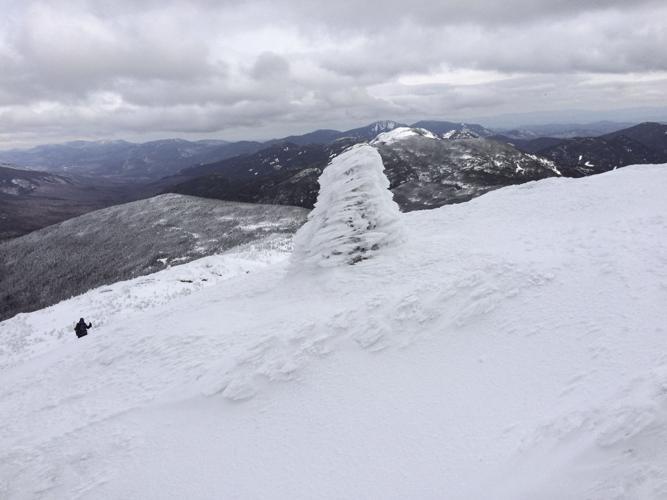
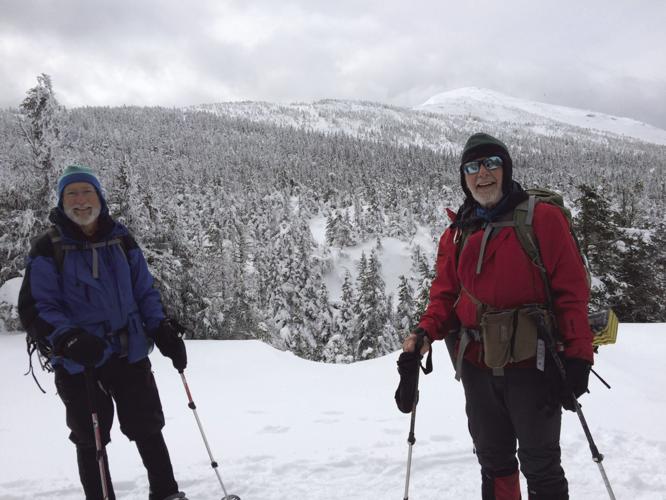
Ron, Guy and I began our trek to Marcy 127 years after the first ascent by Otis and Pond, under much different conditions: a well blazed and maintained trail that had been tramped out by previous hikers. The sky was a brilliant blue and clouds were non-existent, unlike our previous four days of hiking under steel-gray skies and through fog, rain, sleet and winds over 50 MPH. We welcomed the dome of high pressure that was settling over the area. It was a day to celebrate the beauty of the mountains, their upper reaches draped in a gown of snow. When we reached the summit of Mount Marcy we were greeted by a mild wind, a soft cushion of snow that fell the night before and an endless view of the high peaks my father had pointed out many years ago.
The following day, my last winter climb in the Adirondacks this season, Ron and I would attempt to summit Armstrong (4,400 ft.) and Gothics (4,736 ft.) mountains. Three days earlier Doug, Guy and I were turned back a half mile from the summit of Armstrong by gale force winds, sleet and freezing rain- hypothermia weather. Today the sun was blazing bright and the smell of spring was in the air. We encountered only a few strong gusts of wind to remind us that it was still winter.
After reaching the summit of Armstrong, Ron and I continued on our journey by dropping into the col between Armstrong and Gothics, then ascending to the summit of Gothics. This arched peak, with its great slides falling a thousand feet on either side suggested a structure of Gothic architecture to early climbers and the name stuck. The summit of Gothics was coated with a thick layer of wind driven snow, so we discarded our plan of donning crampons, kept our snowshoes strapped on our boots, and continued safely over the three peaks of Gothics, continuing onto Pyramid Mountain.
Pyramid Mountain was aptly named because it resembles the great burial tombs of ancient Egyptian kings; its steep angular sides rise to a sharp point at the summit. When Ron and I reached the summit we peered down into the wilderness abyss as we clung to the few scrub spruce dangling precariously around us. We gazed intently at the massive cirque on the side of Saddleback Mountain and the unobstructed view allowed us to view 30 major peaks. The late afternoon sun was disappearing behind the mountainous background. We couldn’t dawdle, so we quickly descended the steep trail leading to the col between Sawtooth and Pyramid. We aborted our plan to summit Sawtooth and avoid two slides that would be a risky climb in the approaching darkness. Robert MacFarlane wrote, “Our desire is to conquer the mountain, but the mountain will conquer us on its own terms.”
We headed back on a 5 mile trek, passing the south end of Ausable Lake and eventually reaching the parking lot with a full moon gazing down, brilliantly lighting our way. As I neared trail’s end, I was struck by the glow of the moon off Giant Mountain. The magnificent slides of Giant resemble a large five fingered hand, which I coined the name, the “Claw of the Giant”. It was a grand way to end a week-long winter trek in the Adirondacks. I’m already plotting routes for next year to continue on my ADK 46 winter quest. “Mountains are so much more than a challenge or an adversary to overcome, for mountains humble the human instinct and reveal our own insignificance.” (R. MacFarlane).
If you want to learn more about hiking in the Adirondacks, visit the Adirondack Mountain Club’s website at https://www.adk.org. Maps, trail information and lodging is available through the ADK.
•••
For questions and comments contact Gordon at forestpd@metrocast.net


(0) comments
Welcome to the discussion.
Log In
Keep it Clean. Please avoid obscene, vulgar, lewd, racist or sexually-oriented language.
PLEASE TURN OFF YOUR CAPS LOCK.
Don't Threaten. Threats of harming another person will not be tolerated.
Be Truthful. Don't knowingly lie about anyone or anything.
Be Nice. No racism, sexism or any sort of -ism that is degrading to another person.
Be Proactive. Use the 'Report' link on each comment to let us know of abusive posts.
Share with Us. We'd love to hear eyewitness accounts, the history behind an article.