


March has arrived — the sun is higher and its increasing strength is most appreciated as it warms my face. The days are almost three hours longer now than in December, the snow is often soft and deep making for good skiing and easy hiking on well-packed trails. Animal tracks are often visible in the soft snow and the birds are singing their spring songs of praise on warm mornings. Having so many winter activities at hand, yet with the promise of spring in the air, makes March my favorite month of winter.
Although astronomical spring won’t arrive until the vernal equinox on March 20th meteorological spring is already here. The weather men and women have determined that by March 1st the planet exhibits weather patterns that are more spring-like than winter-like, so they’ve declared March 1st the start of spring, and as much as I enjoy winter, I’ll take the earliest date I can get.
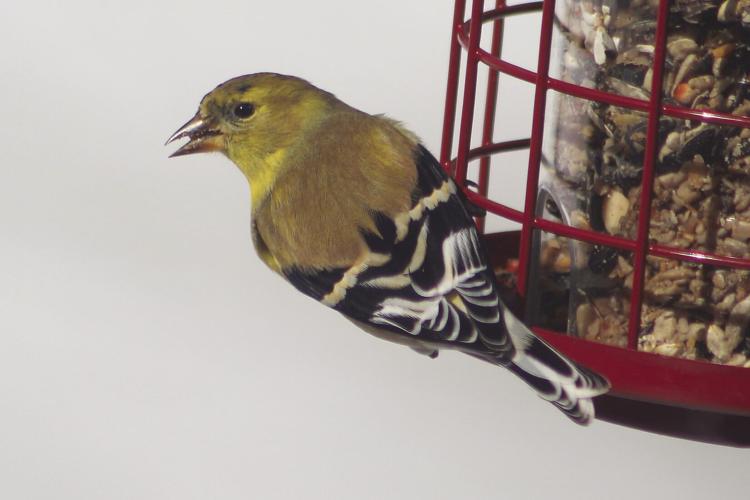
The most obvious indicators that spring is coming are the bright orange weight-limit signs appearing on roadways to herald the arrival of mud season; as the frozen ground melts from the top down, the first few inches of ground thaw out but the water can’t seep down through the frozen layer below, providing our much acclaimed, uniquely-New England mud-season. I prefer to keep my eye out for more subtle signs that spring will actually return to the Lakes Region as I visit our forests, fields, and still-frozen lakes at this time of year. One readily notable change is when goldfinches start to show bits of yellow. They are not yet wearing their brilliant colors of summer, but there’s now a discernible change from the drab brown coloring of just a few weeks ago.
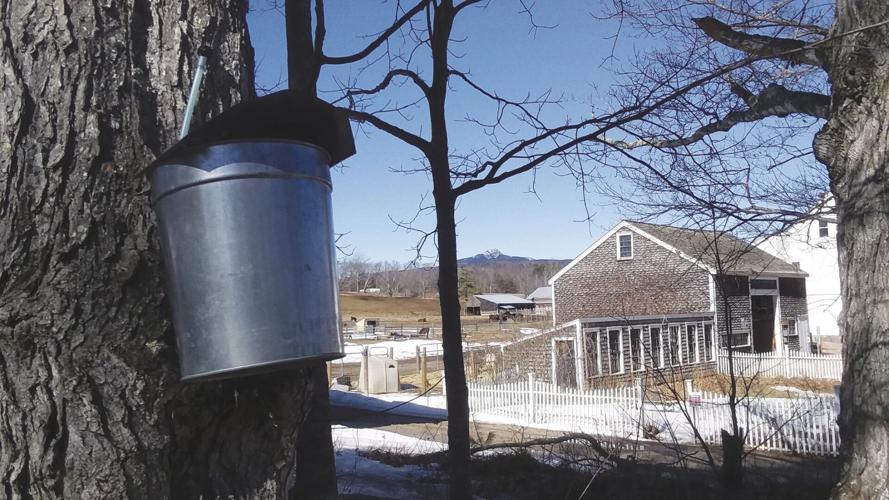
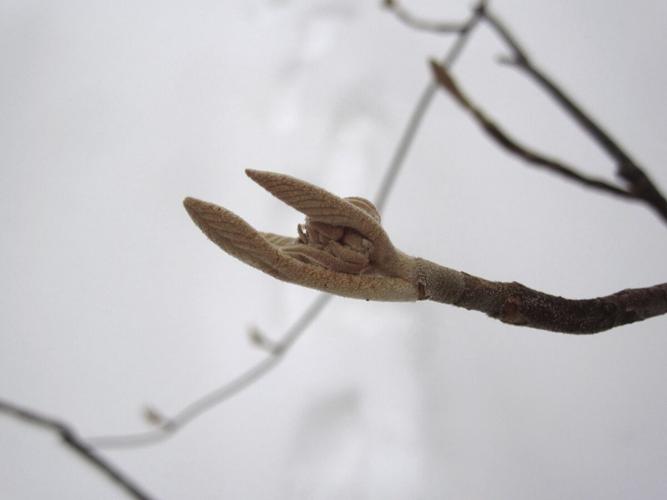
One of the first signs that trees are starting to wake up from their winter slumber are the buds on the red maples. Red maple trees are one of the first trees to leaf out in the spring and their buds are already starting to swell in anticipation, and tinges of red can be seen peeking out. Their close cousin, the sugar maple, follows closely behind the red maple, and they provide their own notice that spring is coming, though their first signs are human-produced: sap buckets hanging on sugar maples along the roadways. These buckets aren’t as numerous as in days past because many sugarbushes have been transferred to using plastic pipes to collect and steer the sap into large containers which are much easier to collect and transport. Because the tubing is often left in place year-round it isn’t obvious when sugaring season has begun but there are still enough good old fashioned metal pails being hung to let us know that the ground and the air and the sun have done enough work to embolden the trees to draw the energy-rich sap stored in their roots last fall up into their branches to fatten their new spring buds.
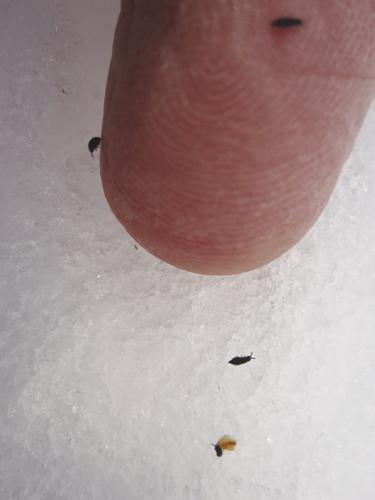
Snow fleas are one of the least obvious indicators of warmer days, but once you become aware of them you’ll notice them everywhere. Walking through the forest on a warm winter day you may notice the snow is sprinkled with hundreds of little specs of dirt or some kind of debris. But if you get down low and look carefully you’ll see these are actually thousands of tiny insects, commonly called snow fleas. This animal’s only mode of transportation involves hooking its tail under its body, then snapping it free, popping it up into the air. If you watch you may see them popping around on the snow like miniature jumping beans. Snow fleas are actually in the forest throughout the summer but they’re practically invisible when they’re not sitting on top of brilliant white snow.
Following some coyote tracks recently on one of our local frozen lakes I came upon several areas that had six inches of wet slush between the snow and the ice. It’s not a pleasant way to travel, and the slush will often freeze onto snowshoes making them weigh about ten pounds each. But it’s a reminder that temperatures are rising, and that one needs to be even more careful when traveling on the ice at this time of year, especially near south facing shore lines and where water currents are moving under the ice.
I also heard my first report of a bear sighting last week. Although bears might wake up and roam in search of food on any unusually warm winter day, their appearance often starts in March. I also saw a chipmunk out and about on the snow, another sign that the winter world is starting to wake up.
On your travels around the Lakes Region — whether on foot, ski, sled, or automobile — keep your eye open for the early signs of spring — it helps to keep the faith that warmer days will return sooner rather than later. And don’t forget to enjoy those cobalt-blue March skies!
•••
Scott Powell lives in Meredith, visiting the forest and waters in the Lakes Region and the White Mountains. He is a Conservation Commissioner for the town of Meredith, on the board of directors of the Lake Wicwas Association, and a member of the Land Stewardship Committee at the Lakes Region Conservation Trust. He writes a weekly journal about nature in the Lakes Region at https://wicwaslake.blogspot.com/ You can contact him at scottpowellnh1@gmail.com.


(0) comments
Welcome to the discussion.
Log In
Keep it Clean. Please avoid obscene, vulgar, lewd, racist or sexually-oriented language.
PLEASE TURN OFF YOUR CAPS LOCK.
Don't Threaten. Threats of harming another person will not be tolerated.
Be Truthful. Don't knowingly lie about anyone or anything.
Be Nice. No racism, sexism or any sort of -ism that is degrading to another person.
Be Proactive. Use the 'Report' link on each comment to let us know of abusive posts.
Share with Us. We'd love to hear eyewitness accounts, the history behind an article.