


A New Hampshire winter snowstorm elicits a wide range of feelings – some people love the beauty and the winter activities it enables, while others dread the travel hassles and the sore backs from moving the snow from where it’s not wanted. But one opportunity it offers for most everyone is the chance to look out in the yard or the forest to see what wild creatures live in your neighborhood. The recent late March storm left a few inches of soft snow, perfect for looking for animal tracks.
In one short walk near the riparian zone (the area where land and water meet) of a local lake the day after the snow fell revealed that at least eight different animals had traveled by in just the prior 36 hours including deer, fox, turkey, otter, mink, squirrel, mouse, and mole. That’s the beauty of new snow – you know the animals leaving tracks passed by since the snow stopped falling. They remind me that these animals are here all the time, I just never see them.
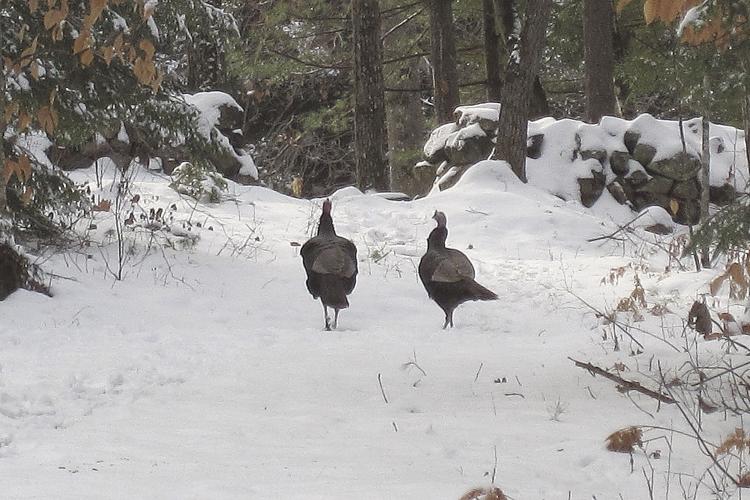
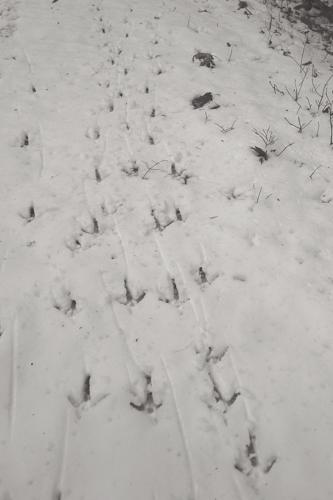
The most interesting tracks were left by a flock of turkeys taking a long stroll to enjoy the pretty spring day. Turkey tracks are pretty easy to identify as there aren’t many birds that leave a print this large – a wild turkey print will be four to five inches long. This particular flock of turkeys consisted of approximately eight birds, which is on the small side of a winter turkey flock. A hen (female) and her brood (chicks) from last summer often join other families in large flocks in the fall and winter. Turkeys will cover a range of four to five square miles over the course of a year, searching out the best food supplies as the seasons change. [Ref: NH Fish and Game]
I always get a reminder of turkey history when I refer to one of the more unique New Hampshire wildlife books, Hilbert Siegler's ”New Hampshire Nature Notes,” written in 1962 – it is completely silent on turkeys. That's because there were no turkeys in 1962 after being hunted to extinction in the state (known as "extirpation"). A first attempt at reintroducing turkeys in 1969 failed, but a second attempt in 1975 was successful, and today there are 40,000 turkeys in New Hampshire, the maximum carrying capacity of the state. There is a nice historical article about the turkey reintroduction in the March/April 2020 issue of the New Hampshire Wildlife Journal.
This time of year the toms (males) are starting to attract their harem with impressive gobbling and bold plumage displays – mating take places in April and nesting in May. By June we'll be looking for cute little turkey poults running around, eating up tics, ants, and other annoying insects. Thank a turkey!
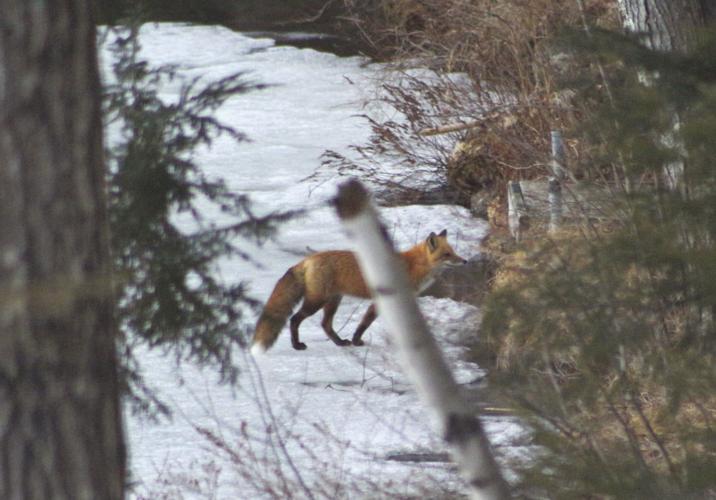
But the turkeys better keep a careful lookout – the foxes are making regular patrols of the local area, still using the lakes for easy travel. Fox on the ice last week wasn’t surprising, but people were – I was a bit surprised to see ice fishing on the lake, even if they were staying close to shore. They told me there's about six inches of ice, but it’s very soft and porous – not safe for travel.
Another nice aspect of March snow – it doesn’t last long. Just a couple of days later, that snow was almost completely gone, and along with it the animal tracks. But the appearance of spring shoots coming up through the snow is just as nice to see. Snowdrop flowers are blooming in warm, sunny spots and crocuses are following close behind. In the forest there are red partridge berries poking through the snow, left over from last summer, having somehow escaped the beaks of those turkeys, partridges (from which they get their name) and the many other animals that feast on them. And of course, the bears are now out on the prowl, so if there are birdfeeders still out in the yard, they should be brought in now to avoid both attracting bears to human areas as well as to avoid the feeder’s destruction.
If we get one more snowfall, don’t be surprised to see bear tracks in the beautiful, but short lived spring snow.
•••
Scott Powell lives in Meredith, visiting the forest and waters in the Lakes Region and the White Mountains. He is a Conservation Commissioner for the town of Meredith, on the board of directors of the Lake Wicwas Association, and a member of the Land Stewardship Committee at the Lakes Region Conservation Trust. He writes a weekly journal about nature in the Lakes Region at https://wicwaslake.blogspot.com/ You can contact him at scottpowellnh1@gmail.com.


(0) comments
Welcome to the discussion.
Log In
Keep it Clean. Please avoid obscene, vulgar, lewd, racist or sexually-oriented language.
PLEASE TURN OFF YOUR CAPS LOCK.
Don't Threaten. Threats of harming another person will not be tolerated.
Be Truthful. Don't knowingly lie about anyone or anything.
Be Nice. No racism, sexism or any sort of -ism that is degrading to another person.
Be Proactive. Use the 'Report' link on each comment to let us know of abusive posts.
Share with Us. We'd love to hear eyewitness accounts, the history behind an article.