


A Settlement Was Developed
Some spring the white man came, built him a house, and made a clearing here, letting in the sun, dried up a farm, piled up the old gray stones in fences, cut down the pines around his dwelling, planted orchard seeds brought from the old country, and persuaded the civil apple tree to blossom next to the wild pine and the juniper, shedding its perfume in the wilderness. Their old stocks still remain. He culled the graceful elm from out the woods and from the river-side, and so refined and smoothed his village plot. And thus he plants a town.
Henry David Thoreau
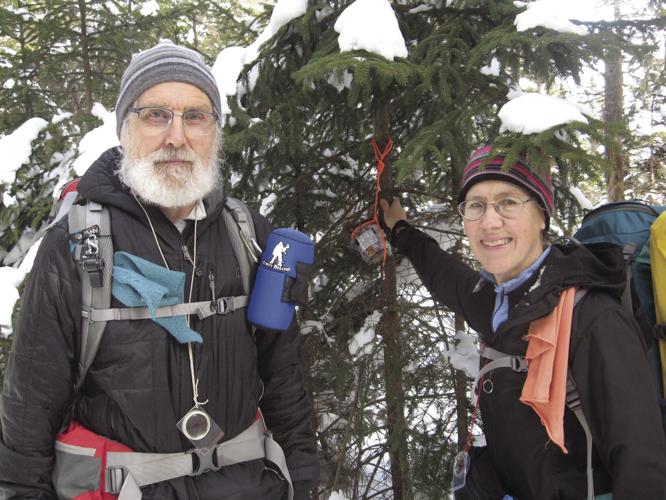
Pushing aside spindly spruce while descending from Northwest Cilley Mountain I stumbled and almost fell into a large hole in the ground. As I righted myself Tom and Karen came up behind me and we gawked at what lay before us, a stone foundation. Close to the foundation was a stone wall about twenty feet long. Was this a site of an abandoned farm? Were there other foundations in the area? Where was the road that led to the farm? Why was it situated so far from other settlements such as Woodstock or North Woodstock? We couldn’t continue our search for other cellar holes as we needed to “beat feet” to get to Cilley Road and climb to the summit of Grandview Mountain.
When I returned home I wanted to find out something about that cellar hole and the possibility that many years ago this was a home among several others that made up a community. I have hiked into other lost communities such as Livermore and Thornton Gore. Was this another lost town swallowed up by the wildness after being abandoned? I found my answer on the website WhiteMountainHistory.org. The cellar hole and stone wall Tom, Karen and I discovered were part of the town of Peeling.
Peeling was the predecessor to the town of Woodstock, NH. In 1763 a section of land was peeled off other land grants and granted to Eli DeMerritt by colonial Governor Benning Wentworth. It was named Peeling for an English town of the same name. Some say it was named Peeling because it was peeled off other land grants. Either way, DeMerritt never settled in the Peeling, the land was re-granted in 1771 and renamed Fairfield, for Fairfield Connecticut. Settlement of the land grant again lagged but the name Peeling persisted. It wasn’t until 1818 that Peeling was finally settled and it grew into a recognized community. It was abandoned around 1860 when the town center moved to the present location of Woodstock. Peeling had a post office (1819-1840), a spruce oil mill (spruce oil was useful in the treatment of muscular aches. It is obtained by the steam distillation of the needles, twigs and branches of the spruce tree), a school house for about 40 students, sawmill and several houses. Symms Sawyer was the town’s first doctor and traveled widely throughout the Pemigewasset Valley, becoming well known for his doctoring duties. As with many of these early communities, greener pastures were found elsewhere and the inhabitants moved to other locations that could provide a more stable livelihood; not too different from today’s realities. (Will some of our struggling towns and villages become ghost towns in a hundred years? History has a way of repeating itself).
After our investigation of the cellar hole and stone wall we continued thrashing through blowdowns, hobblebush, spindle spruce until we arrived at our long sought destination - Cilley Road. This well- maintained snowmobile trail was once the main thoroughfare of Peeling. We stopped along the road for lunch before beginning our climb to Grandview Mountain. By its name I envisioned Grandview Mountain offering spectacular views of the White Mountains, but the view at the summit was nothing more than the surrounding tree line. Not far from the summit was the site of a fire tower that was in operation from 1939-1948 and removed in 1960. Earlier in 1921 a private observatory was built by the North Woodstock Improvement Association, including a path to the tower. This was most likely a tourist attraction to lure travelers to this remote area.
After we reached the summit of Grandview our plan was to bushwhack to the summit of Mount Cilley. However, time was not on our side and we had to ditch our objective and begin the long walk back along snowmobile trails, Forest Road 156 to the parking lot off Route 118. We agreed to return to the Mt. Cilley area to finish the “Cilley Triangle.”
A week later Tom, Karen and I did return to the Cilley Triangle to capture the summit of Mount Cilley and complete our undertaking. We also wanted to visit Elbow Pond, located on the west side of Mount Cilley. We again drove to the large parking area maintained by the Forest Service for hikers like us, as well as snowmobilers, and skiers.
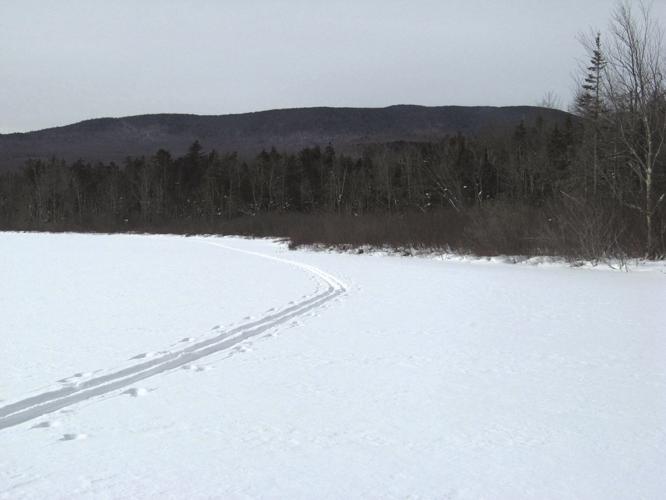
We followed the same route that we took last week, Forest Road 156, to a point where we headed in a southeasterly direction. We ambled through open woods, with occasional thickets of hobble bush that had been browsed heavily by moose. We reached the summit, found the canister, signed in and began our descent to Elbow Pond to have our lunch. We arrived at Elbow Pond, found a picnic site and dug into our packs for a long awaited lunch. Karen prides herself on making special treats for the trail and she never fails to surprise me. This time we feasted on her homemade peanut butter cups.
We returned to the parking lot following Forest Road 156. Several snowmobilers passed by and a local who was skiing stopped to chat. He shared several stories about his youth and growing up in Woodstock, which included the amazing story of the 1942 B-19 crash on Mount Wananomee. He told us that his mother was involved in the rescue of the crew members by setting up a kitchen in the wilderness to feed the search team, led by the late Sherman Adams, Governor of New Hampshire (1948-52) and Chief of Staff to President Eisenhower (1952-60).
Just before arriving at the parking lot I happened to see a kiosk providing a history of the Warren-Woodstock Carriage Road. Before Route 118 was built in 1935 by the Civilian Conservation Corps, the corridor we were hiking on was known as the Carriage Road connecting Warren and Woodstock. The blazed pathway was completed in 1830 and in 1889 it was improved to allow carriages to make the journey. Hotels, such as the famous The Moosilauke at Breezy Point in Warren and the Deer Park Hotel in North Woodstock, along with several boarding houses sprung up along the route to accommodate the increasing numbers of travelers and tourists making the journey between the two towns. Some sections of the abandoned carriage road were incorporated into the construction of Route 118, while remnants of the tread are now maintained by the Warren and Lincoln Snowmobile Clubs in partnership with the White National Forest. “Nothing else conduces so much to attract summer visitors and tourists to our mountains as good highways.” (The Granite Monthly, Feb., 1893).
This multi-use area is one not to be missed by anyone who enjoys riding, snowshoeing or skiing in a pristine wilderness. There are multiple Forest Service Roads that have been built to accommodate snowmobiles and more under construction. A hike into Elbow Pond for a picnic would make a perfect outing for a family willing to ski or snowshoe a mile. If you are adventurous and want to hike into history you can hike Forest Service Road 156 (Mt. Cilley Trail) past Elbow Pond several more miles to explore the remnants of the abandoned town of Peeling. You can find find the location of the cellar holes by reading Dr. Leonard Nybergs’s paper on the history of Peeling found at Whitemountainhistory.org. I am grateful to the late Dr. Nyberg for his research of Peeling/Woodstock.
•••
For questions or comments contact Gordon at forestpd@metrocast.net


(0) comments
Welcome to the discussion.
Log In
Keep it Clean. Please avoid obscene, vulgar, lewd, racist or sexually-oriented language.
PLEASE TURN OFF YOUR CAPS LOCK.
Don't Threaten. Threats of harming another person will not be tolerated.
Be Truthful. Don't knowingly lie about anyone or anything.
Be Nice. No racism, sexism or any sort of -ism that is degrading to another person.
Be Proactive. Use the 'Report' link on each comment to let us know of abusive posts.
Share with Us. We'd love to hear eyewitness accounts, the history behind an article.