


Anthony Trollope, the British writer, published "The Way We Live Now" in 1875. It’s a long novel and like many at the time first appeared as monthly, serialized stories in a London magazine. Trollope was a prolific writer and if you haven’t read one of his many novels, I encourage you to dip in.
Trollope came to mind as I was thinking about my visit to the Zimmerman House in Manchester. Dr. Isadore J. Zimmerman and his wife Lucille wanted a house that wasn’t like all the other New England-style homes in Manchester. They approached the well-known architect Frank Lloyd Wright and asked if he would design their home. He agreed and designed not only the house, but the gardens and the interior details down to the dinnerware. The house was built in 1950 under Wright's direction. Interestingly Wright never visited the house.
During the pandemic when many of us were confined to our homes it became clear we might want to think about “the way we live now.” There is the desire for a home office and possibly a gym. The kitchen, when the family is dining together day after day, becomes an important gathering place. We also realized, in our consumer driven society, how many unused, unworn, outdated items we have allowed to collect over time.
Andrew Spahr, the director of historic houses at the Currier Museum of Art, agreed to give me a tour of the Zimmerman House a few weeks ago. I have visited Falling Water, Wright’s home designed for the Kaufman family in the Laurel Highlands of Southwest Pennsylvania; Taliesin West, Wright’s winter home and studio outside of Scottsdale, Arizona, and one of his Usonian homes near Detroit, Michigan. What would a Frank Lloyd House look like in New Hampshire?
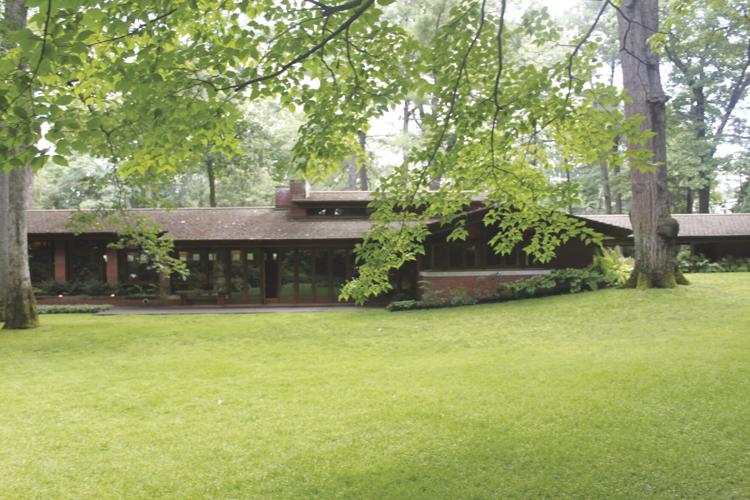
Wright believed in bringing the outdoors in, so the home would appear to encroach on and be part of the landscape. He also believed people should not be encouraged to collect clutter so there are always few closets, shelves and places for “things” to accumulate.
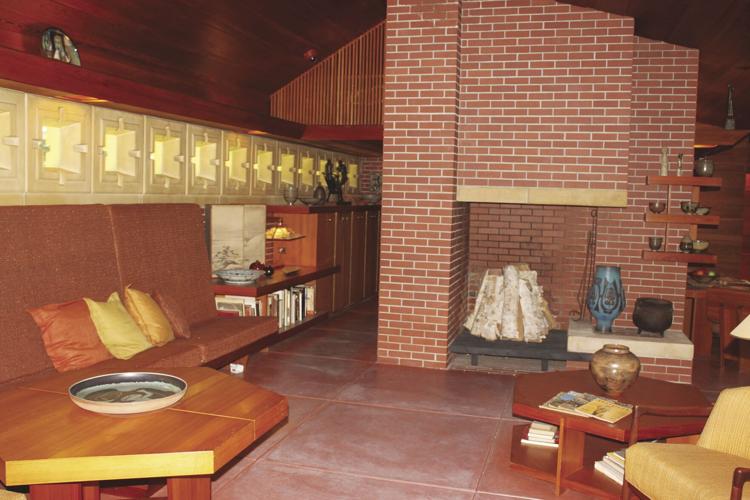
The scale of Wright houses is often small to create a sense of intimacy and yet planned in a way that provides a sense of space. In the Zimmerman House there is a corner with a piano and a music stand with a cello leaning against it. While the house is not large, the main living room is configured so one could invite friends for a concert. Furniture is often built in, yet the other pieces are easily moved so the seating or dining can be reconfigured if necessary. Shelves, built into the walls, allow for art and books. Just not too many. Life must be carefully curated. The Zimmermans collected pottery, paintings, and sculpture.
The exterior landscape is exquisite as is the positioning of the house on the corner lot just in from the top of the street. Large windows give the sensation of the trees and bushes being just inside the living room. The sleeping rooms are small.
The Zimmermans did not have children and when they bequeathed the house to the Currier Art Museum in 1988, they left all their household belongings. An open closet door lets you peak at the clothes they wore. The table is set for what might be breakfast, and kitchen utensils are left as they were in their kitchen.
There are two Frank Lloyd houses in Manchester. The second is just down the street and belonged to another doctor, Dr. Toufic H. Kalil, a colleague of Dr. Zimmerman. Both houses are open for small group tours through the Currier Museum.
How can we transform our living space to accommodate climate shifts, the cost of transportation and the interest in working remotely? Spending a few hours in a house designed by Wright provides one with a sense of what you really need and how one can live in nature to create a peaceful space. Isn’t that what we all desire?
•••
Elizabeth Howard is the host of the Short Fuse Podcast, found on Apple Podcasts, Spotify or through the Arts Fuse. She is a journalist, columnist, and communications consultant. Ned O’Gorman: A Glance Back, a book she edited, was published in May 2016. She is the author of A Day with Bonefish Joe (David R. Godine, 2015). Her articles have appeared in publications in the United States and internationally. You can send her a note at eh@elizabethhoward.com.


(1) comment
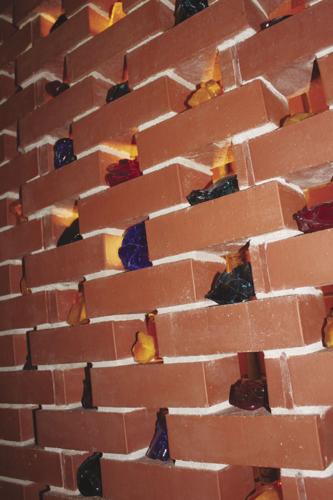
There are many very useful shelves at the Zimmerman house. The picture shows a brick wall that was specifically designed with back-lighting and gaps for the placement of colored glass shards that may have been collected from the Corning Glass works in New York State. It is a modernist interpretation of the stained glass that was common in earlier Wright home designs from the 1890's to the 1930's.
Welcome to the discussion.
Log In
Keep it Clean. Please avoid obscene, vulgar, lewd, racist or sexually-oriented language.
PLEASE TURN OFF YOUR CAPS LOCK.
Don't Threaten. Threats of harming another person will not be tolerated.
Be Truthful. Don't knowingly lie about anyone or anything.
Be Nice. No racism, sexism or any sort of -ism that is degrading to another person.
Be Proactive. Use the 'Report' link on each comment to let us know of abusive posts.
Share with Us. We'd love to hear eyewitness accounts, the history behind an article.