


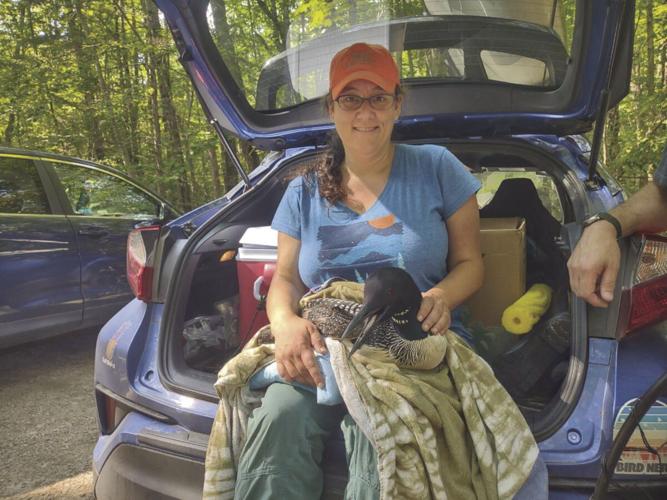
Last month, the Loon Center received a call about a loon in distress on Lake Skatutakee in Harrisville. After days of heavy rain, the lake level had increased, creating a current that washed the male loon over the dam and into Nubanusit Brook below. The loon was swept roughly a quarter of a mile down Nubanusit Brook, and the caller found it sitting in a calm spot of water near a bridge on the East View trail. Water levels in Nubanusit Brook were high, and the loon was out of reach and surrounded by heavy currents.
While LPC biologists Elaina Badders and Mary Caffrey gathered the necessary equipment for a rescue, the center called Brett Amy Thelen, science director at the Harris Center for Conservation Education, to keep an eye on the loon until they arrived.
By the time the biologists arrived, the loon had been swept further downstream and out of sight, traveling through stretches of raging rapids. The group, joined by Thelen's husband Russ Cobb, searched for the loon along the brook, following it half a mile through the woods. As they searched, conditions became more dangerous. The brook was flooding, and some sections had dangerous currents. When a thunderstorm began, the rescue team ended their search for the night.
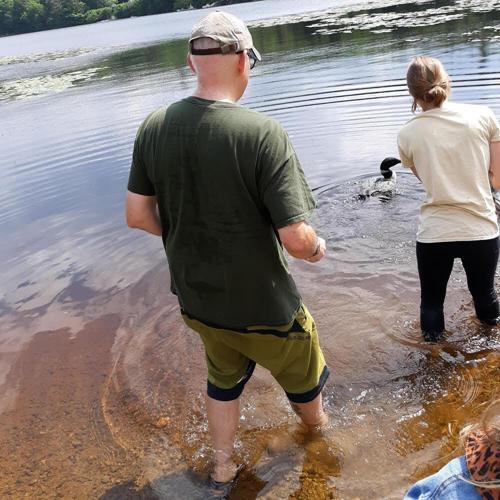
The next morning, Thelen and Cobb returned to the area, determined to locate the loon. They walked a quarter mile up the East View Trail before cutting towards the brook. After another quarter mile, they still had not located the loon. They were about to give up when they heard it call. Following the noise, they located the loon, who had managed to pull itself out of the brook and onto the shore. They called the LPC, and Caffrey returned to the area to help carry the loon back to the trailhead. After a half mile trek carrying the loon, the loon was loaded into a box and transported to Maria Colby of Wings of the Dawn Wildlife Rehabilitation for an exam and observation. Though its feet were a bit scraped up, the loon had no major injuries or underlying problems, and it demonstrated that it was able to swim, dive, and catch fish. After a night of observation, the loon was banded and returned to its lake, where it reunited with its mate and two young chicks. This incredible rescue would not have been possible without a dedicated team of people looking out for the loon.
While the Skatutakee rescue was going on, there was another New Hampshire loon also in need of help. That same week, an LPC crew set out on what they thought would be a routine banding trip on Mascoma Lake in Enfield. Aside from some thick fog, the banding trip appeared relatively routine at first glance: captured both members of the pair and their chick, and all loons were acting normally. The next day, as they ran our routine tests on the blood collected from the adult loons the previous night, they discovered a problem: the male loon of the pair had a blood lead level of 25.8 micrograms per deciliter. This is an elevated lead level for a loon, approaching but not quite at the fatal level. If the LPC could not recapture the loon and remove the lead object from his gizzard, his condition would decline rapidly and he would die of lead poisoning.
The next night, LPC field biologists Caffrey, Phil Keefe, and Jayden Jech returned to Mascoma Lake. Armed with a spotlight and capture net, they searched for the loon family. Fortunately, the rescue attempt went smoothly, and within an hour they had the loon in hand. Just after midnight, the loon was transported to Wings of the Dawn Wildlife Rehabilitation. The next morning, a radiograph revealed a lead object in the loon's gizzard. The loon was transported to the Tufts Wildlife Clinic at the Cummings Veterinary Medical Center for a gastric lavage — a process in which small volumes of fluid are used to flush items from the stomach and digestive tract.
Typically, loons do not display signs of lead poisoning until it is too late to save them. The LPC was fortunate that the banding work allowed them to catch this case of lead poisoning early on, before the loon began displaying symptoms. Though this loon's future is still uncertain, it has a chance of survival. The LPC is hopeful that with the lead object removed and after a few days of treatment, they may be able to get it back on its lake with its mate and chick. This story is a reminder to make the switch to non-lead, loon-safe tackle. The smallest piece of lead fishing tackle can cause fatal lead poisoning in a loon. LPC encourages all anglers to clean out their tackle boxes and get rid of any lingering lead tackle.
LPC's Lead Tackle Buyback program is ongoing — anglers with lead tackle to get rid of may receive a $10 voucher by visiting loonsafe.org for a list of participating retailers. The person who turns in the highest amount of tackle at each shop will receive a $100 prize, and the person who turns in the second highest amount of tackle will receive $50.


(0) comments
Welcome to the discussion.
Log In
Keep it Clean. Please avoid obscene, vulgar, lewd, racist or sexually-oriented language.
PLEASE TURN OFF YOUR CAPS LOCK.
Don't Threaten. Threats of harming another person will not be tolerated.
Be Truthful. Don't knowingly lie about anyone or anything.
Be Nice. No racism, sexism or any sort of -ism that is degrading to another person.
Be Proactive. Use the 'Report' link on each comment to let us know of abusive posts.
Share with Us. We'd love to hear eyewitness accounts, the history behind an article.