


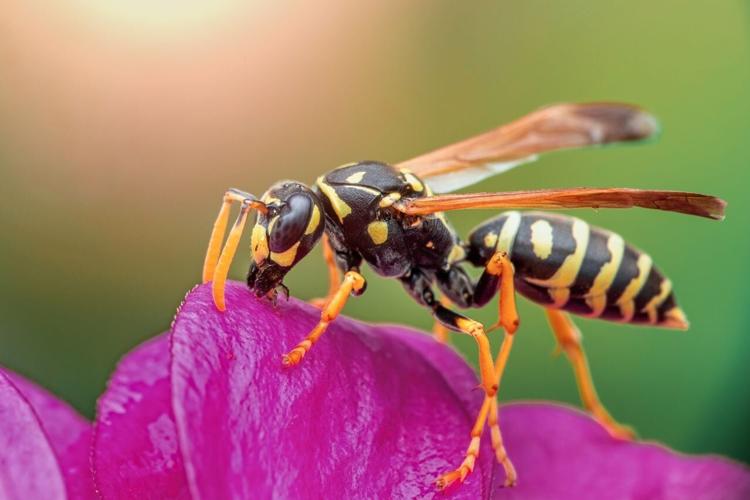

Photo by Skyler Ewing via Pexels
By Stephen Beech
Wasps can recognize one another's faces thanks to specialized brain cells, reveals new research.
They are able to tell the difference between friends, family and foes — much like humans, say scientists.
A new American study, published in the journal Cell, shows how the wasp brain is able to make those distinctions.
Researchers say their findings offer new perspectives in understanding how animals across species — even humans — process social visual information to distinguish one face from another.
Study leader Christopher Jernigan, of Wake Forest University in North Carolina, said: "These wasps that perform facial recognition have neurons similar to those in our own brains that are doing very similar things.
"These groups of neurons are all firing, and each neuron has a slightly different preference for one face or another."
He said the study is the first to describe the group of brain cells, or neurons, that respond to images of other wasps.

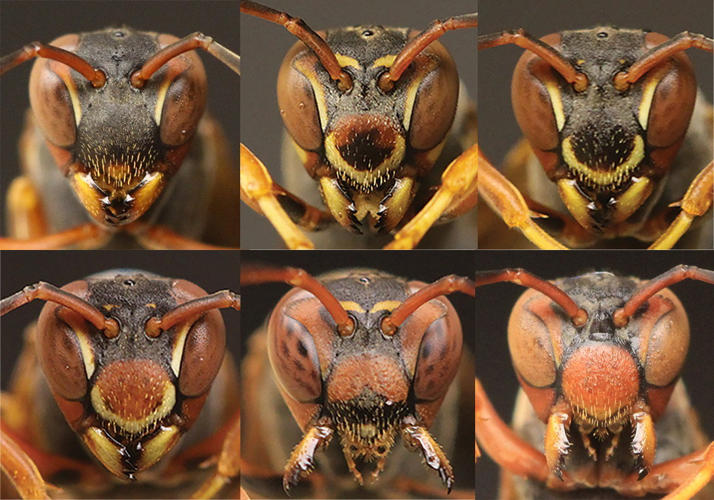
(Wake Forest University via SWNS)
The neurons appear to encode identity-related facial patterns, according to the study.
Jernigan's research focuses on a wasp species called Polistes fuscatus, or the northern paper wasp.
Colonies of the roughly half-inch insects are found across eastern and central North America, from southern Canada through Florida and Texas.
They build papery, umbrella-shaped nests containing hexagonal cells under building eaves and on porch ceilings.
Jernigan said the females use facial recognition to remember individuals in the nest hierarchy.
Once the wasps establish the hierarchy, recognizing faces helps maintain social order day to day without a constant need to battle for dominance.


Jernigan explained that the northern paper wasp provides an "excellent" system for understanding how the brain is shaped by experience in performing a specialized task such as facial recognition.
He said their small size and simpler circuitry make it easier to trace the neural connections involved in facial recognition.
However, the new findings suggest that the wasps and primates, including humans, might use a similar method for facial recognition, despite evolving independently.
Their brains are about the size of a grain of rice, but Jernigan said: "They're able to do this incredibly complex task of remembering and recalling individuals.
"They can tell the difference between the distribution of color patterns on one face versus another.
"They can also perform something called social eavesdropping."
He explained that wasps fight each other to establish a linear dominance hierarchy on the nest.

Photo by ÐлекÑÐ°Ð½Ð´Ñ Ð via Pexels
A wasp can watch two unknown wasps fight and then, upon meeting one of them, know whether they need to fight for dominance.
Jernigan, who conducted the research in collaboration with colleagues at Cornell University in Ithaca, New York, said: "They will treat the winner of that fight independently in a third interaction differently than they would the loser.
"Despite having these small brains and relatively simple vision, they have these really complex social lives that revolve around this specialized ability to recognize each other."
He said the study received funding from the National Institutes of Health and the National Eye Institute in part "because this system, hopefully, holds the potential to help us understand our own brains as we study the circuit connections and the role of experience in giving rise to identity recognition."
Jernigan and his colleagues now plan to look at nuances such as whether wasps recognize facial expressions.
He added: "It's really remarkable that they have this kind of really human-like or primate-like ability that you wouldn't typically expect for an insect.
"And I think it's almost unbelievable that they have some of the similar kind of neural computations for doing a similar task as we do.
"It takes a tremendous amount of neural connections to do something similar in a primate."


(0) comments
Welcome to the discussion.
Log In
Keep it Clean. Please avoid obscene, vulgar, lewd, racist or sexually-oriented language.
PLEASE TURN OFF YOUR CAPS LOCK.
Don't Threaten. Threats of harming another person will not be tolerated.
Be Truthful. Don't knowingly lie about anyone or anything.
Be Nice. No racism, sexism or any sort of -ism that is degrading to another person.
Be Proactive. Use the 'Report' link on each comment to let us know of abusive posts.
Share with Us. We'd love to hear eyewitness accounts, the history behind an article.