


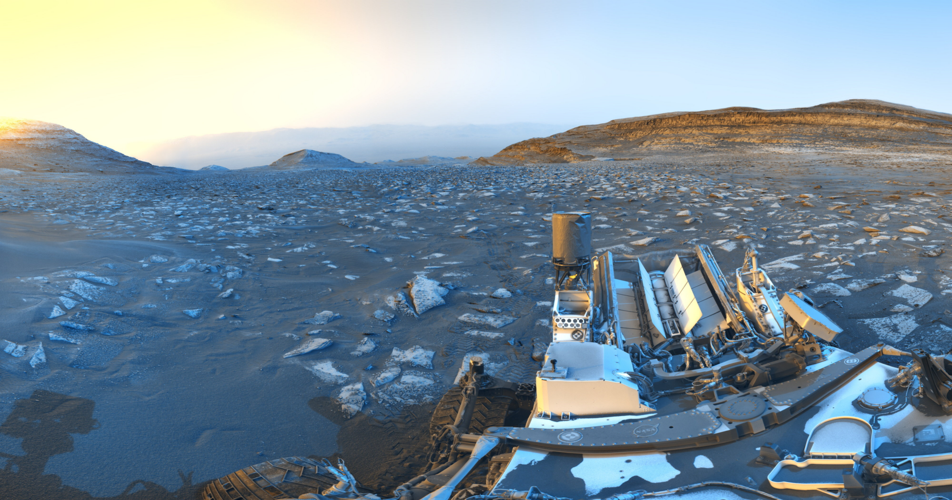

Curiosity's "postcard" from Mars. (NASA/JPL-Caltech via SWNS)
By Dean Murray
A special "postcard" from Mars celebrates the Curiosity rover’s 5,000th day on the Red Planet.
While parked at a sand ridge nicknamed “Chocolatal,” NASA’s exploratory robot used its black-and-white navigation cameras to capture panoramas at two times of day.
The first was taken on August 30 at 9:56 a.m. local Mars time; the second was taken on September 2 at 5:39 p.m. local Mars time.
After being sent back to Earth, the two images were merged together by NASA technicians and colour was added for an artistic interpretation of the scene, with blue representing the morning panorama and yellow representing the afternoon one.


(NASA/JPL-Caltech/MSSS et al. via SWNS)
The rover’s deck can be seen in the foreground, including its can-shaped UHF antenna, used for sending data to orbiting spacecraft, and its finned Multi-Mission Radioisotope Thermoelectric Generator (MMRTG), a nuclear power source, at its rear. The rover’s tracks can be seen trailing off in the distance.
Curiosity is in the lower foothills of Mount Sharp, a 3-mile-tall (5-kilometre-tall) mountain that sits within Gale Crater.
“This image looks down toward the crater floor, with the crater rim barely perceptible on the horizon,” said NASA.
Launched in 2011 to assess whether Mars ever had conditions suitable for microbial life, Curiosity has been exploring the Red Planet since touching down in Gale Crater in August 2012.


(0) comments
Welcome to the discussion.
Log In
Keep it Clean. Please avoid obscene, vulgar, lewd, racist or sexually-oriented language.
PLEASE TURN OFF YOUR CAPS LOCK.
Don't Threaten. Threats of harming another person will not be tolerated.
Be Truthful. Don't knowingly lie about anyone or anything.
Be Nice. No racism, sexism or any sort of -ism that is degrading to another person.
Be Proactive. Use the 'Report' link on each comment to let us know of abusive posts.
Share with Us. We'd love to hear eyewitness accounts, the history behind an article.