




Is it actually possible to boycott AI in 2026?
You can boycott AI to a point. You can cancel ChatGPT, delete AI apps, switch tools, and refuse to give money to companies whose practices you disagree with. What you cannot do in 2026 is avoid AI completely, because it already runs inside the search engines, email, banking, maps, and phone you use every day, WebFX reports.
In Clearfield, Pennsylvania, a town of about 5,000 people, a rumor that a data center was coming recently circulated. Although the rumor was unverified, the reaction resulted in a wave of public sentiment from residents swearing off AI entirely.
What does it mean to boycott AI?
Boycotting AI means deliberately refusing to use or pay for AI products or the companies behind them, as a form of protest. In practice, that ranges from canceling a ChatGPT subscription to avoiding an entire company’s ecosystem because you object to how it builds or deploys AI.
The broader case for boycotting AI usually comes down to concerns that reach past any single company: The environmental cost of data centers, the use of artists’ and writers’ work to train models without consent, data privacy, and the effect on jobs.
While canceling a chatbot subscription is a direct action, it is distinct from the broader challenge of navigating AI's integration into essential digital services.
What does boycotting AI actually involve?
A real AI boycott starts with the tools you choose and pay for, then runs into the AI you never signed up for. The first part is straightforward. The second is where “I’m done with AI” stops being realistic.
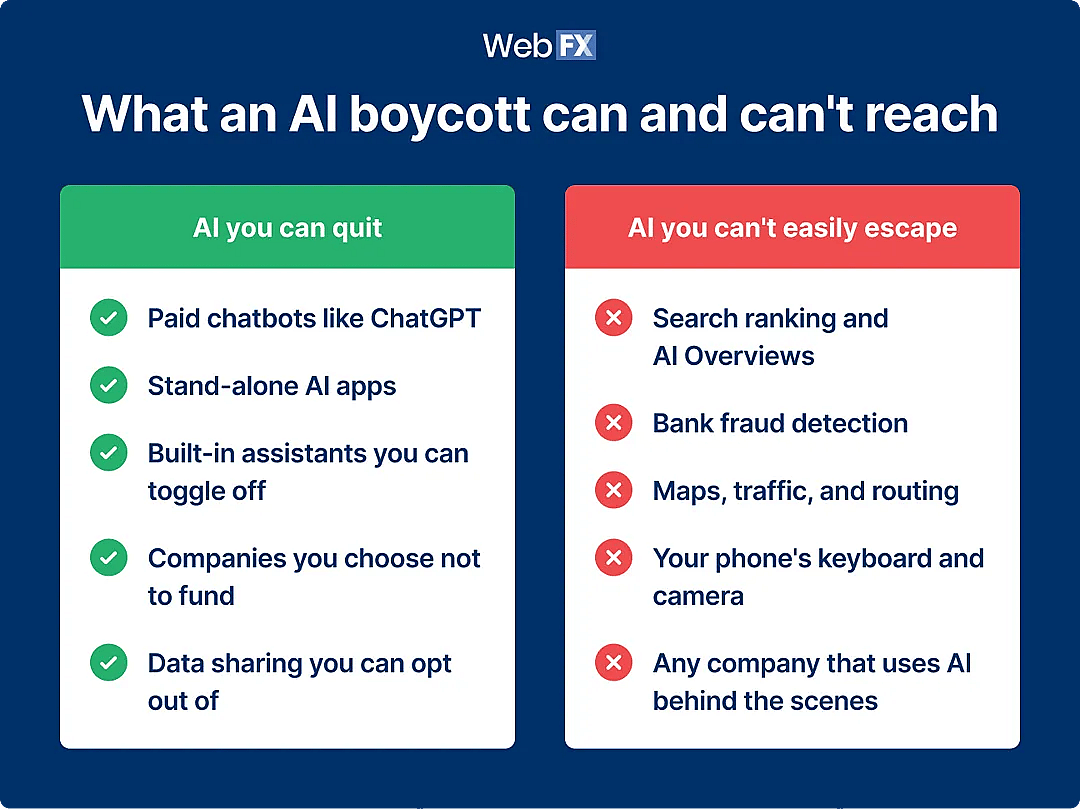
Here’s what you can actually control:
- Cancel paid AI subscriptions: Drop ChatGPT Plus, Gemini Advanced, Claude Pro, or any stand-alone AI tool you pay for. This is the most direct way to stop funding a company you disagree with.
- Delete stand-alone AI apps: Remove the chatbots and AI image or writing tools you’ve installed.
- Disable built-in AI features: Turn off assistants like Apple Intelligence, Microsoft Copilot, or Google’s AI features in your browser and operating system where the settings allow it.
- Switch to alternatives: Move to tools from companies whose policies line up better with your values, or to services that lean less on AI.
- Opt out of data sharing: Adjust privacy settings so your activity isn’t used to train models where platforms offer that option.
Do all of that and you’ve meaningfully cut your direct AI use. You’ve stopped paying the companies you object to, and you’ve sent a signal with your wallet, which is the part of a boycott that actually carries weight.
What you haven’t done is escape AI entirely, because it also runs your search engine, your bank’s fraud detection, your phone’s keyboard, and the map that gets you to work. That’s worth understanding, because it changes the goal from avoiding AI to using it on your own terms.
Can you actually avoid AI in everyday life?
You can’t fully avoid AI in everyday life without giving up most modern technology, but you can be deliberate about how you use it. Most people picture AI as ChatGPT, Gemini, or Claude, the tools you log into and ask questions. Those are easy enough to quit. The harder part is that AI is baked into the fabric of everyday technology in ways you never see.
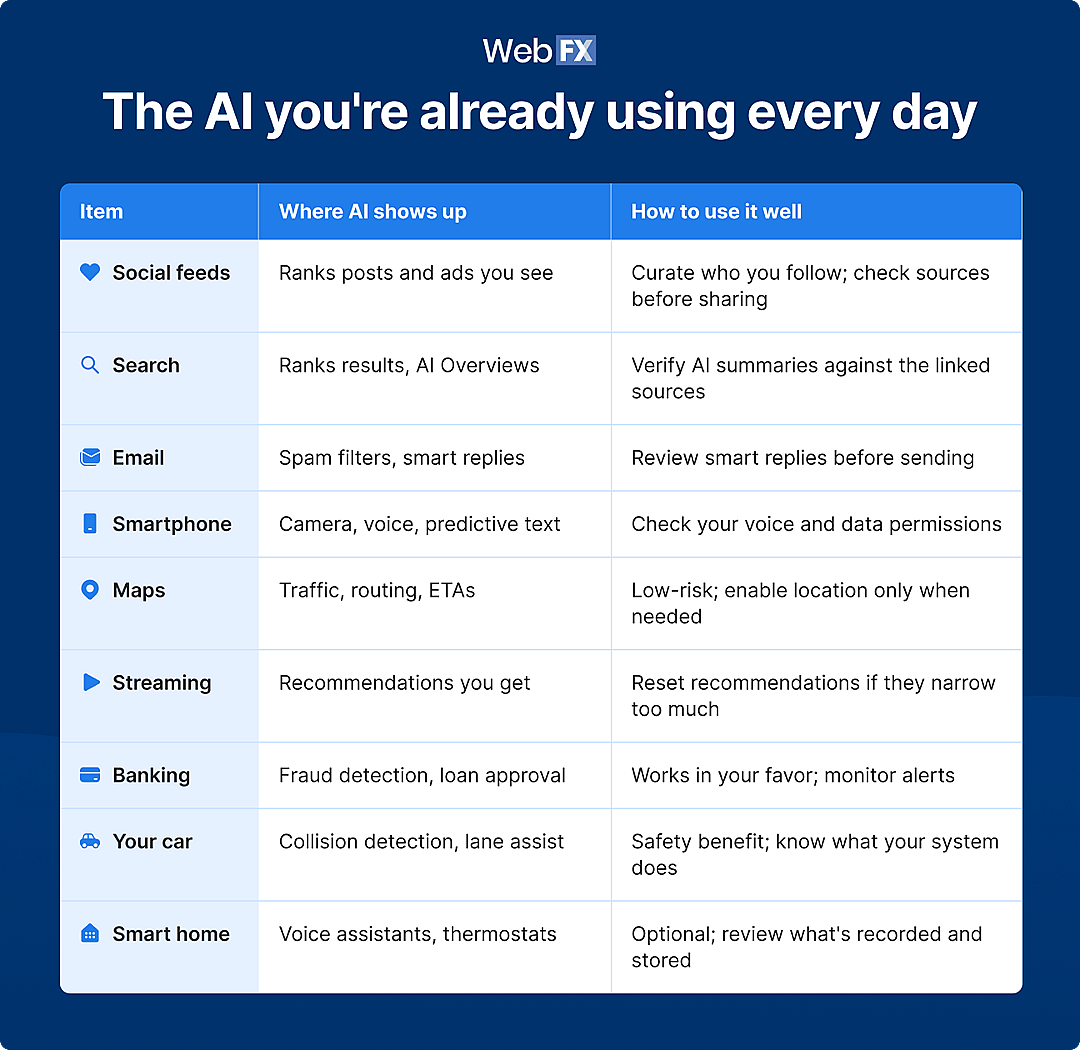
Some of these you’d never want to turn off. AI-powered fraud detection protects your bank account, and collision detection makes your car safer. Others are worth a closer look, like how your social feed is ranked, what your phone records, or how much you trust an AI overview before acting on it.
That’s the real takeaway, because you’re not choosing between using AI and avoiding it. You’re choosing how deliberately you engage with the AI already woven into your day. Full avoidance would mean deleting your social media, ditching your smartphone, dropping online banking, and buying a car from before 2015, and even then you’d meet AI every time you dealt with a company that uses it.
Short of moving off the grid, a full AI boycott isn’t realistic in 2026. The more useful question is which tools you trust, which settings you adjust, and where the convenience is worth it.
AI is already here, and adoption is growing fast
AI adoption is accelerating quickly, and referral data shows the shift plainly. Tracking of website visits across more than 1,000 sites, primarily established mid-to-large businesses, provides a view of how quickly people are shifting to AI tools.
Data shows ChatGPT referral traffic to those sites grew by more than 100,000% between May 2024 and May 2026. That’s the kind of growth curve you rarely see outside the earliest days of a breakout technology, and it happened in just two years.
And that’s only ChatGPT. It doesn’t count Perplexity, Gemini, Claude, Meta AI, or Google’s AI Mode, all of which send people to websites, too. Add them in and the shift is even sharper.
The reason it’s happening so fast is simply because AI removes friction that traditional search never could. Google a question and you get ads, an AI summary, ten links, cookie banners, and pages written to rank rather than to help. Ask an AI and you get a direct answer at whatever depth you want. It isn’t always right, but it answers the exact question you asked, and people are moving toward that experience quickly.


This isn’t a trend that reverses, so instead of asking whether you can avoid AI, the more useful question is how to engage with it deliberately, starting with the concerns driving people to boycott in the first place.
The real concerns, and what to do about them
There are legitimate concerns regarding AI that involve policy, regulation, and accountability. So if these are the concerns driving people to boycott, the real question is what you can actually do about each one.
What about AI’s environmental impact?
AI does require significant computing infrastructure, which means increased demand for energy, water, and data center capacity. Those environmental costs are real, but they’re also highly dependent on how and where that infrastructure is built.
For example, data centers use water for cooling, but newer approaches are reducing freshwater demand. Closed-loop cooling systems can significantly reduce water use, while companies like Microsoft are developing data center designs that eliminate water evaporation for cooling.
The same applies to energy. More efficient chips, cooling systems, data center designs, and cleaner energy sources can all change the environmental footprint of AI over time.
The takeaway: AI has an environmental cost, like other large-scale digital infrastructure. The more useful question is how that impact can be measured, managed, and reduced as the technology scales.
Will AI take everyone’s jobs?
As the workforce changes, professionals are increasingly tracking how their fields evolve and building skills alongside AI technology. AI will reshape more roles than it eliminates outright, though the disruption is real enough to take seriously.
Certain roles will shrink, which deserves thoughtful regulation and real investment in workforce development. As with most shifts in tech, jobs tend to evolve with the technology. While AI may not replace humans entirely, it is expected to change the positions available in some industries.
Is AI a privacy problem?
Regarding privacy, users can be deliberate about which tools they use and what they share, as there is variance between platforms. AI does raise genuine privacy questions.
A common concern is that mobile devices are “listening” because users see ads for topics they have discussed. Research indicates that ads are powered by millions of signals, and AI processes that intent data at scale to serve relevant ads. That pattern can often be explained by behavioral data and advertising signals without assuming the device recorded the conversation.
Is AI regulated enough?
Regarding governance, voters can research where local, state, and federal candidates stand on AI policy.
AI policy in the U.S. is underdeveloped relative to how fast the technology is moving. That’s changing slowly, but it needs to move faster. It is expected to be a major issue in elections over the next several years.
Conversely, AI is also being utilized in sectors that receive less public attention.
AI is already making our lives better in ways that don’t get enough credit. It’s accelerating drug discovery and medical diagnostics, making vehicles safer through collision detection and driver assistance, and optimizing power grids and flight routes to cut waste. It’s putting comprehensive knowledge within reach of people regardless of where they live or what they can afford. Even the smartest people can only hold so much in their heads, and AI can pull from an almost unlimited pool of data to surface answers faster.
And again, we are in the very early stages of this. The tools people are reacting to today are a rough draft. They’ll get dramatically more efficient, more accurate, and more useful over the coming decade. Just as the early internet was slow and clunky before it became something nobody could imagine living without, AI is on a similar path, though we’ll need better solutions than massive data centers spread across the world to scale it.
An alternative approach: Use AI intentionally
One approach to the prevalence of AI is to use the technology responsibly and intentionally. A full boycott isn’t realistic, but that doesn’t leave you powerless. You have real choices about which tools you support and how you use them.
Instead of asking “Can I avoid AI?”, consider these questions:
- Which tools do you actually trust with your data? Choose companies whose ethics and privacy practices line up with yours.
- Are you informed about how AI is being regulated? Factor candidates’ AI positions into how you vote.
- What trade-offs are you willing to make? Decide where you’ll reduce use and where the convenience is worth it.
This approach allows users to choose tools based on personal standards, advocate for regulation, and hold technology companies accountable for responsible development.
This story was produced by WebFX and reviewed and distributed by Stacker.


(0) comments
Welcome to the discussion.
Log In
Keep it Clean. Please avoid obscene, vulgar, lewd, racist or sexually-oriented language.
PLEASE TURN OFF YOUR CAPS LOCK.
Don't Threaten. Threats of harming another person will not be tolerated.
Be Truthful. Don't knowingly lie about anyone or anything.
Be Nice. No racism, sexism or any sort of -ism that is degrading to another person.
Be Proactive. Use the 'Report' link on each comment to let us know of abusive posts.
Share with Us. We'd love to hear eyewitness accounts, the history behind an article.