




Is AI content bad for SEO? Here’s what determines ranking
Asking whether AI content is bad for SEO usually means asking a more practical question: Will publishing this hurt my rankings? The answer depends on how the content was made rather than what made it.
Google’s core position has remained consistent since February 2023. Its ranking systems reward quality regardless of production method, and the spam policies target automation used to manipulate rankings rather than automation itself.
That leaves the harder question, which is what separates AI content that performs from AI content that gets buried. Here, WebFX covers Google’s actual position, the process failures behind most underperforming AI content, and what a workflow that produces rankable AI content for SEO looks like.
Is AI content bad for SEO?
AI content is not bad for SEO. Bad content is bad for SEO, and AI makes bad content faster to produce, which is why the two get confused.
Consider what happens when someone opens a chat window, types a keyword, and publishes the output. The result has no research foundation, no original data, no verified claims, and no brand context. It would underperform if a person had written it the same way.
Now consider the same model working from a strategist’s outline, competitive research on what currently ranks, first-party data, and a documented brand voice, followed by expert review. That output can compete, and often does.
The variable is the process, and the process is where the skill lives. Most teams reaching for AI have not built one yet, which is the real reason so much AI content underperforms.
Does Google penalize AI content?
No. Google does not penalize content for being AI-generated, and it has said so directly since publishing its guidance on AI-generated content in February 2023. Its ranking systems reward original, high-quality, people-first content that demonstrates experience, expertise, authoritativeness, and trustworthiness, however that content is produced.
The policy line sits at intent. Using automation of any kind with the primary purpose of manipulating search rankings violates Google’s spam policies, and that applies equally to a person and a model.
Google also noted the concern is not new. Roughly a decade earlier, mass-produced human-written content raised similar alarms, and the response was to improve ranking systems to reward quality rather than ban a production method.
What the spam policies actually cover
The relevant policy is scaled content abuse, which addresses producing many pages primarily to manipulate rankings rather than help users, typically with little or no original value. Whether a person, a model, or a combination created those pages is not the test.
Enforcement follows the same logic. The March 2024 core update folded helpfulness signals into core ranking alongside the updated spam policies, and Google completed the rollout on April 19, 2024, reporting 45% less low-quality, unoriginal content in results against an expected 40%.
That number measured low-quality and unoriginal content rather than AI content, so it cannot be used as evidence of an AI-content penalty.
Why most AI content fails
The pages that lose traffic after a core update share a pattern, and it is not the presence of a model in the workflow. Each failure below describes a step someone skipped.
No research foundation
Content that ranks is built on knowledge of what already ranks. A draft produced without studying the current results has no way to identify what the top pages cover, where the gaps are, or what the reader actually came for.
A model does not automatically know your current SERP or competitive context unless the workflow supplies it. Skipping the research step means the draft has no target beyond the keyword itself.
No original input
Search results reward pages that contribute something unavailable elsewhere. First-party data, a client example, a tested workflow, an internal benchmark, or a named practitioner’s judgment all qualify.
A model working only from what exists tends to restate the consensus, and a restatement of page one gives Google no reason to rank you above page one. The same applies to a human writer who read the top five results and nothing else.
Unverified claims
Generative models produce confident, well-formed sentences around statistics that do not exist. They also cite sources that turn out to say something different from the claim attached to them.
Publishing unverified specifics damages trust with readers faster than any ranking signal, and in regulated categories it creates real liability. Every number needs a primary source you opened yourself.
No brand or audience context
A model given a one-line prompt produces copy that could belong to any company in the category. Voice, positioning, terminology, and the specific way your audience describes its own problems are all context the model cannot infer.
Maintaining brand voice with AI-assisted drafting is achievable, and it depends on supplying that context before drafting rather than editing tone in afterward.


No expert review
Someone with domain knowledge has to read the draft before it publishes. That person catches factual errors, thin recommendations, and the confident statements that turn out to be wrong. Volume makes this failure worse rather than causing it. Publishing one unreviewed page creates a quality problem. Producing large amounts of low-value content primarily to manipulate rankings can cross into scaled content abuse.
How to use AI content for SEO
Using AI well is a skill, and it takes time to build. The teams getting results treat generation as one step inside a process that starts with research and ends with expert review, rather than as the process itself.
Here is what that sequence looks like in practice:
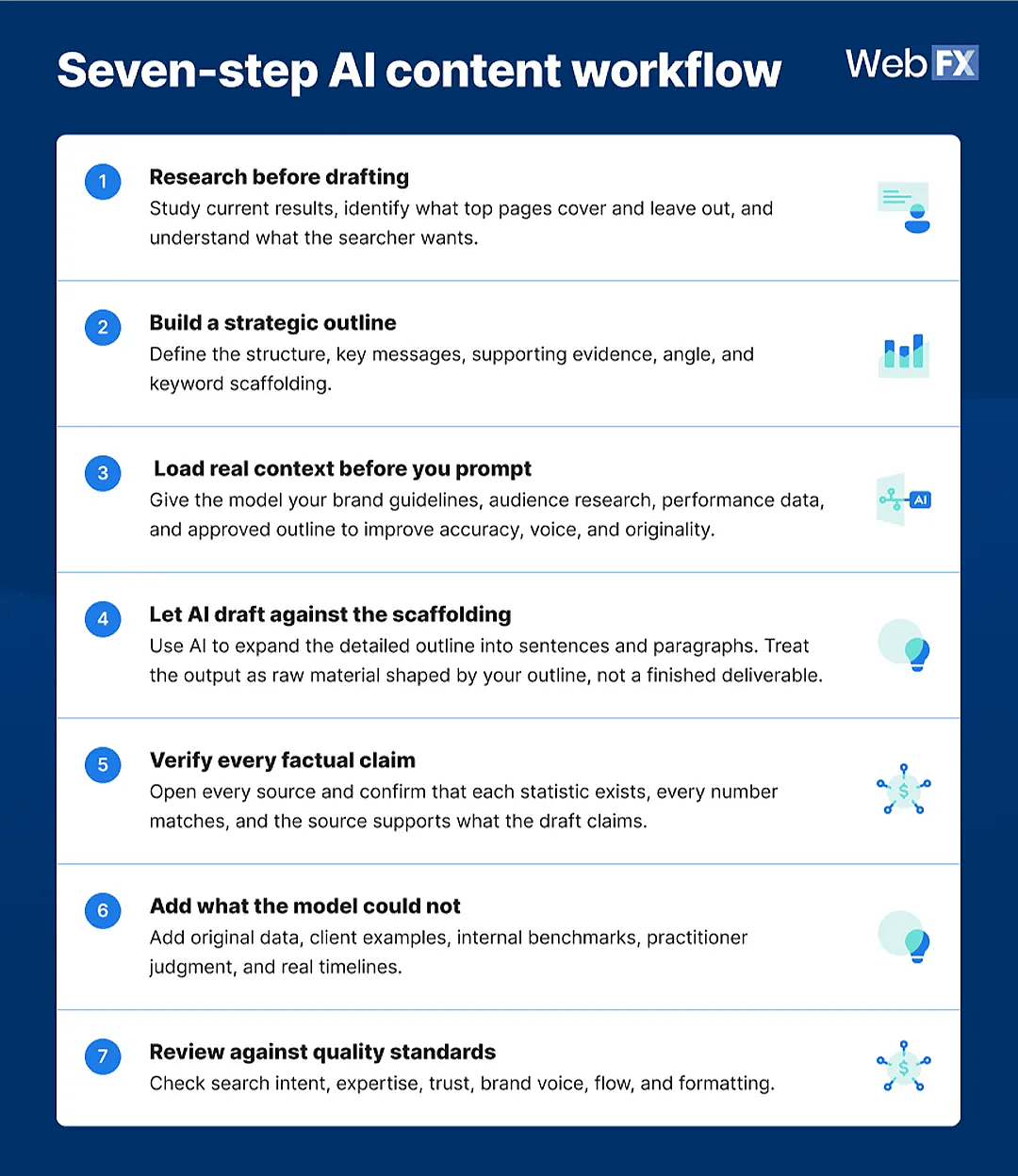
1. Research before drafting
Study the current results for your target keyword before drafting begins. Identify what the top pages cover, how they structure the answer, what they leave out, and what the searcher actually wants.
This step determines everything downstream. An outline built without it produces a draft aimed at nothing in particular.
2. Build a strategic outline
The outline is where strategy gets decided: Structure, key messages, supporting evidence, the angle, and the keyword scaffolding. A person owns those decisions and approves the result, and AI can help develop or refine the structure once the direction is set.
An outline built on real research produces a usable draft. An outline the model invents from the keyword alone produces the same shape as every other page on the topic.
3. Load real context before you prompt
Give the model your brand guidelines, audience research, performance data, and the outline before asking for a draft. The difference between a model working from that and a model working from a one-line prompt shows up in accuracy, in voice, and in whether the piece contributes anything new.
Context engineering is the part of this work that separates useful output from generic output, and it is the part most teams skip.
4. Let AI draft against the scaffolding
Generation is where AI earns its place. Expanding a detailed outline into sentences and paragraphs is faster with a model than without one.
Treat the output as a draft rather than a deliverable. It is raw material shaped by your outline rather than a finished page.
5. Verify every factual claim
Open every source. Check that the statistic exists, that the number matches, and that the source says what the draft claims it says.
This step is not optional and it does not compress. It is the single highest-value use of human time in the entire workflow.
6. Add what the model could not
Original data, a client example, an internal benchmark, a practitioner’s judgment, a real timeline. This is the information gain that determines whether the page contributes or restates.
If nothing in the draft could only have come from you, the piece has no competitive argument.
7. Review against quality standards
Read the finished page against the criteria Google’s search quality raters apply: Does it fully satisfy the search intent, does it demonstrate real expertise, would a reader trust it. Then check brand voice, flow, and formatting.
Grading content against those standards before it publishes catches the problems that otherwise surface as a ranking drop.
What AI does well and what it does not
The workflow above assumes a clear split between what AI handles and what a person handles. Here is where that line falls, task by task:
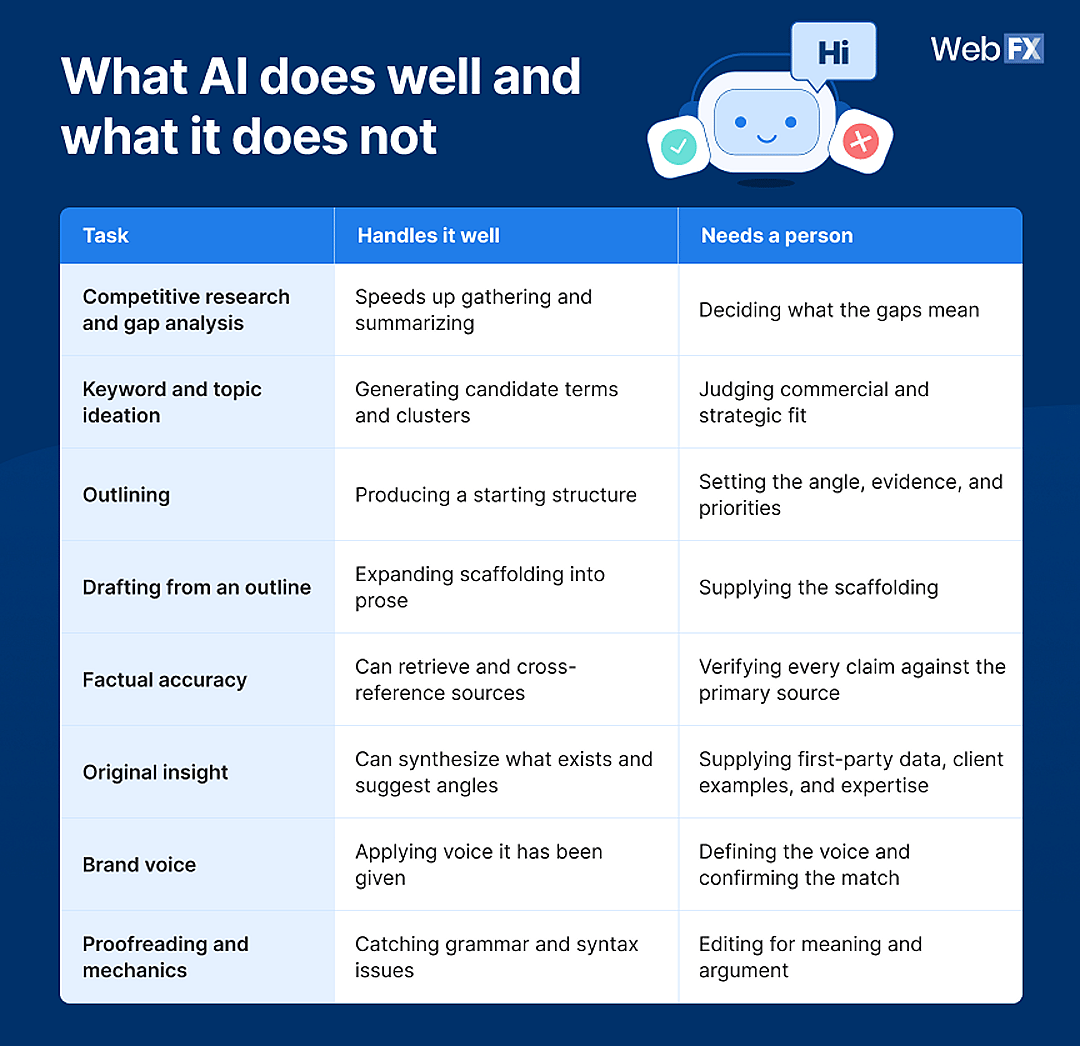
The pattern is consistent. AI accelerates execution, while judgment, verification, and original contribution stay with people. That division is why AI-assisted copy can be strong copy, and why unreviewed AI output usually is not.
This story was produced by WebFX and reviewed and distributed by Stacker.


(0) comments
Welcome to the discussion.
Log In
Keep it Clean. Please avoid obscene, vulgar, lewd, racist or sexually-oriented language.
PLEASE TURN OFF YOUR CAPS LOCK.
Don't Threaten. Threats of harming another person will not be tolerated.
Be Truthful. Don't knowingly lie about anyone or anything.
Be Nice. No racism, sexism or any sort of -ism that is degrading to another person.
Be Proactive. Use the 'Report' link on each comment to let us know of abusive posts.
Share with Us. We'd love to hear eyewitness accounts, the history behind an article.