


The U.S. Army set off waves of anxiety in Iowa when it confirmed plans to carry out two controlled explosions at an ammunition facility there with just a few days’ notice. According to the Army, dozens of old barrels containing lead azide, an explosive used as a detonator, have become unstable and pose an “unacceptable risk of accidental detonation.” Intentionally detonating the barrels is considered the best option for controlling the risk, the Army determined.
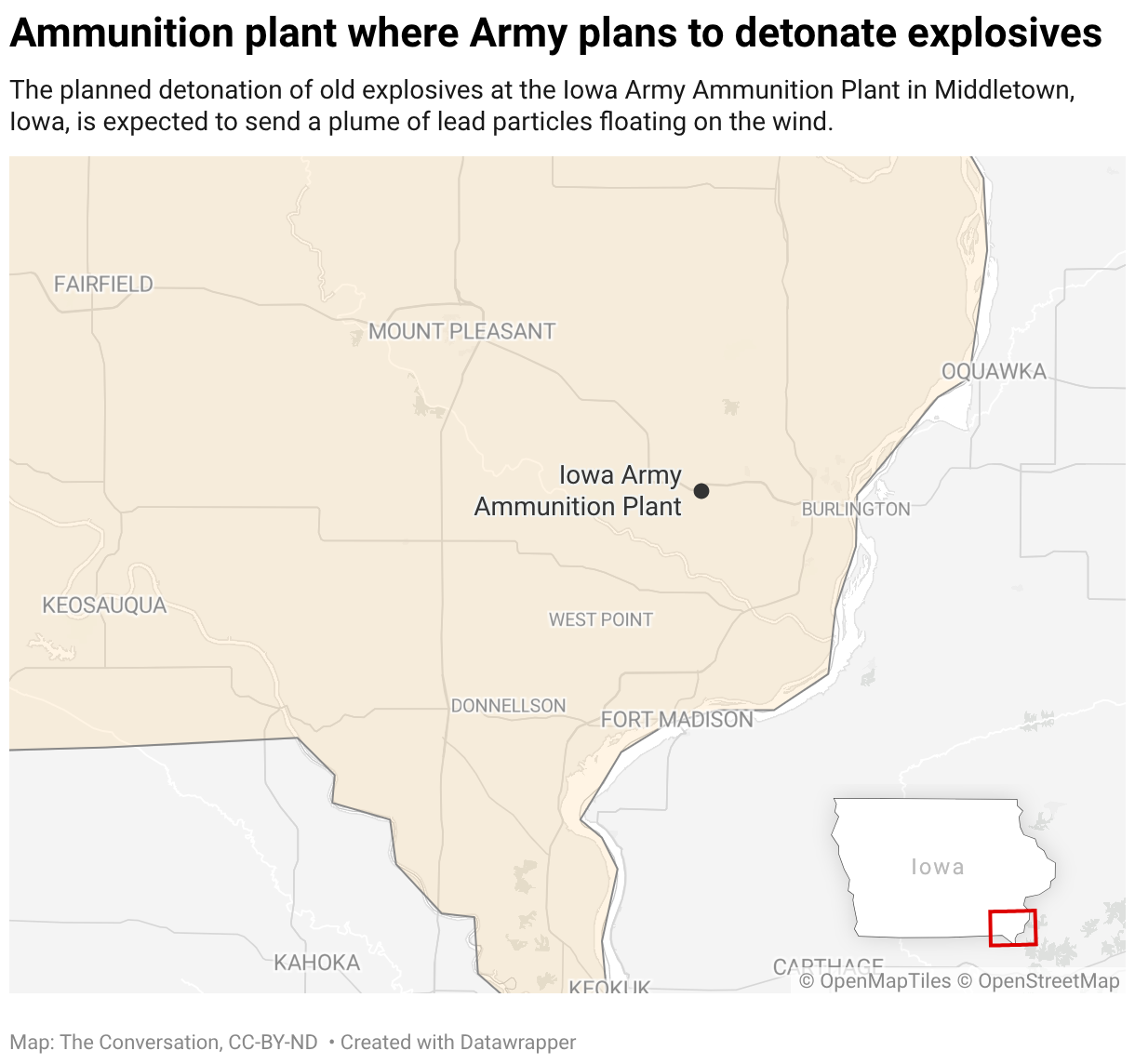
However, the explosions are expected to release a large plume of lead particles, and lead is a neurotoxin. The Iowa Army Ammunition Plant is in Middletown, a town of about 360 residents in southeast Iowa. People and farms would be in the path of the plume as the wind blows it for miles.
The detonations were briefly delayed by the backlash and rescheduled for Nov. 23, 2026. And a federal appeals court separately paused the Army’s emergency Environmental Protection Agency permit for the detonations after two groups sued. It wasn’t immediately clear if the plan would be delayed again. The Justice Department argues that the permit isn’t necessary in the face of an immediate threat.
With all the concern, we asked Patrick O'Shaughnessy, a professor of occupational and environmental health at the University of Iowa, about the risks people in the region would face. O'Shaughnessy is part of a team scrambling to have testing in place when the Army carries out its detonation plan.
What risks do the Army’s planned explosions pose for people?
If you picture a dust plume, it carries particulate matter that can get into the lungs as you breathe. In this case, we’re talking about small particles that contain lead, which is toxic to humans and pets.
Those particles will settle over the area downwind of the detonation site. First it’s air pollution – if you’re outside, you can inhale those particles. Then it becomes surface pollution. The lead dust can get on your hands and into your body. The big concern there is for young children. If you think about 2-year-olds, they put everything in their mouths.
Lead is easily absorbed by the body. It gets into the bloodstream, and it can cause harm to just about every major organ in our bodies, including the nervous system and the brain. It tends to hide out in bones and teeth, where it can leach out and cause harm.
Studies have shown lead exposure is a major concern for pregnant women with developing fetuses. In young children, lead exposure can slow their brain development. Long-standing results from studies have demonstrated a reduction in IQ in children with chronic lead exposure, such as from lead-based paint in old houses.
The Centers for Disease Control and Prevention says there is no safe level of lead in the body. That’s a pretty strong statement.
What’s known about where the plume is likely to travel?
Where this plume travels and how far depends primarily on the wind speed and direction in the hours after the explosions.
We have a sense of what happens from studying pollution from smokestacks. Smokestacks are tall for a reason – they eject the pollutants high into the atmosphere so the pollutants dilute as they drift downwind.
In this case, instead of a steady stream coming out of the smokestack, it’s going to be a big puff that will literally create a cloud. That cloud will rise and start dissipating as it is diluted in the air. It will become invisible at some point, but that doesn’t mean the lead isn’t there.
If the Army had blown up those storage containers on Nov. 20, as initially planned, the forecast was for a fairly strong 15-mile-per-hour surface wind. The plume would have mostly diluted by the time it reached I-80, which is where I’m sitting, about 80 miles to the north.
If the Army goes through with its rescheduled plan on Nov. 23, the preliminary forecast is for much slower wind blowing toward the south-southeast. Slower wind means the plume would affect a smaller area, but people there would experience a higher concentration of lead as it slowly floats by.


That may mean fewer people are affected, but the exposure could be more intense. We won’t know exactly what people will experience until it happens.
What can people do to stay safe in those areas?
Honestly, I would find a way to get out of the area for the day. If you can’t leave, the Army has a list of precautions that people should take, and I think those are good recommendations.
The Army is advising people near the plant to vacate their homes during the detonation and others to shelter in place. That means staying indoors and closing all your doors and windows. If you can, shut off the furnace – it pulls in air that could be contaminated as the plume travels through an area.
Within a few hours, the plume will have dissipated or moved on. But that doesn’t mean the lead disappears. It falls to the ground, meaning you and your pets can still get it on you.
After the plumed dissipates, the Army suggests getting a hose and spraying down window sills, cars, any horizontal surfaces where the dust can accumulate. Car door handles can easily collect and transfer the lead to people. If you have children’s play areas or toys outside, wash those down.
Lead is a persistent compound – there’s no way to degrade it. Washing it off surfaces transfers the lead to the soil. At this point in the year, the majority of the crops have been harvested, so there’s less risk of lead settling on plants in farm fields. However, some dairy farmers are concerned about their cows getting into lead that settles on grass.
Our results from sampling during and after the plume should help people better understand the risks.
What is your team planning for testing?
My colleagues and I will be looking at two aspects of potential exposure to lead: the airborne dust, which we’ll collect with instruments during the plume to get the lead concentration, and then dust that settles on surfaces and the ground, which we’ll collect with gauzelike pads and send to a lab for analysis.
The lab will be able to tell how much lead is in those samples, and the air samples will let us calculate how much people were exposed to the lead.
This is all happening last minute – we only found out about the plan a few days before the Army initially planned to detonate the barrels. Thankfully, the university and our federal- and state-funded centers have the people and technology to quickly carry out testing. We hope to have results about a week after it happens. The U.S. Environmental Protection Agency also has a team that will be doing sampling.
This article is republished from The Conversation, a nonprofit, independent news organization bringing you facts and trustworthy analysis to help you make sense of our complex world. It was written by: Patrick O'Shaughnessy, University of Iowa
Read more:
- Why lead is dangerous, and the damage it does
- Which state you live in matters for how well environmental laws protect your health
- A century of tragedy: How the car and gas industry knew about the health risks of leaded fuel but sold it for 100 years anyway
Patrick O'Shaughnessy receives funding from the National Institute of Environmental Health Sciences


(0) comments
Welcome to the discussion.
Log In
Keep it Clean. Please avoid obscene, vulgar, lewd, racist or sexually-oriented language.
PLEASE TURN OFF YOUR CAPS LOCK.
Don't Threaten. Threats of harming another person will not be tolerated.
Be Truthful. Don't knowingly lie about anyone or anything.
Be Nice. No racism, sexism or any sort of -ism that is degrading to another person.
Be Proactive. Use the 'Report' link on each comment to let us know of abusive posts.
Share with Us. We'd love to hear eyewitness accounts, the history behind an article.