




60+ AI prompt examples for marketers
AI tools like ChatGPT, Claude, and Gemini are only as good as the prompts you give them. Vague prompts produce generic outputs. Specific, well-structured prompts produce results you can actually use.
The difference between a mediocre AI response and a great one often comes down to how you ask. This list includes 60+ AI prompt examples for marketers, organized by use case.
Each prompt includes variables you can customize for your brand, audience, and goals.
In this article, WebFX will cover:
Research AI prompts
One way you can use AI tools is to help you conduct surface-level research on a topic. Here are some examples of prompts you might use to research different subjects:
- “In less than 100 words, explain what the information technology industry does.”
- “List five examples of products that metal fabricators make.”
- “What are the benefits of using influencer marketing?”
- “Give me a list of five effective digital marketing strategies businesses should use.”
- “How do enterprise resource platforms work? Explain in 200 words or fewer.”
- “Summarize the top 5 trends in [industry] for [year] based on recent reports and news. Include sources where possible.”
- “What are the most common objections [target audience] has about [product/service]? List 5-7 objections with suggested responses.”
Writing and content AI prompts
Using ChatGPT to write a full article is discouraged. However, ChatGPT can be useful for generating simple article outlines, which you can then use to write the pages yourself.
Here are some ChatGPT prompts you might use for content outline generation:
- “Generate an outline for a blog post called ‘Best Pest Control Tips.’ Include an introduction, 10 tips, and a conclusion.”
- “In less than 200 words, create an outline for an article that explains the benefits of hiring a financial consulting company.”
- “Write an outline for a 3-minute video about how to build a birdhouse.”
- “Generate an outline for a page that explains [your company]’s services.”
- “Write an outline for an article called ‘What Does Finance Software Do?’”
- “Write a compelling introduction for a blog post titled ‘[title]’ targeting [audience]. Hook the reader in the first sentence and preview what they’ll learn.”
- “Generate 10 headline variations for an article about [topic]. Include a mix of how-to, listicle, and question formats.”
- “Create a content brief for an article on [topic] targeting [keyword]. Include: target audience, search intent, key points to cover, and suggested word count.”
Social media AI prompts
It’s not just blog posts and articles that AI can help you write content for — it can handle social media as well. Of course, it’s important to note that you shouldn’t just copy and paste whatever ChatGPT gives you. Rather, the responses to these prompts can give you a starting point for your posts:
- “In less than 50 words, write a short Instagram post that advertises the new blender from [your company].”
- “Create a Twitter post that promotes a special 50% off sale on [your company]’s shirts for the month of August.”
- “Write a Facebook post that promotes a new vacuum cleaner product. Use a casual but professional tone.”
- “Write a LinkedIn post celebrating how [your company] helped generate [amount of money] for their clients in the past year. Use a formal tone and limit the post to 100 words or fewer.”
- “Write a fun social media post that encourages people to buy [your company]’s line of Christmas sweaters this December.”
- “Write a carousel post outline for Instagram about [topic]. Include a hook for slide 1 and key points for slides 2-5.”
- “Create a TikTok script under 60 seconds that explains [concept] to [audience]. Use a hook, value section, and clear CTA.”
- “Draft 5 variations of a social media hook for a post about [topic]. Test different emotional angles: curiosity, urgency, FOMO, and aspiration.”
- “Write a LinkedIn post announcing a [product launch or company update]. Keep it professional but personable, under 150 words.”
- “Generate 10 hashtag suggestions for a [platform] post about [topic] targeting [audience].”
Email marketing AI prompts
Next, we have some prompts for marketing emails. Just like with social media, you don’t want to copy and paste the responses you get for these, but they can give you a basic template to work with.
- “Write an email subject line that promotes a 25% discount on shoes at [your company].”
- “Draft an email between 50 and 100 words that advertises [your company]’s manufacturing services.”
- “Write an email that encourages parents to shop at [your company] for their kids’ school supplies this August. Do it in less than 100 words.”
- “Generate an outline for an email newsletter for [your company]. Make it between 300 and 400 words long.”
- “In less than 100 words, create an email that promotes a new line of phone cases in a fun and casual voice.”
- “Write a 3-email welcome sequence for new subscribers to [brand]. Email 1: introduction. Email 2: value/tips. Email 3: soft CTA.”
- “Create 5 subject line variations for an email promoting [offer]. Test urgency, curiosity, and benefit-driven approaches.”
- “Draft a re-engagement email for subscribers who haven’t opened emails in 90 days. Keep it short, friendly, and include an incentive.”
SEO AI prompts
Generative AI tools like ChatGPT can assist with SEO campaigns. These prompts encompass a range of techniques designed to improve rankings in organic and AI search results:
- “Tell me 5-6 related keywords for [insert target keyword] based on page one of the search results.”
- “Analyze this blog post and tell me what changes I should make to help me rank better for [target keyword].”
- “Using [insert link for article or blog post], give me five topics that page one of the search results are talking about for [insert keyword] that I’m not.”
- “Tell me potential content gaps for the following keyword, based on the top-ranking pages in the search results: [insert keyword].”
- “Give me 4-5 visual improvements I can add to this page to improve user experience and readability: [insert URL].”
- “Generate a list of 10 long-tail keyword variations for [primary keyword] that indicate purchase intent.”
- “Write a meta description for a page about [topic] targeting [keyword]. Keep it under 155 characters and include a clear value proposition.”
- “Analyze this page [URL] and suggest 5 internal linking opportunities to other relevant pages on the site.”
Content repurposing AI prompts
These AI prompt examples are designed to transform existing content into different formats, such as turning blog posts into social media snippets or videos.
- “Condense this blog post to a 100-word social media post with a link to the original content.”
- “Pull five key points from this article and put them in an infographic.”
- “Take the title of this video and turn it into a graphic for an Instagram post.”
- “Take the table of contents from this article and turn it into a two-minute video script.”
- “Gather the top 10 takeaways from this filmed presentation on [topic in your industry] and build a blog post outline with them.”
- “Turn this case study [paste content] into a LinkedIn post highlighting the key results and takeaways for [audience].”
- “Extract 5 tweetable quotes from this article [paste content] that would resonate with [target audience].”
- “Repurpose this webinar transcript [paste content] into a blog post outline with key sections and takeaways.”
Data analysis AI prompts
AI analytics can help you save time on managing your data while finding actionable ways to improve your marketing. For these prompts, you’ll have to upload your data to ChatGPT as a table, spreadsheet, or other format, so it can read and process it fully.
If you want to use ChatGPT to help you analyze data, here are a few prompts for doing so:
- “Show me the top trends from this table in a visual format.”
- “Generate a bar graph for the [insert name] column.”
- “In 100 words, identify the top four financial trends from this year’s sales.”
- “List the top 10 key points from this dataset so I can write a blog post explaining them.”
- “Generate a scatter plot to show the relationship between [column 1] and [column 2].”
- “Analyze this campaign performance data [paste or upload] and identify the top 3 areas for improvement with specific recommendations.”
- “Compare these two datasets [paste or upload] and summarize the key differences in a format I can share with stakeholders.”
Lead generation AI prompts
Lead generation at scale can get repetitive. These prompts help you personalize outreach, craft discovery questions, and analyze what’s working:


- “Write a cold outreach email for [product/service] targeting [job title] at [company type]. Personalize the first line and include a clear, low-friction CTA.”
- “Suggest 5-7 discovery questions to ask a potential client in [industry] who is struggling with [pain point].”
- “Analyze our last 10 sales calls [paste notes or transcripts] and identify the top 3 objections. Suggest responses for each.”
- “Write a LinkedIn connection request message for [target persona] that references their recent [post/article/achievement] and opens a conversation about [topic].”
- “Create a follow-up email sequence (3 emails) for leads who downloaded [resource] but haven’t booked a call. Space them 3, 7, and 14 days apart.”
Video and podcast AI prompts
Video and podcast content have many moving pieces. These AI prompt examples help you plan episodes, write scripts, and repurpose content across formats:
- “Generate 5 podcast episode ideas for [brand/topic] targeting [audience]. Include a title and 3-bullet outline for each.”
- “Write a YouTube video script for a [duration] video about [topic]. Include a hook, main content sections, and a clear CTA.”
- “Create a short-form video script under 60 seconds explaining [concept] to [audience]. Use a hook-value-CTA structure.”
- “Turn this blog post [paste content] into a video script for YouTube. Add visual cues and on-screen text suggestions.”
- “Write show notes for a podcast episode about [topic] featuring [guest]. Include key timestamps, resources mentioned, and a summary.”
6 tips for creating marketing AI prompts
There is a prompt for anything and everything you could need ChatGPT’s help with, even if you have to create it yourself. Finding the right prompt and practicing prompt engineering can help you get more out of your AI companion.
Let’s go over a few tips for writing effective marketing AI prompts:
1. Give ChatGPT a general word count
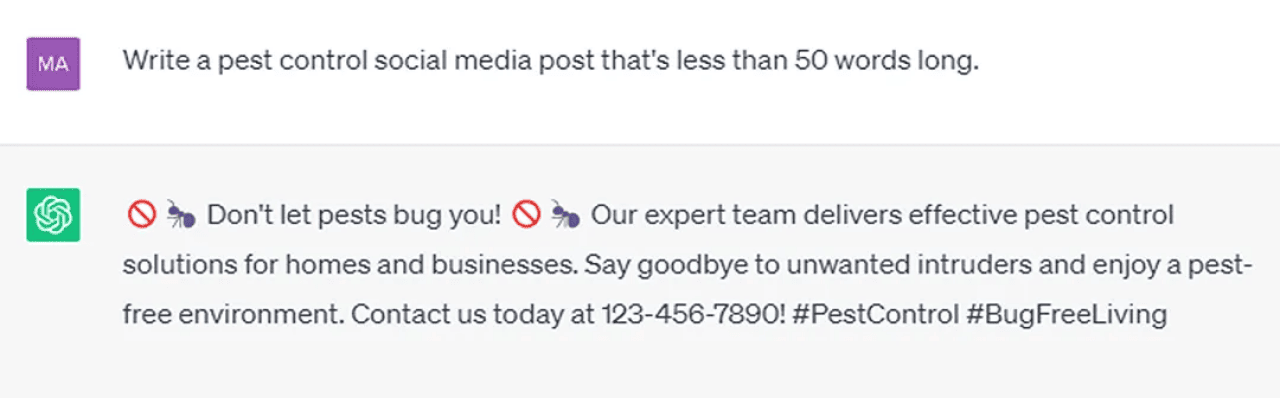
Firstly, it’s a good idea to always include a general word count when you give ChatGPT a prompt. That helps ensure that the result is the length you want. In certain cases, ChatGPT can tend to generate results that are much longer (or, occasionally, much shorter) than what you’re looking for, and this helps you avoid that.
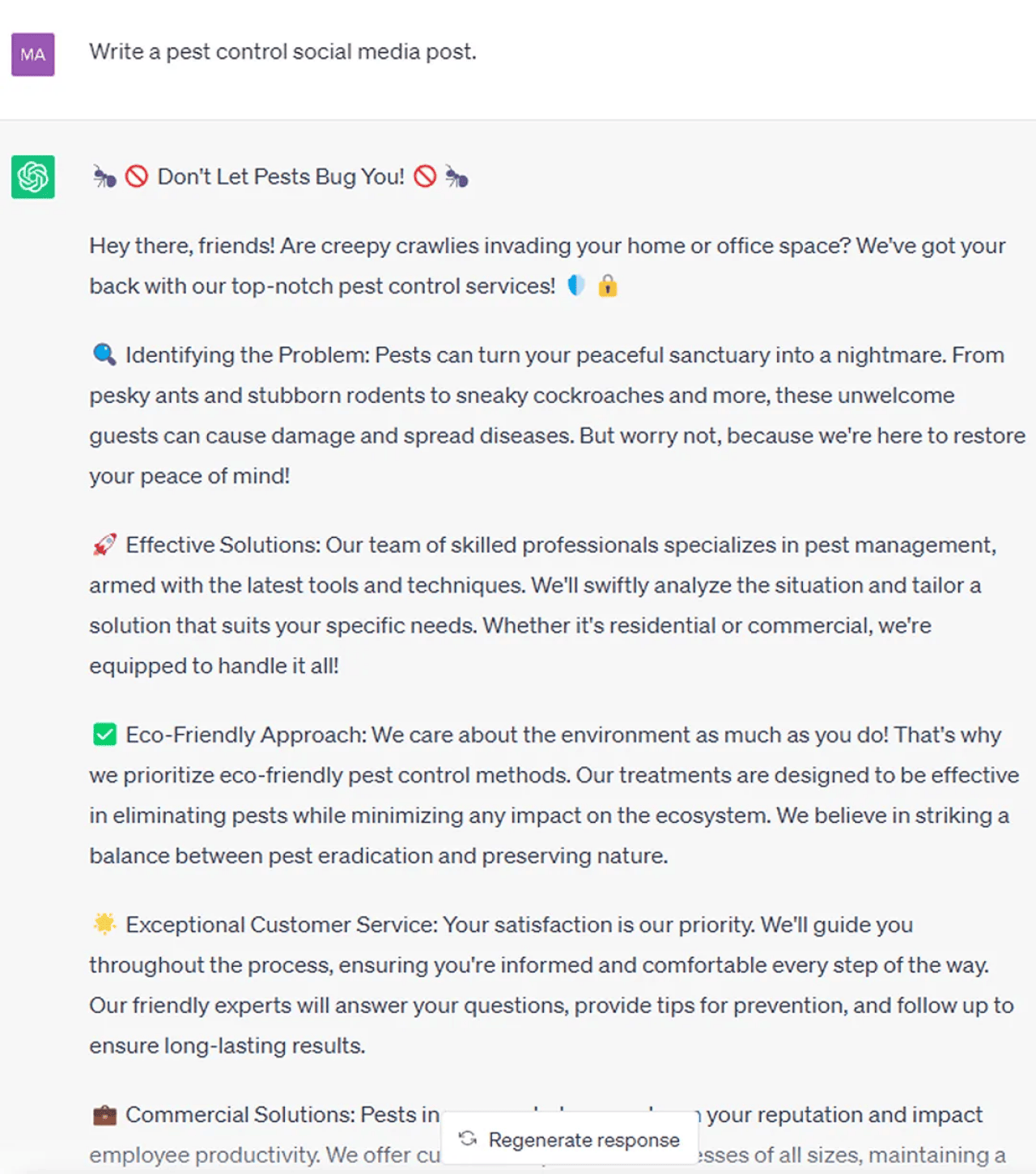
One way to do this is to start the prompt with a phrase like, “In less than 500 words…” or “Using between 100 and 200 words…” Of course, even then, ChatGPT will sometimes still outright ignore the word count you provide, and you’ll have to follow up your original prompt by asking ChatGPT to shorten its response.
2. Keep marketing AI prompts as concise as possible
Another way to improve your prompts is to keep them as simple and concise as you can. ChatGPT can handle big words, but complex syntax can still confuse it. When possible, it’s advisable to phrase things as straightforwardly as possible, using as few clauses as you can.
So, don’t say this:
- “I want you to generate a piece of email copy that compels users to buy our new line of shirts, but I want you to do it in a way that sounds sort of fun and casual, and I want you to do it using less than 100 words in total.”
Instead, say this:
- “In less than 100 words, generate a marketing email that encourages users to buy a new line of shirts. Use a fun and casual tone.”
3. Don’t ask ChatGPT to generate new or creative ideas
Finally, don’t give ChatGPT any prompts where you ask it to be creative or come up with a new idea. Why? Because it can’t do it.
ChatGPT works by pulling from what people have written online. While it won’t copy anything word-for-word, it will still copy ideas.
If you ask ChatGPT to come up with an original idea, one of two things will happen. Either it will produce something that doesn’t make any sense, or it will present an idea that it stole from an actual person somewhere online. In either case, you don’t want to rely on ChatGPT to be creative for you. That’s what human brains are for.
4. Be specific with your prompt
To make sure you get exactly what you want from ChatGPT, you have to be as specific as possible — possibly overly specific. Here’s how to do that:
- Clearly state what you want the AI to do. Should it write you a list, explain it in a paragraph, or go into lengthy detail? And what information should it consider?
- Use clear language. Avoid ambiguity and jargon. Keep it really simple to avoid confusion or poor results.
- Tell the AI what type of output you want. You can ask for a paragraph, a list, a table, or even a graphic. As AI becomes more advanced, the capabilities for results increase.
5. Provide context
Give ChatGPT all the background information to understand the task. If you have data, links, or even keywords that could help with the results, provide them. Many of the prompts above show how to do so in practice.
6. Experiment with your prompts
Finally, take on the role of a prompt engineer and experiment with the results. Try different prompts to see what works most effectively."
If you don’t get exactly what you want on the first try, tweak your initial prompt and resubmit or add more information through different chats. The more you practice and experiment, the better your results will be!
This story was produced by WebFX and reviewed and distributed by Stacker.





(0) comments
Welcome to the discussion.
Log In
Keep it Clean. Please avoid obscene, vulgar, lewd, racist or sexually-oriented language.
PLEASE TURN OFF YOUR CAPS LOCK.
Don't Threaten. Threats of harming another person will not be tolerated.
Be Truthful. Don't knowingly lie about anyone or anything.
Be Nice. No racism, sexism or any sort of -ism that is degrading to another person.
Be Proactive. Use the 'Report' link on each comment to let us know of abusive posts.
Share with Us. We'd love to hear eyewitness accounts, the history behind an article.