


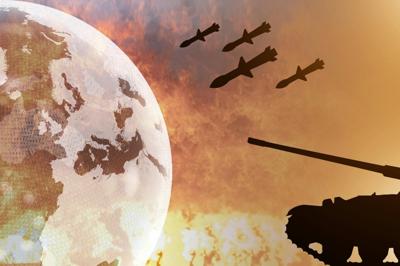
(BLOOMINGTON, INDIANA) U.S. Air Force Secretary Troy Meink recently confirmed that the United States has weapons deployed in Earth’s orbit. To date, the U.S. Space Force, the space service branch of the U.S. armed forces, has provided relatively few details about what these weapons are or what they can do except that they are what Meink called “on-orbit space control weapons.”
Meink’s announcement is significant, but not necessarily because the U.S. is the first country to place weapons in orbit. For years, the U.S., Russia and China have accused each other of developing and testing such capabilities, although none has publicly acknowledged deploying space weapons – until now.
We are scholars of space law and governance, and our research illustrates the challenges of uniting diverse groups to establish norms related to the use of resources, safety zones and conflict prevention in new domains such as space. Without better communication and deeper coordination between the world’s space powers, we could witness the beginning of a space arms race.
Failed attempts to prevent a space arms race
In 1981, the United Nations added the Prevention of an Arms Race in Outer Space, known as PAROS, to its agenda.
More than four decades of diplomatic efforts under PAROS have produced meager results, though there was a United Nations agreement in 2024 that made progress on reducing threats.
Despite many countries’ proclamations supporting space arms control, no multilateral treaty banning weapons in space has been adopted. With global arms control generally in retreat, and the apparent lack of political will among the three major space powers, efforts to control space weapons have reached an impasse.
The question increasingly is not whether an arms race in space can be prevented, but how it will be managed.
Ambiguities allow weaponization
The Outer Space Treaty of 1967, to which all major space powers are parties, is often described by scholars, practitioners and policymakers as the constitution of outer space.
Article IV of the treaty remains the only legally binding international provision specifically regulating weapons in outer space. The article prohibits countries from placing nuclear weapons or other weapons of mass destruction in orbit around Earth. It also imposes a broader prohibition on military activities on the Moon and other celestial bodies, including establishing military bases, testing weapons and conducting military maneuvers.
However, the article does not prohibit conventional weapons in Earth’s orbit. That omission is significant. The treaty can be understood as implicitly permitting what it does not prohibit: the placement of such weapons in orbit.
China has used these ambiguities as cover for its own space weaponization efforts. In a 2007 test, China destroyed one of its own satellites while in orbit, and it has recently deployed a mysterious space plane.
China, nonetheless, reacted critically to the recent U.S. weapons announcement. In September 2026, it urged Washington to stop expanding its military presence in space. That same month, Russia renewed calls for the demilitarization of outer space.
Both countries have long advocated stronger international restrictions on space weapons. Russia and China twice jointly proposed a treaty prohibiting the placement of weapons in outer space. The U.S. opposed the proposals in 2014, pointing to their failure to also cover important ground-based, anti-satellite weapons.
But Russian and Chinese declarations in favor of keeping weapons out of space sit uneasily alongside their own activities.

In 2020, U.S. Space Command, part of the Defense Department, accused Russia of testing a space-based anti-satellite weapon after an orbiting Russian satellite released a projectile. Russia said the spacecraft was performing an inspection mission.
In 2024, the United States said Russia had launched another satellite, Cosmos 2576, which it assessed to be a “counter space” weapon capable of attacking other satellites.
China has similarly demonstrated increasingly sophisticated operations in orbit. Five Chinese spacecraft conducted satellite flybys in 2024, an exercise that a senior U.S. Space Force officer later described as practicing “dogfighting in space.”
None of this proves that every suspicious Russian or Chinese spacecraft is a weapon. Many technologies used for servicing, inspection and maneuvering around satellites are inherently dual-use. But it does put Moscow’s and Beijing’s calls to keep weapons out of space in perspective.
It also illustrates the security threat now taking shape. Washington can point to Russian and Chinese activities to justify its own weapons. Moscow and Beijing can now point to acknowledged U.S. weapons to help justify their actions, which could result in a self-fulfilling prophecy.


War in space
Space has been part of warfare for decades. The 1991 Gulf War has sometimes been called the first “space war” because of the unprecedented role satellites played in navigation, communications, intelligence and targeting. But satellites primarily supported military operations taking place on the ground.
That distinction has gradually eroded. NATO formally recognized space as a military theater in 2019.
Russia’s 2022 invasion of Ukraine then demonstrated something different, in which the very definition of a weapon was challenged.
Hours before Russian troops crossed the border, a cyberattack disrupted the U.S. satellite network Viasat, in what was dubbed by commentators as the first “space-cyber war.” Space-based services were no longer merely supporting military operations but were themselves deliberately targeted as part of a military campaign.
The acknowledgment of weapons in orbit represents another step in that evolution. Space assets are transitioning from systems that primarily support warfare in other domains to systems that can be weapons, targets and participants in combat and are often replete with vulnerabilities that could be exploited by an adversary.
That does not mean future space warfare will resemble Star Wars dogfights or Starfleet armadas taking on Borg cubes. But the emerging battlefield is likely to be much more complicated. Satellites can be disrupted through jamming and spoofing, disabled through cyberattacks, approached or manipulated by other spacecraft, attacked from Earth or potentially attacked by weapons already in orbit.
This makes the connection between space and cyberspace particularly important. A country seeking to neutralize an adversary’s satellites may have several options, ranging from a cyberattack or electronic interference to physically damaging it. At the same time, space-based critical infrastructure has never been more vital to the functioning of the global economy.
Military strategy therefore has to adapt not merely to warfare in space but to warfare across an increasingly interconnected space-cyber nexus.
An arms race that must now be managed
The important question is no longer whether space will become militarized. It has been militarized for decades. Nor is it even whether states will develop weapons capable of affecting objects in space. Several already have done so.
The new question is how nations manage a strategic environment in which weapons are openly deployed in orbit, satellites are increasingly being targeted, and attacks can move between the space and cyber domains.
Public acknowledgment may itself have strategic consequences.
The U.S. Space Force argues that revealing the existence of its orbital weapons can strengthen deterrence by making adversaries aware that it possesses capabilities with which to respond. But transparency can also accelerate competition.
Russia and China can now point to U.S. weapons to justify deploying their own. The same logic and its consequences animated debates during the Cold War.
Forty-five years after the United Nations began debating the prevention of an arms race in outer space, that arms race increasingly looks less like something to prevent than something governments must learn to manage.
This article is republished from The Conversation, a nonprofit, independent news organization bringing you facts and trustworthy analysis to help you make sense of our complex world. It was written by: Scott Shackelford, Indiana University and Eytan Tepper, Indiana University
Read more:
- Trump is proposing a US Space Academy – if created, it could blur the lines between NASA and the military
- Trump wants an AI Force like Space Force, but that could make AI’s risks harder to manage
- NASA’s Artemis II crewed mission to the Moon shows how US space strategy has changed since Apollo – and contrasts with China’s closed program
Scott Shackelford receives funding from the U.S. Air Force Office of Scientific Research to study the nexus of space-cyber power, which will culminate in the publication of an edited volume on this topic. Indiana University is also a member of the Space ISAC.
Eytan Tepper receives funding from the U.S. Air Force Office of Scientific Research to study and lay the foundations for a theory of space-cyber power. Indiana University is also a member of the Space ISAC.


(0) comments
Welcome to the discussion.
Log In
Keep it Clean. Please avoid obscene, vulgar, lewd, racist or sexually-oriented language.
PLEASE TURN OFF YOUR CAPS LOCK.
Don't Threaten. Threats of harming another person will not be tolerated.
Be Truthful. Don't knowingly lie about anyone or anything.
Be Nice. No racism, sexism or any sort of -ism that is degrading to another person.
Be Proactive. Use the 'Report' link on each comment to let us know of abusive posts.
Share with Us. We'd love to hear eyewitness accounts, the history behind an article.