


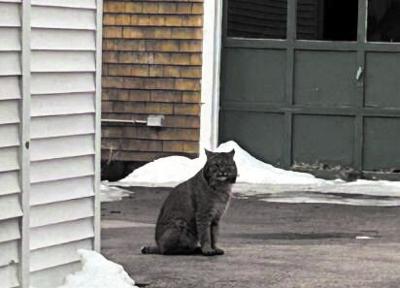
PORTSMOUTH — A bobcat came “eye to eye” with a resident in a city neighborhood near downtown recently, as the wildcat population in New Hampshire continues to grow.
Beth LaMontagne said she spotted it in her neighbors' yard after hearing growling just after 6 a.m. in the Bartlett and Morning street area. LaMontagne walked outside and stood roughly 15 feet away from the animal. The bobcat looked her way and LaMontage safely scurried into her home after quietly snapping some pictures.
"We looked at each other eye to eye for a bit," LaMontagne said. "It seemed healthy, well-fed and calm. I guess that if we were standing next to each other, its ears would have come up to about my hip. I was shocked at how well it blended in with the brush and stonewall in their yard. Then sense kicked in and I thought, 'Maybe I should move so it can't see me.'"
Back inside her home, LaMontagne watched the bobcat clean itself before leaving her neighbors' deck and walking away.
How bobcats became 'abundant' in New Hampshire
Patrick Tate, a wildlife biologist with New Hampshire Fish and Game, receives a handful of tips about bobcats each week from across the state, including one about the Portsmouth sighting.
In 1989, Fish and Game ended bobcat hunting and trapping out of concern for the species’ population in the state. The number of bobcats in New Hampshire has since rebounded, and each year increases 10% to 15%, according to Tate.
“They’re not threatened or endangered,” Tate said Monday. “They’re actually an abundant species in the state.”
More Portsmouth news: Condo prices at The Maris in North End to be $3 million-plus for 3 bedrooms
Tate believes the bobcat spotted in Portsmouth is male, which have home ranges of roughly 30 square miles. The average female ranges 25 square miles, he said.


“Males will overlap other male home ranges roughly 25%,” he said. “Therefore, the photographed bobcat is a resident of the area though (its) home range likely covers portions of multiple towns.”
New Hampshire Fish and Game has been tracking the state’s bobcat population since 2014, though the number of bobcats in New Hampshire was increasing long before that. The state agency’s most recent population estimate of 2,200 bobcats was taken in 2011, meaning the number has grown exponentially since that point.
Bobcats can 'develop comfort' in residential areas: What are dangers?
In residential settings, bobcats tend to appear more often near homes with birdfeeders and chicken coops, according to Tate. He advised chicken owners not to allow them to free range and removing birdfeeders if a bobcat is known to visit the neighborhood.
“The bobcats are interesting in that they can develop comfort around residential settings and humans easily. They can appear to be very nonchalant and they don’t bother with anything,” Tate said. “The trouble with bobcats is if they become rabid, they can become aggressive and pursue.”
Tate urged wildlife enthusiasts and locals to give bobcats a wide berth but not to assume the creature is rabid.
“Food is generally the attraction for bobcats to go into residential settings and learn to become comfortable with people,” he said.
Bobcats prey on mice, squirrels, woodchucks, moles, shrews, raccoons, foxes, domestic cats, grouse, different bird species, reptiles, porcupines and skunks.
•••
These articles are being shared by partners in the Granite State News Collaborative. For more information, visit collaborativenh.org.


(0) comments
Welcome to the discussion.
Log In
Keep it Clean. Please avoid obscene, vulgar, lewd, racist or sexually-oriented language.
PLEASE TURN OFF YOUR CAPS LOCK.
Don't Threaten. Threats of harming another person will not be tolerated.
Be Truthful. Don't knowingly lie about anyone or anything.
Be Nice. No racism, sexism or any sort of -ism that is degrading to another person.
Be Proactive. Use the 'Report' link on each comment to let us know of abusive posts.
Share with Us. We'd love to hear eyewitness accounts, the history behind an article.