


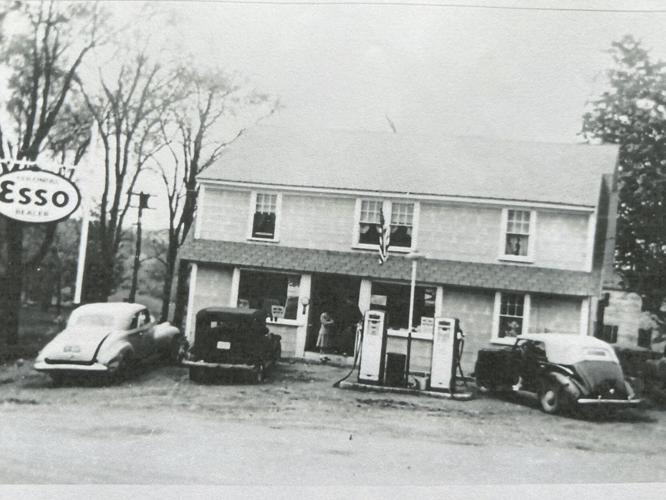


A week after I moved to town in 2015, the Gilmanton Corner Store shut down. A small red building at the intersection of routes 140 and 107, the store building continued to house a pizza place/cafe for a few years after that, but that business always seemed steeped in sadness. It vacated in 2020, and then for almost two years, the store sat empty, bearing a "for sale: sign. It was an emblem of failure in the heart of our town.
But then in October 2023, good news struck: An ambitious couple bought the store, with plans to renovate it and turn the place into a store once again. Amid all the celebrating here in town, one name kept cropping up: Roxey.
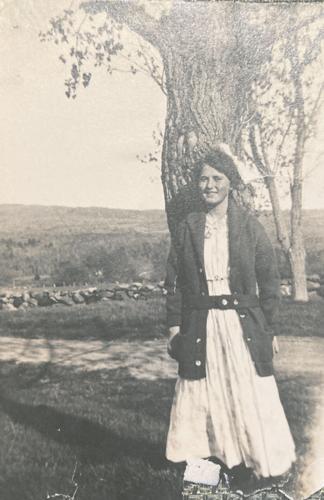
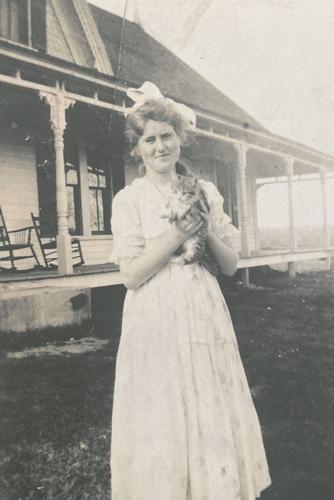
Roxey Stockwell (1900-1989) built the Corner Store with her husband Harmon in the late 1930s and continued on as storekeeper until 1949. I knew her when I was a kid, vaguely. She was a tiny white-haired woman in the 1970s. She was supremely ebullient and she moved about town bathed in the warm light of adoration. No one ever needed, or bothered, to speak her last name. Roxey was a rock star.
During World War II, Roxey was the hub of the community. The store had one of the town’s few telephones, and when news broke — if a baby was born, if a soldier was killed — it was Roxey who got the call and then traveled over dirt roads to meet with the relevant families. Meanwhile, the store was a clubhouse. Kids stored their baseball gloves there. Unemployed men sat outside, hoping to land a few hours’ work baling hay or slopping pigs.
My whole life, I’ve known a little about Roxey. But when Roxey’s name came back into circulation last month, I wondered: Who was this woman, exactly?
I knew that all answers lay with her grandson, J.R. Stockwell, a local carpenter. J.R.’s roots in town go back to the late 1770s. He’s a mainstay on the local cemetery committee. On his workbench, there’s often a broken grave marker he’s midway through repairing. He owns every one of the annual town reports published since 1900, and he is the keeper of all things Roxey.
I arrived at J.R.’s house on a cold, gray morning, and he told me that Roxey grew up in East Branch, New Brunswick. It was a village of 75 people, meaning that Roxey, her parents and her 11 siblings constituted 19% of the population. The Mitchell family lived, J.R. said, “on a dirt road, in a house that was hard to get to. They’d grow and grind to survive. Her dad fished for eel in the St. Nicholas River.”
On the dining room table, J.R. had Roxey’s papers laid out for me, and I soon found Roxey describing her childhood in neat cursive. “My mother walked every day (5 miles) to wash dresses,” she said. Home with her siblings, most of them older, Roxey learned to recite poetry. “As soon as my mother went off to work,” she wrote, “I would climb onto an my stage, a huge fishing net upstairs, and, with my old book in hand, I’d proceed to recite, ‘Into the Valley of Death Rode the 600,’” a poem by Tennyson. “I’d play house with paper dolls cut from catalogs. Could make furniture out of cardboard. Was nothing for me to be around dead people. My folks washed and dressed them for burial.”
Roxey’s parents were Presbyterians. Every evening, Roxey “knelt by the bedside and prayed. Everything about me spoke of God,” she said, “the sunrise, the sunset, the clouds that looked as if they were drawing water from the sun.” Everything was, Roxey believed, “God saying, ‘I will never destroy the Earth again with a flood.’”
When Roxey went to school, there was no paper on hand. The students wrote everything on small personal slates, keeping rags and water by their desks to wipe them clean. “If we wanted to draw,” she wrote, “we had to do it on the slate.”
Life in East Branch was spare, bordering on drudgery. “Many times,” she wrote, “I’d cry because I had to make supper or wash dishes.”
In 1912, when Roxey was 12, her older sister, Janie, took pity on her. Janie was 28 and living in Pittsfield. She brought Roxey south for a visit. “It was just supposed to be a vacation,” she wrote, “but I loved it.” She stayed.
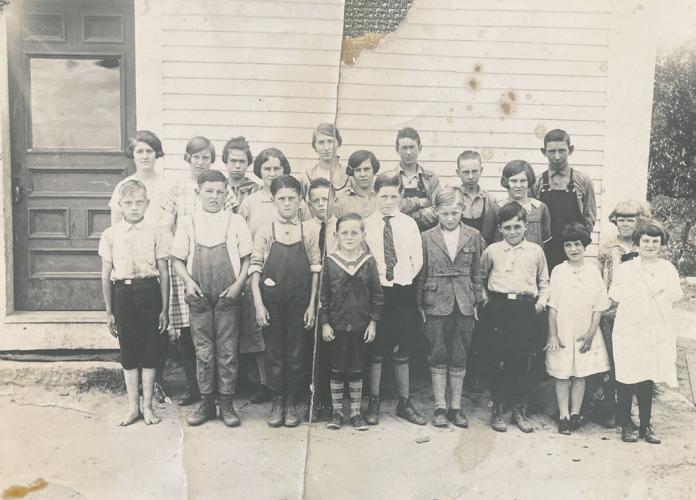
By 1926, Roxey was teaching elementary school in Barnstead. “She taught,” her granddaughter and former student Nancy Lines would later remember, “the old-fashioned way. You learned to read. You learned to write with clear penmanship.”
Part of Roxey’s old-school approach involved religion. Never mind that our country was founded on a separation of church and state. Our early schools were often overtly Christian, and when Roxey explained her pedagogy to a reporter, she said, “You have to look at others as God looks at them. I taught that in school. When they got rid of prayer, I decided to sing it. Nobody bothered me about it.”
“She was always smiling,” remembers another former student, Paula Gilman. “To my knowledge, all the students loved her.”
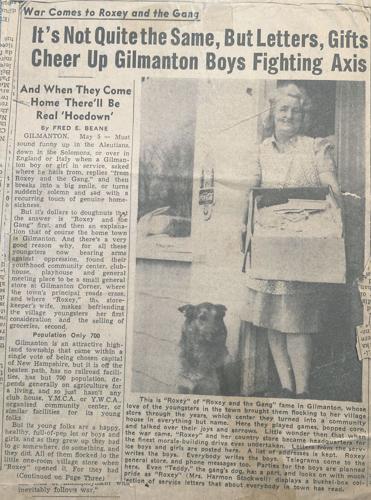
By 1944, Roxey was a country legend. That year, with World War II raging, The Manchester Union Leader dispatched a reporter, Fred E. Beane, to write about “Roxey and the Gang” — the kids who hung out at the store. Some of Roxey’s gang were fighting in the war, and Beane’s piece, which ran on page 1, features a photo of Roxey holding a bushel box of letters mailed to the store by servicemen who wanted the whole town to know their story.
The Union Leader piece revels in the podunk backwater vibe of our village, calling it an “attractive highland township of 700” that’s full of “happy, healthy, full-of-pep boys and girls.” These children are “active and hopeful of the future,” and it is Roxey who binds them together amid the war and its worries. Beane relates that, when it came time for one local boy, an orphan named Louis Cota, to enlist, “He came down to the village store and clubhouse to say goodbye. He shed tears. So did the gang. He asked them to write him. They said they would — and have.”
Roxey had five children of her own. Soon after the last of these kids left the nest, in 1950, she went back to teaching elementary school. She taught in town for a decade, then finished out her career in Alton and Franklin. All the while, she lived across the street from the store and shined with an unrelenting positive attitude.
On Oct. 19, 1988, just three months before she died, she visited my grandmother, Jane Cumming, in the house that I now live in. “What a lovely home!” Roxey proclaimed in her diary. “We ate brunch in the Red Room in front of a crackling fire. Jane read a letter from a young man who had been wounded — lost two fingers — in the Civil War. He later died from lockjaw.”
Grisly stuff, no doubt, but Roxey had been around dead people. Roxey had endured hardship. Roxey was tough, and her diary entry ends with a flourish of brightness: “What a great morning this has been!”
•••
Bill Donahue has written for Outside, Harper's, The Atlantic and The Washington Post Magazine. He lives in Gilmanton, and his book, "Unbound: Unforgettable True Stories From The World of Endurance Sports," will be published by Rowman & Littlefield in June. This column is adapted from his online newsletter Up The Creek.


(0) comments
Welcome to the discussion.
Log In
Keep it Clean. Please avoid obscene, vulgar, lewd, racist or sexually-oriented language.
PLEASE TURN OFF YOUR CAPS LOCK.
Don't Threaten. Threats of harming another person will not be tolerated.
Be Truthful. Don't knowingly lie about anyone or anything.
Be Nice. No racism, sexism or any sort of -ism that is degrading to another person.
Be Proactive. Use the 'Report' link on each comment to let us know of abusive posts.
Share with Us. We'd love to hear eyewitness accounts, the history behind an article.