


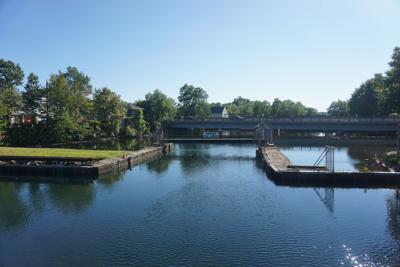
MEREDITH — According to a new report from the Lake Winnipesaukee Alliance, the Big Lake's environment is declining. Leaders say the most important markers of its health are the so-called “three S’s”: stormwater runoff, septic effluent, and salt. What will it take to solve them? Innovation, partnership, and investment.
Most significantly, Signs of Decline: Assessing the State of Lake Winnipesaukee, released Sept. 24, found water clarity is declining, and cyanobacteria and phosphorous levels are increasing.
Mark Ishkanian, board chair for LWA, said November marks the organization's 50th anniversary during a press conference last month. Ishkanian reflected on the organization’s years of data collection through partners such as the New Hampshire Department of Environmental Services and the University of New Hampshire.
“We've collected data over the years, and we really haven't given you an assessment of what that data shows. But now we know the trend lines, and you know, here's the information, that's what we're doing here with a state of the lake assessment,” Ishkanian said. “We're assimilating all this data and getting the clearest and best picture of what's happening on the waters.”
Ishkanian said those who live around the lake have probably noticed subtle changes, but haven't understood trends and factors driving them.
Ishkanian said a year ago, the organization hired Eric Siy as its new executive director, taking over for Pat Tarpey, who led the organization for 14 years.
Siy's made a difference in the work thus far, Ishkanian said.
Before bringing his expertise to the Lakes Region, Siy was president of the Lake George Association, and spent 10 years directing the FUND for Lake George, leading the merger of the two organizations in 2021. Lake George in the Adirondacks of Upstate New York was a “highly relevant training ground,” Siy said, for his transition to Winnipesaukee, as both bodies of water are highly populated, and facing manmade environmental pressure.
Siy said they have “hit the ground running” since he joined. Siy introduced the Legacy Strategy at the media event, an outline to understand the threats facing the lake and what LWA and partners can do to tackle them. The result is state of the lake assessment.
“It is a comprehensive data pull and analysis of every strand that we could identify and weave into this story of the science,” Siy said. “It's designed to inform and empower.”
Although Siy said, “All is far from lost,” he continued, “We cannot delay. Now is the time to act. The lake is not going to wait.”
Through years of data collection and observation, the LWA put together the comprehensive assessment.
Siy said the most visible sign of decline was the frequency of cyanobacteria blooms in summer 2024. Siy said they saw a year-over-year increase of blooms 2017-24, averaging 23%, and spiking in 2024.
“Every part of the lake was affected, the lake's clear water, the signature feature of Lake Winnipesaukee, turned ‘pea soup green,’ and in numerous locations was unsafe for swimming," Siy said. “The blooms really were the wakeup call that spurred a lot of people to ask, 'Well, why are they occurring and what are we going to need to prevent this from happening in the future?'”
Siy said cyanobacterial blooms can be harmful because they produce cyanotoxins, dangerous to people and animals. Siy said not every bloom is toxic, but they can be.
An overload of phosphorus into the lake is also worsening the cyanobacteria issue, he said.
“Phosphorus is a fertilizer, essentially, and it is feeding the growth of algae, and it is feeding the potential for more and larger cyanobacterial blooms in the future. So where's all that phosphorus coming from?”
Siy said over 10 tons of phosphorus has gone into the lake over the last 40 years. Siy said they are anticipating this amount to increase, unless something changes.
Another key finding from the assessment is loss in water quality. Siy said over the past 40 years, Lake Winnipesaukee has lost, on average, more than 8 feet of water clarity.
Siy said this number was “alarming,” and “an indicator that the lake is in trouble.”
He also noted “what happens on the land, happens to the lake.”
Siy said the lake is experiencing a loss of natural land cover, which works to protect water quality. New homes, driveways and other developments all have an impact.
“It is really, really important to understand we currently have, in the watershed, 27,000 buildings,” Siy said. “By 2017, there's the potential for an additional 17,600 buildings. This is what that looks like, and you will note that much of the current development encircles the lake, it's along the shoreline.”
The Shoreland Water Quality Protection Act, a statewide law, regulates vegetation removal, digging, and development within 250 feet of public waters.
Siy calls the primary threats to shoreline “the three S’s”: stormwater runoff, septic effluent, and salt.
The State of the Lake Assessment found 44.5 billion gallons of stormwater runoff flows into Winnipesaukee every year. This number is expected to increase by 3 billion gallons each year if land-use trends continue.
With increased development on the shore, natural soil is replaced with driveways or patios. Natural land on the shoreline acts as a buffer for the lake, with rainwater gradually soaking into the Earth. With pavement near the shoreline, rainwater instead sheets across the pavement, directly into the lake.
Septic effluent flows into watershed soil every day at a rate of 1.6 million gallons from roughly 19,000 septic systems.
“Risk levels are defined by a number of factors: the soils those septic systems reside on, proximity to flood zones near wetlands, depth to bedrock, etc.,” Siy said. “So, there is science, there are metrics that define risk levels, so this is need to know information going forward in protecting the lake."
Siy called road salt “the acid rain of our time.”
In the report, Siy said they found the lake is at two times the natural background levels of salt in the water, which are expected to rise to as much as six times natural levels.
“The beauty is, these are problems that we know how to address,” Siy said. “We are not trying to land anybody on Mars, not even on the moon, we are simply working to put this lake on a lower-nutrient, low-salt diet. And if we do that, and we do it soon, we can protect the lake.”
Siy said there are two possible futures for Winnipesaukee, “a greener lake, or a cleaner lake.” He said actions taken now will affect this generation's children and grandchildren, and how they enjoy the lake.
Siy said the LWA Blueprint for Lasting Protection aims to save the lake using three elements: innovation, partnership, and investment.
“That is the trifecta. These are the three pillars upon which the future of protection will be built,” Siy said. “The most exciting part for all of us is we are now building the tools needed, the protections needed, guided by the science, to ensure we set the pace for change, and we increase resilience and protect the lake.
"Who's it going to take to protect the lake? It's going to take all of us. Everyone has a role to play.”
Ishkanian emphasized the economic importance of Lake Winnipesaukee, reflecting on meetings the LWA hosted over the summer, with hundreds in attendance.
“We basically described the lake as the goose that laid the golden egg, and in doing so we're trying to get people to understand the connection between how clean water is the attraction that drives property values here, that makes this lake such a valuable resource for people who want to vacation here or own property here.”
Forrest Bell, chief executive officer and founder of FB Environmental Associates, and Amalia Handler, the firm's limnologist and senior project manager, spoke during the press conference Sept. 24.
“We commissioned them as partners to work closely with us in doing the data sweep, the aggregation, and analysis of all of the data that went into this first of its kind report,” Ishkanian said.
Handler outlined how over the past decade, 10 individual water management plans were built to lay the foundation for this assessment, which concluded roughly a year ago.
Handler is one of the lead scientists on the Lake Winnipesaukee project. Handler said they analyzed over 300,000 water quality observations across four decades, using satellite land-use data to track watershed development over time.
With this data, Handler said they were able to create a custom predictive model.
“So, this allows us to simulate current and projected phosphorus loads to the lake, and it gives us detailed insights about the lake's past, present, and potential future under a business-as-usual scenario,” Handler said. “And so, a really crucial component of this is that the model provides the baseline conditions for our understanding of what's going on in the lake. But also a framework to build a solutions-based science, so we can now test for different types of development practices that will reduce phosphorous pollution, and actively change the future trajectory.”
Read the report at trends.winnipesaukee.org.
Siy said the LWA will continue to grow partnerships and relationships, as saving the lake is a collective effort.
“We've essentially presented, this morning, the science of the problem," Siy said. "The way I'd like to look at it, the next phase is the science of solving the problems that face this lake, and we now have the data, the baseline, and can use that to guide next steps in those actions that are going to be most effective in relieving pressures from the three S's.
“This lake is not just a natural treasure, one of the jewels in nature's crown. It is also the economic living heart of our region, has a huge economic footprint,” Siy said. “As goes that water quality so go property values, so go business revenues, etc. The time is now, the lake will not wait.”


(0) comments
Welcome to the discussion.
Log In
Keep it Clean. Please avoid obscene, vulgar, lewd, racist or sexually-oriented language.
PLEASE TURN OFF YOUR CAPS LOCK.
Don't Threaten. Threats of harming another person will not be tolerated.
Be Truthful. Don't knowingly lie about anyone or anything.
Be Nice. No racism, sexism or any sort of -ism that is degrading to another person.
Be Proactive. Use the 'Report' link on each comment to let us know of abusive posts.
Share with Us. We'd love to hear eyewitness accounts, the history behind an article.