


LACONIA — Pillsbury Realty Development's proposal for Laconia Village will need to come back before the Technical Review Committee at least one more time, but the developer planning the largest real estate project in recent city history remains on track to submit a site plan to the planning board in July.
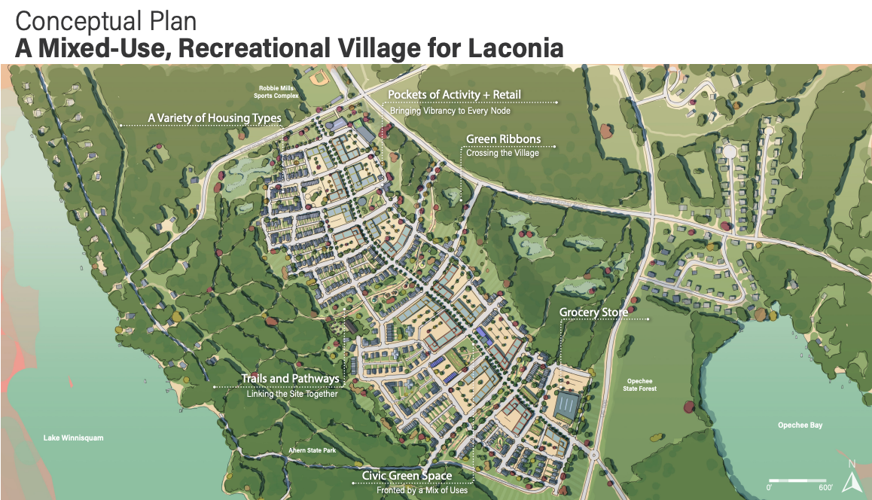
Representatives from Pillsbury Realty, a Londonderry-based business, won the opportunity last year to purchase the 217-acre parcel of land, home of the Laconia State School for decades, which has been sitting underutilized for years. Pillsbury proposes to built what would amount to a new village within city bounds, a center of commerce and place where thousands will live, a place where city offices could relocate, and a development which, according to the narrative of the project presented to the city’s Technical Review Committee on Tuesday morning, would also highlight some of the natural amenities on and near the property.
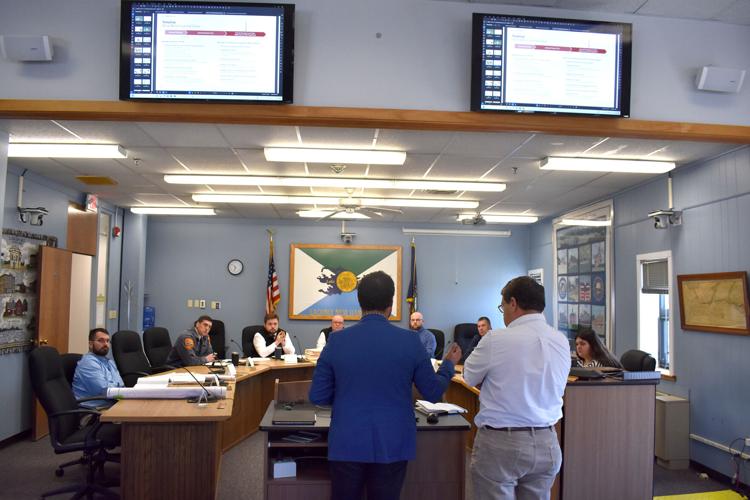
The Technical Review Committee includes representatives from all city departments which would be affected by building projects, whose aim is to fine-tune proposals before they enter a formal site plan review process by the planning board. Pillsbury introduced its plan at a committee meeting in December. The Tuesday meeting featured a more specific plan that addressed concerns previously illuminated by the committee.
Yet more concerns and critiques were brought to light on Tuesday, though none seemed significant enough to delay the developer’s stated timeline, which would have a site plan submitted to the planning board in time for review at its Tuesday, July 1 meeting.
Pillsbury developers are calling the plan for the former State School property “Laconia Village,” and its construction would bring 2,050 units of housing in various sizes and affordability levels, 100,000 square feet of office space, 120,000 square feet of retail, a 125-room hotel, 75,000 square feet of recreation facilities and another 75,000 square feet of space that could be built for civic uses, such as a library or a relocated City Hall.
The project would be built in three phases, with the first phase, the one nearest Parade Road, built first, including a space for a large retail tenant, such as a grocery store.
First, though, the developer must build the infrastructure — including about 5 miles of roads. Many questions posed at the committee meeting revolved around road surfaces, pedestrian paths and sewer lines.
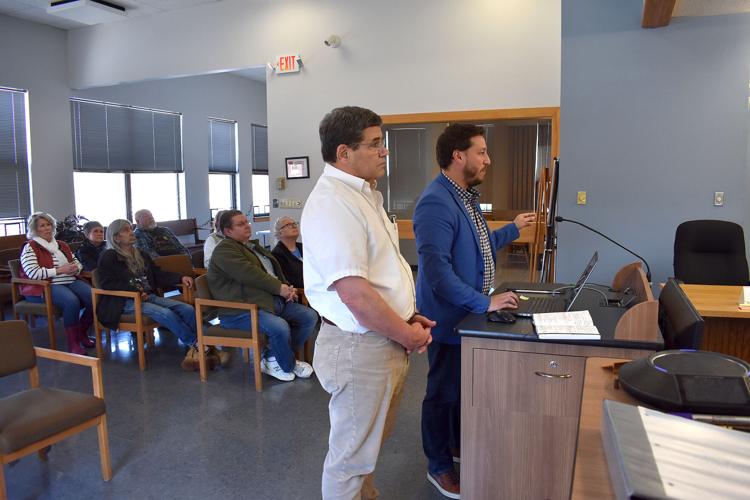
Bob Duval and Justin Kearnan presented Pillsbury’s plan to the committee. Duval said their plan as presented would result in a net reduction in stormwater runoff from the property of about 20%, through a strategy that includes wide use of permeable asphalt, strips of green space running through the development, retention ponds and below-ground infrastructure, such as drains and catch basins.
“The best way to treat stormwater is to treat it where it is generated,” said Duval, explaining the strategy behind the various design elements. “If we can’t catch it in the pavement or in the green area ponds, we will be using sub-surface systems.”
Nate Guerette, assistant director for the department of public works, said he himself was not a fan of permeable pavement, a kind of paving that allows rainwater to trickle in between larger aggregate instead of flowing across the top of the road surface. Guerette’s complaint had to do with such a broad application of that material, and his concern the surface might not perform consistently over time.
“When it’s new, it works,” Guerette said, but it’s downhill from there. The material can become clogged with sand and other fine materials, and although there are methods to remove the debris, “you’ll never be able to get that as permeable as Day 1. It can’t be done.”
“Are you saying you’d rather not see us use permeable pavement?” Duval asked.
“I think that’s what I’m saying,” Guerette replied.
Duval said he would revise the plan to reduce the use of permeable pavement, but he would likely need to increase the use of sub-grade water management scale.
“We’ll work on this and come up with some solution that works,” Duval said.
Guerette also asked the Pillsbury team if they could take another look at the route they’ve included for the WOW Trail, which would cross Parade Road at the Elm Street intersection, follow Meredith Center Road up to a proposed new intersection about halfway between the Elm and Eastman Road intersection, then travel through green spaces on the property before exiting at Ahern State Park.
Guerette said the stretch of road between the Elm Street intersection and where the WOW Trail would turn into the property could be problematic due to its pitch.
“Trying to ride a bike up from the intersection of Elm and Parade would be pretty challenging for folks,” Guerette said.
Duval said part of the reason for the trail's placement on the plan is due to wetlands at the lower stretches of the property, but he would look at the feasibility of relocating the trail.
“We are certainly open to ideas,” Duval said.
Pedestrian traffic was again on the minds of the committee when it came to the roundabout planned for the main entrance on Parade Road. The current plan calls for a five-way rotary, with two exits for Parade Road, one for Old North Main Street, one for Right Way Path leading into Laconia Village, and the last for the Ahern Park access road. If the park road were relocated from the rotary to its own intersection further south, it could simplify the rotary design, and make for safer pedestrian access to Ahern as well as Laconia Village, said Tyler Carmichael, assistant planning director. However, he added he didn’t want to make the approval of the overall project contingent on that issue.
Lastly, Guerette asked if the 12-inch sewer main that will be installed by the developer could be continued through the development and terminated at Eastman Drive, therefore allowing for future developments to make use of that same piece of infrastructure.
Kearnan and Duval said they would take the criticisms away with them and incorporate them into a new plan they would bring back to the committee for one last tune-up.
“We’ll come back to the TRC in June, which would tee us up for the Planning Board in July,” Kearnan said.


(0) comments
Welcome to the discussion.
Log In
Keep it Clean. Please avoid obscene, vulgar, lewd, racist or sexually-oriented language.
PLEASE TURN OFF YOUR CAPS LOCK.
Don't Threaten. Threats of harming another person will not be tolerated.
Be Truthful. Don't knowingly lie about anyone or anything.
Be Nice. No racism, sexism or any sort of -ism that is degrading to another person.
Be Proactive. Use the 'Report' link on each comment to let us know of abusive posts.
Share with Us. We'd love to hear eyewitness accounts, the history behind an article.