


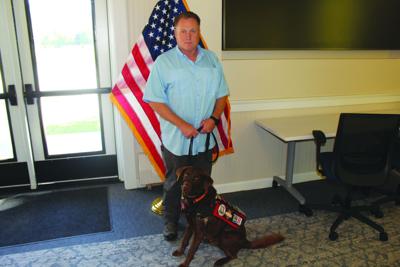
FRANKLIN — Sean Downey and his service dog Luke, or “Scooby” to his adoring fans, live at the new Easterseals NH Military & Veterans Campus, advocating for the life-changing impacts of service dogs.
Downey met his brown Lab through Operation Delta Dog, a nonprofit organization that rescues dogs from shelters and trains them to be working service dogs for veterans struggling with post-traumatic stress, a brain injury, or sexual trauma in the military.
Downey and Luke were not paired together right away. Through the program, Downey spent the first six months training with rescue dogs twice a week in Hollis. During this time, Downey learned handling techniques for his future service dog in real-world scenarios, like the grocery store or an elevator.
Over those months, Operation Delta Dog program evaluators observed the veterans and their work with the dogs, creating matches. Evaluators kept in mind veterans’ lifestyles, such as other pets, housing types, or children.
“He is my personality. It's incredible. It really is,” Downey said.
Downey’s daughter came in to observe one of his training classes with Luke, and said, “That’s the one.”
For the next year, Downey brought Luke home for visits to acclimate and continued to train together twice a week. The program’s total training time spans two years. Luke graduated from in training to a certified service dog. All service dogs trained by Operation Delta Dog are Assistance Dogs International certified.
Downey said he and Luke healed together, keeping in line with Operation Delta Dog’s motto of “rescue one, save two.”
Downey had been in counseling for about a decade following a divorce and loss of his house. With Luke by his side, Downey said he feels like a whole new person.
“After 10 years, the therapist finally said, 'We can now do a will call,' which means that it actually worked,” Downey said. “The things that we're doing to get better, self-care, having a service dog, showing up, medication, whatever it takes. This is all part of the circle of self-care. And because of him, I am no longer in crisis. It's not crisis management.”
Coming from a shelter, Luke came with his own trauma, specifically an intense fear of gunshots. During hunting season, Downey will put a bright orange vest with a bell on Luke when he's outside, for safety.
“You live with those traumas, and you help them. You support the dog as well, because they're dogs. They're animals,” Downey said. “It's not a canine military unit, where it's like you need to act a certain way, and if you don't sniff out that bomb, then you're fired. It doesn't work that way. It really doesn't work that way. I mean, he's a Lab.”
Luke also helps Downey with his post-traumatic stress and anxiety. When he senses changes in Downey’s mood, and spikes of anxiety, he attempts to ground him, resting his head in Downey’s lap. He also helps with day-to-day activities, trained to stay close and keep Downey calm in a crowded grocery store, for example, and can even push elevator and door buttons.
Simply having Luke to take care of has moved Downey’s focus from his own struggles to catering to Luke’s routine and needs.
Downey said he had moments of second thoughts about having a service dog. When this happened, Downey said all he had to do was look at Luke.
“You're like, 'OK enough, you're making it all about you,'” Downey said. “Save this dog's life. This dog is going to save your life. You know, you have to look at it that way, because it’s just a quick instinct.”
Downey commended Operation Delta Dog for the valuable connections veterans can make through the organization, as well as its flexibility.
“If the dog's not the right fit, you can always talk to the people and they'll get a different one,” Downey said. “Problems in life, financial, medical, you can stop the program, and then pick the program back up later on. It's all about the success of the dog and the veteran. That's the beauty of the program.”
Before living in Franklin, Downey lived in Bedford. Now, on the campus, Downey can let Luke run free in the 200 acres of open field, which he especially loves to do in the winter months.
Downey said Luke is quite a pampered dog, often getting home-cooked meals of ground beef and vegetables. He also loves to snack on apples, but only if they are peeled.
Since completing the program, Downey emphasized how active his social life is now, compared to when he was in crisis.
“The biggest challenge right there is to pick up that phone and ask, because you're asking for help,” Downey said.
“After about two years of having him is when things started to change quite a bit, not waiting for things to come to me. I started to go to things, started to take action and become involved. He gave me that confidence.”
Now, Downey is involved in an array of volunteer and advocacy work.
“There's groups that are down in the VA with other veterans, and they see me, and I'll talk to them out in the parking lot for half an hour. All of a sudden, they're in the class,” Downey said.
Downey is now the first peer support volunteer at his local VA center, and an active volunteer with Camp Resilience, a nonprofit in Gilford that holds wellness retreats for veterans, active duty military members, first responders, and their families. He also gives presentations for Operation Delta Dog at community events, also working as a mentor and meeting one-on-one with incoming veterans who may feel overwhelmed about the service dog training program. In the winter, Downey and Luke head to Gunstock Mountain Resort, where Downey teaches adaptive skiing with Lakes Region Disabled Sports.
Downey does not forget none of this would be possible without Luke, recounting a time he ran into an old training program classmate, and saw the same change in him.
“We saw each other at the VA and sat down. And the dogs just were working, lying down and we spoke for about two hours. And I looked at him, and I'm like, 'You're a different person.' And he said, 'You are, too, and in a positive way,'” Downey said.
Through his time with Luke, Downey said he's found children are the most respectful, always asking if it's OK to pet Luke. Downey said adults tend to see Luke’s “do not pet” patch on his vest, and even mention it as they are petting him. When people make noises or intentionally try to get Luke’s attention in a public place, Downey said this is a harmful distraction from his job.
“I don't come up to somebody with a wheelchair and say, 'Can I pet your wheelchair,' right?” Downey asked. “He's a tool, he's doing something. He's providing services for me. And I guess people just don't look at it that way.”
Downey said Luke is working about 5% of the time. Some of this time, Downey will “loan” Luke out to a fellow veteran or friend going through a rough time. Downey said the other 95% of the time, he gets to share him with the rest of the world.
The second Luke’s vest comes off, he knows he's off duty, turning into a ball of energy. Even when he is off duty, Downey said Luke still takes action if he senses someone struggling, and will walk over to rest his head on their lap.
September is National Service Dog Month. To learn more about Operation Delta Dog's program, visit operationdeltadog.org.
Downey continues to advocate for the program that brought him Luke, and completely changed his life.
“It's so much more than just a service dog program. The connections that you make afterwards between the veterans and the people in the community. What it does for people that have been isolated and are now out in the community, because they feel they have confidence.”


(0) comments
Welcome to the discussion.
Log In
Keep it Clean. Please avoid obscene, vulgar, lewd, racist or sexually-oriented language.
PLEASE TURN OFF YOUR CAPS LOCK.
Don't Threaten. Threats of harming another person will not be tolerated.
Be Truthful. Don't knowingly lie about anyone or anything.
Be Nice. No racism, sexism or any sort of -ism that is degrading to another person.
Be Proactive. Use the 'Report' link on each comment to let us know of abusive posts.
Share with Us. We'd love to hear eyewitness accounts, the history behind an article.