


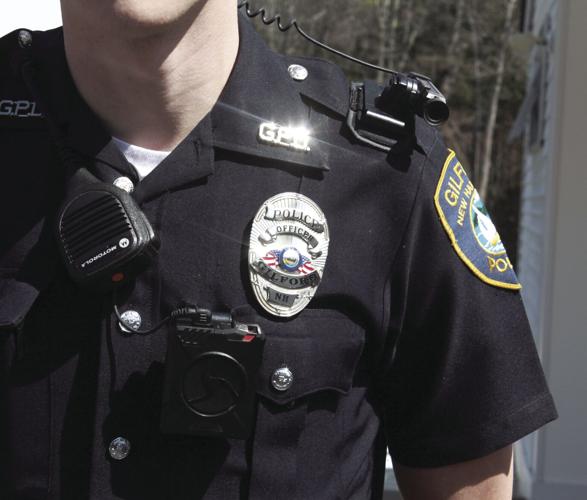
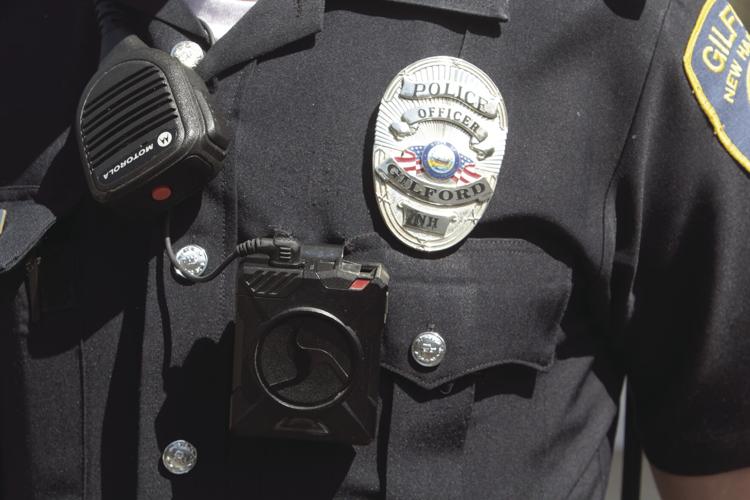
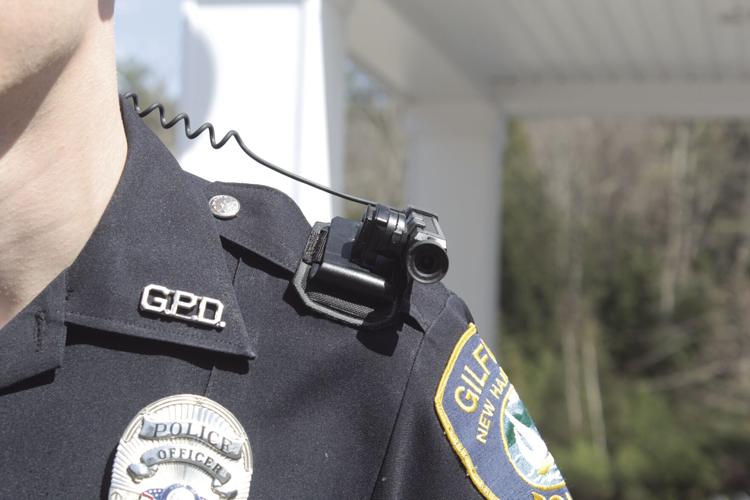
GILFORD — A $50,000 grant from the federal Bureau of Justice Assistance will help offset the cost of body cameras at the Gilford Police Department – one of the first in the Lakes Region to have this technology to reduce lethal force and de-escalate violence.
For roughly five years, officers in the Gilford Police Department – which now number 23 – have had tasers, which emit low-level electricity that stuns potential assailants for about two minutes. The tools are considered key deterrents in situations that could become physically dangerous.
“Our goal is to reduce the use of force, and reduce the risk of injury to police officers,” said Gilford Police Chief Kris Kelley. “Our goal is to use as little force as necessary. Body cameras are tools to record on-the-job events and enhance accountability, while tasers help prevent situations from becoming violent, and are their presence helps take unwilling suspects into custody, he said." It changes the approach officers can take and often (the presence of a taser) just de-escalates the situation,” helping to head off person-to-person contact that could result in injuries. Body cameras are viewed as ways to deter and record aggressive actions by police and suspects who may be tempted to use physical force.
Taser 7, the latest taser technology used now by Gilford Police, can emit an audible and visible arc of electricity that can serve as an initial warning, before the interaction results in any use of force.
“Our goal is to use the technology to reduce the use of force, and the physical confrontation numbers,” Kelly said.
Of the $50,000 that Gilford received, roughly $43,000 will go to offset money the police department spent to purchase body cameras, Kelly said.
It’s unknown how many of the state’s 174 municipal police departments currently have tasers and body cameras, said Pat Sullivan, retired chief of Goffstown Police and executive director of the NH Association of Chiefs of Police.
“Each community governs itself and establishes it own budget,” including for police work, Sullivan said. Tasers and body cameras, which cost roughly $2000 apiece, are widely recognized tools of up-to-date police work that reduces the need for physical contact, and increases accountability on the job.
“Anything officers can put between the deadly force option is a benefit to everybody,” said Sullivan. “Everyone from line officers to chiefs wants the accountability that body cameras bring.”
However, there are ongoing costs, he said – notably in the price of redacting taped testimony of minors and victims of sexual assault and others who require privacy under the law. That can run $10,000 to $20,000 a year for a contract with a company to remove identifying and invasive segments from the body camera footage.
Storage presents another challenge. The tapes, which are evidence, must be stored for seven to ten years, said Sullivan. “In Manchester or Merrimack, even smaller communities, that’s a huge amount of data.”
“The grants are a big help to bring this technology into the communities,” he said. “But the grants run out eventually,” which shifts the bill to taxpayers.
Communities need to find ways to pay for ongoing costs of the equipment, or include it in municipal law enforcement budgets, he said.
“The accountability is a tremendous thing,” said Sullivan. “However, there’s a cost. We are stewards to our own communities and the way that they spend money, and what they use it for.”


(0) comments
Welcome to the discussion.
Log In
Keep it Clean. Please avoid obscene, vulgar, lewd, racist or sexually-oriented language.
PLEASE TURN OFF YOUR CAPS LOCK.
Don't Threaten. Threats of harming another person will not be tolerated.
Be Truthful. Don't knowingly lie about anyone or anything.
Be Nice. No racism, sexism or any sort of -ism that is degrading to another person.
Be Proactive. Use the 'Report' link on each comment to let us know of abusive posts.
Share with Us. We'd love to hear eyewitness accounts, the history behind an article.