


LACONIA — Leaving high school behind, while a time often celebrated, can also come with anxieties about what comes next. This change can be especially challenging for students who haven’t earned a diploma, but have aged out of the public school system.
In the Laconia School District, these students are part of the Transition Program, a new operation established two years ago. Prior to that, the services were provided by a third party.
District staff have found handling the responsibilities in-house has provided better integration into the community, as well as a significant cost savings.
The program is the district’s compliance with state law RSA 186-C:2, which went into effect in 2022, and expanded the definition of “child with a disability” to include all people younger than 22 who have been identified by their school district as needing special education services, and for whom districts must continue to provide education until they turn 22.
The program at Laconia High School was created by Jen Sottak, student services director, and special education teacher Dawn Adolfsson. The goal of the program is to prepare students for the next phase of their life, which, depending on the student, could vary from living independently and working at a job, to living in a supportive home and navigating local services.
Amy Hinds, interim superintendent, said developing the district’s own program allows for more control and specialization for a group of students who can have differing interests and capabilities.
“I think it’s a more personalized program, with a stronger connection to their own community,” said Hinds. “We’ve been able to grow those connections, and hopefully have then turn into something they could do independently to earn income.”
Savings
Hinds said that usually during the middle school years, school counselors meet with parents of students in the special education program and discuss whether it would be appropriate for their child to pursue a diploma. If the consensus is that the student’s challenges are unlikely to permit them to achieve all the necessary credits, then that student’s education will instead be focused on gaining skills to assist them in their life after high school.
Once the student completes their fourth year of high school, they will walk with the rest of their class — they receive a certificate of completion in place of a diploma — then join the transition program, which they can stay in until they turn 22.
Until two years ago, the transition program was operated by Easterseals, according to Hinds. The last figure they had from Easterseals was $165,000 for one year, and Hinds estimates it would be closer to $300,000 today, based on the number of students who currently attend the program.
The savings for the district by handling it in-house is around $150,000, Hinds said. The district staffs the program with a single, veteran educator, and various other staff members assist as appropriate from time to time.
More than the savings, though, Hinds said the program offers a better return for the students.
“It’s been awesome. It allows them to continue to do things in the school setting and contributing to the school culture,” Hinds said. The students are able to engage with other students, through programs such as unified sports. “We’ve been able to grow a lot, we’ve had flexibility to do things based on the interests and needs of the students.”
Gage and Dylan
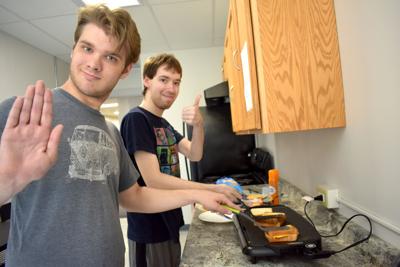
Dylan Godwin, 21, and Gage Mitchell, 20, are two current students in the program, and their days are busy, often with visits to places off the school campus. On a recent Wednesday, they spent the morning helping to set up tables and chairs for the Hands Across the Table community meal at the St. Andre Bessette parish hall. Later, they went to the simulated apartment — which has a kitchen, bathroom, bedroom and laundry facilities — and practiced making grilled cheese sandwiches.
In addition to domestic tasks, they have also learned skills useful in a workplace. They’ve studied how to be effective communicators, how to work in a team, and are certified to work in food service.
Adolfsson said they’ve had opportunities to put those skills to use, as several local businesses have opened their doors to her students.
Mitchell’s favorite place to work is Paradise Island, a tanning salon, where he sweeps the floors and cleans windows, and helps answer phones when needed. “It’s very nice, no crowds of people, very relaxing and no pressure,” he said.
Mitchell has also been helping the school custodial staff, and he’s made an impression. He will be working this summer as a part-time custodian.
Godwin’s preferred place to spend time is the diner Randy’s Pit Stop, where he enjoys helping co-owner Kamryn Guilmette by tidying the dining room and preparing vegetables.
Guilmette said he’s happy to have some extra help.
“Dylan is super helpful,” Guilmette said, adding he and his brother, the other co-owner, both worked previously at a residential facility that specializes in students with intellectual disabilities.
“Dylan works great, he’s pretty well focused, he takes care of his business and he’s excited to be here,” Guilmette said, adding he thinks the program is “fantastic."
"Challenged or not, it’s really just helping each other out, passing down knowledge.”
Access to the community
Sottak, who helped create the program, said students have taken advantage of opportunities to do different activities every day, to visit different businesses and community services, while still being connected to the school culture and activities.
“Their access to the community increased 10-fold by taking it on as a district,” Sottak said. “It is about increasing their access to the community and all that it offers — because this is where they’ll be living.”
In Adolfsson’s view, the success of the program has been due in part to the embrace it has seen from the community. She said only once did she get a “no” when she asked if students could visit.
“Everyone has said, 'Please come in,'” Adolfsson said. “I’m excited that the boys are busy, the community is so welcoming. We are busy every day.”


(0) comments
Welcome to the discussion.
Log In
Keep it Clean. Please avoid obscene, vulgar, lewd, racist or sexually-oriented language.
PLEASE TURN OFF YOUR CAPS LOCK.
Don't Threaten. Threats of harming another person will not be tolerated.
Be Truthful. Don't knowingly lie about anyone or anything.
Be Nice. No racism, sexism or any sort of -ism that is degrading to another person.
Be Proactive. Use the 'Report' link on each comment to let us know of abusive posts.
Share with Us. We'd love to hear eyewitness accounts, the history behind an article.