


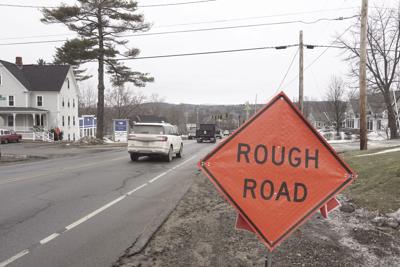
As the Lakes Region prepares to emerge from another winter, the change of season means a familiar set of challenges face road maintenance crews.
Fluctuating temperatures set off a freeze-thaw cycle — often within a matter of hours — that causes road pavement to break apart, and the road surface to sag and heave. For motorists it means uncomfortable travel.
An extreme example of this variation occurred last Thursday when the temperature reached a high of 60 degrees only to plunge 48 degrees before the end of the day, according to the National Weather Service.
When melting snow puddles up on the surface of streets and highways the water seeps into cracks in the pavement. Once the temperature drops below freezing those cracks get bigger because the water expands when it freezes. When the temperature yo-yos on either side of the freezing mark for days at a stretch potholes and frost heaves are the result.
“The severity (of the problem) depends on how much the temperature changes,” Laconia Public Works Director Wes Anderson explained.
Highway crews do their utmost to push snow banks further back away from the pavement so melting snow can run off into catch basins or drainage ditches along the shoulders and not pool on the streets or roads themselves.
But officials acknowledge that every spring the roads will take a beating, at least to some degree.
When potholes begin to appear highway crews often fill in the damaged section with cold patch — a gravel/asphalt mixture that is laid down without heating it. It's quick and cheap, but it’s only temporary.
Some local departments have turned to more advanced methods in an effort to make the repairs more long-lasting.
The Gilford Highway Department is using a technique which Public Works Director Meghan Theriault calls milling and filling. That procedure involves cutting the pot holes out before putting in the cold patch so the pot holes don’t come back, she explained.
The development of potholes depends on lots of factors that vary by location, including weather (temperature and precipitation), presence of groundwater, pavement condition, date of last paving, construction history or lack of modern construction, explained Eileen Meaney, spokesperson for the state Department of Transportation.
State highway crews use a combination of “high-performance cold patch” and paving materials from a hot box. The crews then often follow up in the spring or summer with fresh hot mix asphalt to patch potholes.
“To date we have found no better solution for frost heaves or potholes than construction that includes a properly graded road with about 3 feet of sand, gravel, crushed stone and 4 1/2-plus inches or pavement with proper drainage,” she said.
Roads — both paved or dirt — are much more tender during the spring until the ground has completely thawed out, and all the snow has melted and run off. During that time communities temporarily limit the weight of vehicles that travel on streets and roads that are particularly susceptible to damage.
Meredith imposed the weight restrictions Feb. 21, according to Crag Hale, the operations manager for the town’s Highway Department.
Weight limits in Laconia will take effect next Monday, March 7, according to Anderson. Belmont’s will go into effect the same day. Gilford typically posts roads starting in mid-March.
In Meredith, where about 40 to 45% of the town’s roads are unpaved, the town has stockpiled crushed stone to be used to fill in muddy areas of dirt roads, Hale said.
The freeze-thaw cycle has aggravated the condition of the pavement on the Route 3 bridge in Meredith which goes over the railroad tracks and Maple Street to the extent that the temporary signs have been put in place to warn motorists of the rough surface.
Work on the bridge, which includes repairs to its deck, is scheduled to begin on March 14, Meaney said.
Hale thinks frost heaves have become a bigger problem over the years, but he is unsure of the reason.
Theriault said in the 20 years she has worked in the road maintenance field she has seen the weather become much more erratic.
“The rain has been much more intense,” she said.


(0) comments
Welcome to the discussion.
Log In
Keep it Clean. Please avoid obscene, vulgar, lewd, racist or sexually-oriented language.
PLEASE TURN OFF YOUR CAPS LOCK.
Don't Threaten. Threats of harming another person will not be tolerated.
Be Truthful. Don't knowingly lie about anyone or anything.
Be Nice. No racism, sexism or any sort of -ism that is degrading to another person.
Be Proactive. Use the 'Report' link on each comment to let us know of abusive posts.
Share with Us. We'd love to hear eyewitness accounts, the history behind an article.