


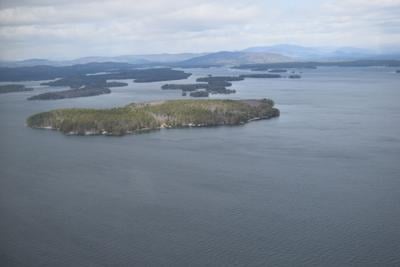
A local group is advocating for the health of Lake Winnipesaukee and pollinators around it, and they're taking their cause all the way to the capital. Tonya Albee and Six Legged Society, of Wolfeboro, want to make sure insecticides don't affect water quality and ecosystems in the Lakes Region.
The New Hampshire Pesticide Control Board will hold a public meeting next Monday, in Concord, to discuss bipartisan House Bill 1431, which aims to regulate neonicotinoid insecticide use to protect water quality.
Neonicotinoids are neuro-active insecticides chemically similar to nicotine, widely used in crop protection and tick and flea control.
HB 1431 passed with minor modifications this year, and moved on to the Senate. As of April 14, the bill was referred to interim study, essentially leaving it floating without resolution.
“The Senate then said, even though they heard 10 years' worth of inaction in the chronology from us and the desire for legislation, they voted that the rulemaking authority should still have another shot at it,” said Albee, founder of the Six Legged Society. “They emphasized that should they do nothing this year, that they'd be very willing to rethink their position next year, if the pesticide board did not act on this.”
The Six Legged Society is a group of citizens collaborating to save biodiversity, with a focus on impacts to pollinators, according to its website.
Albee went to the Pesticide Control Board. Members said they would implement “restricted use” on neonicotinoid insecticides.
Albee said most of the public is not aware of what restricted use really means.
“So, neonicotinoids have a whole series of chemicals within them, with all these crazy names that nobody remembers, and restricted use would take it off the shelves from, like, the local hardware store,” Albee said. “If you go over to Home Depot, or Lowe's, or any of that, they would not be able to sell it anymore. It would only be professional applicators. So, that's the value of restricted use.”
Restricted use for neonicotinoids does not tackle the whole problem, according to Albee and Rep. John MacDonald (R-Wolfeboro). Albee said one of the main focuses of the Aug. 17 meeting is turf, which is why she and MacDonald urge the public to attend.
Albee said implementing restricted use on neonicotinoids is “not enough of a scope for what Rep. MacDonald's goal and my goal was, which was to have significant, or real, impact.”
Albee submitted a petition earlier this year to the NH Pesticide Control Board requesting turf be restricted, and is eager for leaders to make the change.
David Rousseau, director of the state Division of Pesticide Control, said the control board will be recommending increased restrictions and discussing pesticide licensing at the meeting Monday. They will also be discussing how this impact farming, and which particular neonicotinoids will require a license to purchase and use. They will propose restricting particular neonicotinoid active ingredients found in turf, and potentially taking away their use.
“The real contamination source that was of major concern, from our perspective, is turf runoff going into our lakes, and contaminating and hurting our lake of invertebrates, and the lake water quality,” Albee said.
Albee said the public came out in full force at a meeting in May, and hopes to have the same next week.
“We want to repeat, that so they know there is a big public outcry to say, 'We do not want to contaminate our lakes with these chemicals,'” Albee said. “We do not want to continue harming, and adding more stressors to our lakes, that are already struggling.”
MacDonald is a lifelong Lakes Region resident and advocate for protecting lakes, having also served as a State Police detective and Marine Patrol officer. This year, he was a recipient of the Reverend Sidney Lovett Memorial Award for Exemplary Lake Advocacy, an honor given every two years from NH LAKES. MacDonald is primary sponsor of HB 1431.
“I'm hopeful that the pesticide board will address these issues in a timely fashion. If not, then I have full intentions — if I'm hopefully reelected — to bring this bill forward again, with some of the things that we want to address,” MacDonald said. “But again, I'm hopeful that the pesticide board is going to address these issues. I'm hoping that they'll go outside of their own knowledge, and speak to some of the people that are professionals that have been looking at this, working on this issue, for probably the past 10 or a dozen years throughout the country.”
Neonicotinoid runoff has already had impacts on local bird populations. Albee said the Lakes Region has lost a third of its bird population in recent years, with a decline in mostly insect-eating species.
“There are no insects for them to eat. So, things like chickadees, their babies are starving to death, because of these kinds of losses. There's other things people can do to protect them, like turn off the lights so they get more caterpillars, but this is one we should face off with,” Albee said.
Aquatic insects, such as mayflies and caddisflies, are also vulnerable to neonicotinoids. The chemicals dissolve easily and are washed into the lakes, and have been measured in parts per trillion, and so are incredibly toxic. If the lakes lose mayflies and caddisflies, the trout population which depends on them will collapse, affecting local anglers, as well.
Dragonfly populations in the Lakes Region are also vulnerable to these chemicals, as they spend the first two years of their life in the lake, before they develop into adults to fly out of the water for a summer before they die. Albee said many residents have noticed a decline in these insects, which is impacted greatly by neonicotinoid contamination.
Albee said when comparing these chemicals to DDT, a synthetic chlorine compound used as an insecticide and linked to long-term health issues in humans, neonicotinoid chemicals are thousands of times more toxic to a bee.
“My generation lived through that trauma. And we certainly thought it was probably the most devastating chemical we'd ever encounter, but we're wrong,” Albee said. “This chemical is the most widely used chemical in the world, and hence, it's quite often overused. You know, there are times where it's necessary, but certainly not like it's currently being used. And it's also highly sensitive.”
Albee said there has been legislation in Vermont, Maine, Connecticut, New York, and now Massachusetts, to protect water bodies from neonicotinoid runoff. “It's unusual that New Hampshire has sort of fallen behind, when lakes are so important to us.
“We’ve got so much information, so many people that are experts that are outside of the state, that have been dealing with this for years. So, I hope that the pesticide board will take some testimony from those folks, because they’re the experts in the field.”
Albee said a significant topic of discussion at the meeting will be ornamentals, like flowers and shrubs. She said in Connecticut, there was legislation restricting neonicotinoids, but did not include ornamentals into the rules. Many people used this as a loophole, and continued using the chemicals. Albee does not want this to occur in New Hampshire, and will emphasize the inclusion of ornamental plants into the control board’s rules at the meeting.
MacDonald said among other sponsors of HB 1431, it's a pretty even split between Democrats and Republicans.
“We all share the same concern about protecting our lakes, because, you know, that's a major driver for our tourism. And I think the Legislature is starting to take more of a serious look at these problems,” MacDonald said. “We've got other issues that we have to deal with. The cyanobacteria fund, which we've started a task force that I'm on along with Sen. [Mark] McConkey, and probably a dozen other people that are involved in New Hampshire LAKES, and have concerns about the cyanobacteria, and how we're going to fund that whole process.” McConkey is a Republican from Freedom.
MacDonald said Rep. Rosemarie Rung (D-Merrimack) is also very concerned about the quality of the lakes, and cyanobacteria. Rung has a summer home on Lake Kanasatka, in Moultonborough, and MacDonald said bacteria levels had just gotten out of control in that area.
“They’ve got some funding, and they’ve really moved forward with addressing it. Hopefully — I know there’s been good results — but hopefully, those results will continue in the future,” MacDonald said.
“We don’t want to get into a situation where we are with the DDTs and the PFAS and these other things that may have been set aside, and the public may not be aware of the dangers of them,” MacDonald said. “And, I’m hoping we got a good jump on it, which I think we do.”
“The more we let this run into the lake, the more we're facing what John referenced, was like the PFAS, it becomes a mitigation problem instead of just an avoidance problem,” Albee said. “And the cost difference between those two is enormous.”
The Pesticide Control Board meets at 9:30 a.m. on Monday, Aug. 17, at the NH Judicial Branch Administrative Offices building, 1 Granite Place South, Room 208.


(0) comments
Welcome to the discussion.
Log In
Keep it Clean. Please avoid obscene, vulgar, lewd, racist or sexually-oriented language.
PLEASE TURN OFF YOUR CAPS LOCK.
Don't Threaten. Threats of harming another person will not be tolerated.
Be Truthful. Don't knowingly lie about anyone or anything.
Be Nice. No racism, sexism or any sort of -ism that is degrading to another person.
Be Proactive. Use the 'Report' link on each comment to let us know of abusive posts.
Share with Us. We'd love to hear eyewitness accounts, the history behind an article.