


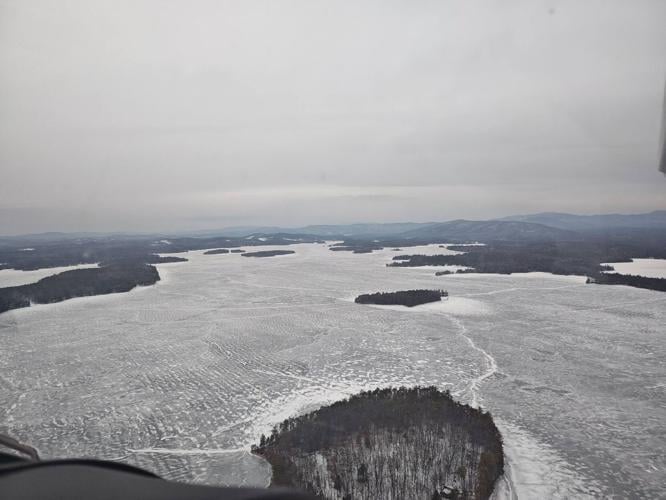
GILFORD — Dave Emerson has been flying since before he graduated high school, and the owner of Emerson Aviation is relied on twice a year to make a call about when the ice is “in” and “out” on Lake Winnipesaukee.
Emerson said this year’s ice-in date was Jan. 12. He said while it froze up quickly, it's about on schedule.
“I am looking for The Broads, primarily, to freeze, because that is usually the last place, since it is the deepest part of the water,” Emerson said. “I take the [M/S] Mount Washington navigation map, and as long as that route is covered, I call it.”
Emerson tends to fly daily, but said recent “atrocious” weather has made his trips less frequent, due to the wind, snow, rain, and fog. He said a customer flew on Sunday, and reported there was broken up water in The Broads, a large area of open water in Gilford where some areas are more than 200 feet deep.
The wind was whipping on Monday morning, so he opted not to fly, but went to the scenic view to look from the ground. Emerson saw The Broads were frozen, and then on Wednesday, he took to the sky in his Cessna 172 high-wing, single-engine plane to confirm what he and others were reporting from the ground. He made the announcement on the Emerson Aviation Facebook page on Wednesday evening, but said ice-in occurred sometime between Sunday night and Monday.
“I went up to take a few shots and confirm that it was, in fact, iced over,” Emerson said.
Emerson said he is looking for “full coverage,” noting there are still open shorelines around the docks from bubblers in the water. The same goes for ice-out, when Emerson will fly above the Big Lake to see if the cruise boat could make all its stops.
The tradition of calling ice-out goes back decades, to the days of Bob Aldrich in the 1950s, before being passed to Emerson in 1979. Aldrich was a pilot and customer of Emerson Aviation.
Ice-in, however, is a much newer tradition, with Emerson making the determination for about a decade, after fielding inquiries from local residents.
“Ten years ago, people started asking about ice-in, because we have more growth on the islands, and contractors are trying to get their supplies out there,” Emerson said. “But it is a curiosity thing for a lot of people, too.”
There is no official recognition for what Emerson does, just a winter standard accepted by the community. He’s been the guy to do it since he was a senior in high school, one year before graduating from Gilford High School in 1980.
“Bob was a pilot and doing it for the Gilford Rotary at the time, but he told me what to look out for to call ice-out,” Emerson said. “He was aging out, and looked to pass the torch, so we started doing it.”
Emerson made the call with his father, Alan, at the start, but in the mid-1980s, he left the airport business. He returned in 2003, and has been calling ice-out ever since. Both dates can be difficult to predict.
“We’ve seen a variety of conditions over the years,” Emerson said. “One season does not fit all.”
Emerson called this year’s ice-in average, noting it normally takes place in the first couple weeks of January. He noted while December saw some extremely cold temperatures, the lake was actually very warm, due to the heat of the summer.
“There was a lot of energy put into the lake, and it took a lot of energy to remove it and get it to cool down,” Emerson said.
Emerson said he is helped by Alton Bay ice runway representatives, who have been checking on ice depths ahead of their planned opening. The ice on the east side of the lake is at 1 foot in some spots, and close to it in others, but a full 12 inches is what's needed for the runway to be operational. Emerson said the rain and warmer temperatures didn’t seem to affect the ice depth much in the area, and he said this is likely the same for The Broads.
Emerson said wind also plays a huge role, as it will hinder the formation of ice, and the lake may have frozen earlier without the windy nights. While there was some rain, and some warmer weather mid-week, the single digits expected over the next couple nights should help retain, and create, more ice depth.
“We are supposed to get some very cold temperatures, so we should have a nice, mirror finish, with Olympic-quality ice,” Emerson said.
Emerson recommends people take extreme caution when going on the ice, as depth can vary greatly. He said just because it is 8 inches in one spot doesn’t mean it won’t drop in depth even a few feet over. Emerson said the lake acts like a “natural bubbler,” and even after an established cold spell, the depth can be unpredictable.
“This doesn’t mean it is safe to be out there; it just means that we have full ice coverage,” he said. “Even in the best conditions, people need to make sure they are always checking. I would not be venturing out on the ice too far without doing that.”


(0) comments
Welcome to the discussion.
Log In
Keep it Clean. Please avoid obscene, vulgar, lewd, racist or sexually-oriented language.
PLEASE TURN OFF YOUR CAPS LOCK.
Don't Threaten. Threats of harming another person will not be tolerated.
Be Truthful. Don't knowingly lie about anyone or anything.
Be Nice. No racism, sexism or any sort of -ism that is degrading to another person.
Be Proactive. Use the 'Report' link on each comment to let us know of abusive posts.
Share with Us. We'd love to hear eyewitness accounts, the history behind an article.