


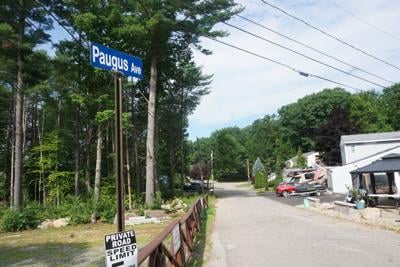
LACONIA — The decades-old debacle over Prescott and Paugus avenues was resolved at a council meeting Monday night, with councilors voting unanimously to declare specified sections of the roads as emergency lanes indefinitely.
Mayor Mike Bordes moved to approve the section of Prescott from the intersection of Weirs Blvd, adjacent to 644 Weirs, to the end of the pavement adjacent to 102 Prescott, and all of Paugus as year-round, emergency lanes with no end date.
Council was deciding between indefinitely declaring the roads as emergency lanes, or making the private roads winter-only emergency lanes. Previously, residents had to petition the council every year, on July 1, to renew the road as emergency lanes. This decision ensures they will no longer have to do so.
Residents of Prescott and Paugus attended council meetings and public hearings on the matter throughout the summer, inviting city leaders to observe the road’s layout and conditions. Councilor Mike Conant (Ward 6) attended a neighborhood meeting in July, toured the neighborhood, and expressed personal concerns over access in the case of medical emergencies on the roads.
Residents continuously approached the council at meetings to voice concern about the ability for emergency vehicles to reach them when needed.
Public works staff will maintain and plow the qualifying sections of Prescott and Paugus, in order to ensure emergency vehicles can reach residents and pass along the road safely. The costs of maintaining the roads will be funded by the winter and highway maintenance budget. The declaration does not mean the roads are now public. Under state law RSA 231:59-a, abutting property owners are still responsible for non-emergency maintenance.
During the public hearing held Monday, no residents spoke.
After years of effort from neighbors, gathering together and requesting action, residents were pleased with the declaration, many breaking out in applause.
The council also moved to approve a special exception to City Ordinance 194-4-B, which prohibits the city’s solid waste collectors from entering a private road or driveway to collect trash. The council voted unanimously to allow solid waste to be collected at the curve of Prescott and Paugus for properties abutting the emergency lanes.
During time for public comment about matters on the agenda, Mark Hammil, a resident of Paugus for over 40 years, spoke.
“I hope that this will continue to find resolution, and I look forward to seeing some of the results of the discussions that took place in the July 27 meeting, and that it gets referred to the committee with estimates, and that we proceed towards a resolution.”
The issue dates back to the early 20th Century, when The Prescott Farms Company developed the neighborhood, consisting of Prescott and Paugus avenues as well as the Stonecrest Condominium development. The roads were dedicated to the landowners abutting the roads in 1927. In accordance with state law at the time, the city lost rights to the road if it was not accepted within 20 years as a public way, which it was not. The city officially lost rights to the roads in 1947.
A law went into effect in New Hampshire on Jan. 1, 1969, regarding “making a private road public by prescription,” which is determined by a court. This said the use of private roads by abutters and their guests does not deem it public. As dead-end roads are not used by the public to travel through the city, the roads cannot be considered public.
Under current city policy, the city can only accept roads through the betterment process.


(0) comments
Welcome to the discussion.
Log In
Keep it Clean. Please avoid obscene, vulgar, lewd, racist or sexually-oriented language.
PLEASE TURN OFF YOUR CAPS LOCK.
Don't Threaten. Threats of harming another person will not be tolerated.
Be Truthful. Don't knowingly lie about anyone or anything.
Be Nice. No racism, sexism or any sort of -ism that is degrading to another person.
Be Proactive. Use the 'Report' link on each comment to let us know of abusive posts.
Share with Us. We'd love to hear eyewitness accounts, the history behind an article.