


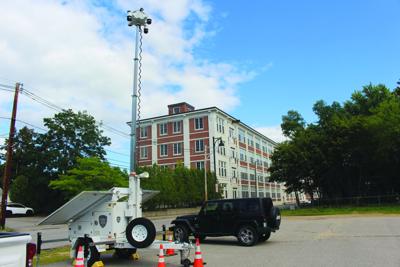
LACONIA — The council approved the Laconia Police Department accepting a $86,500 grant from the Department of Homeland Security to purchase solar-powered pole cameras to replace existing, aging cameras, at their meeting Monday night.
The council voted to approve the request 5-1, with Councilor Eric Hoffman (Ward 3) in dissent.
Residents were divided during the public hearing Monday night, about alleged surveillance and data storage from the cameras.
“I just wanted to remind everyone that there are already eight cameras existing, exactly what we're asking for this grant, and to bring this grant in, and approve it, is to help to replace some of those that have gotten old and are not working any longer. They've been in place for years. We're just looking to add more and to replace the others,” Doreen Richards, a Ward 1 resident, said.
Richards submitted a Right-to-Know request to the police and state Department of Safety to find out if the cameras have “automated license plate reader technology or Flock.”
Richards received written confirmation from the police department, on Sept. 3, they have never “owned, leased, tested, deployed, assessed, or registered an ALPR, LPR, or number plate scanning device or Flock."
Police further stated to Richards the department reviewed Flock technology in 2022, and deemed license plate readers “not feasible under applicable state statutes and rules.”
Chief Matt Canfield said they "very briefly" viewed the technology for Laconia. Canfield emphasized the same cameras have been deployed across the city for 30 years.
Lloyd Wiley, who lives and owns two properties on Davis Place, where a pole camera was recently deployed, shared his perspective.
“I had the pleasure of having the police chief and the public works supervisors come down. They put up no trespassing signs, they put up a pole camera. And I want to tell you that since they have done that, in two months, I have had no issues whatsoever down here, no traffic. I mean, this has been a whole new neighborhood. I have been battling with this for 20 years.”
Wiley said the cameras act as a great deterrent, as in the past he's had people urinating in his backyard, doing drugs, and drinking.
“I sympathize with this gentleman and in his problems with his private property. His private property is not my problem," said Ken McKay, a resident of Ward 6. "My tax dollars shouldn't be used to protect his private property. He can get cameras all he wants if he wants to protect his private property. I can protect my property however I see fit, but my tax dollars are not for everyone else.”
Jonathan O’Brien, of Ward 6, said he has cameras monitoring his home, but there’s a difference between his equipment and pole cameras.
“I can control if that company starts doing something I don't like, I can control that. When it starts going into the public domain, I can't control that. Citizens can't control that. And I think there's a general unappreciation for how fast technology is changing. I work in technology and it's crazy.”
Trish Wedley, of Ward 4, said over the past decade, she and her husband have set up cameras around their home to catch video of the violence they often hear but cannot see. Wedley said her husband collaborates with Canfield.
“Nonetheless, we are not calling the police every day. We, in fact, are greeting them when they come by on their daily visits. We are offering them any of our camera footage, and we certainly don't have these wildly expensive cameras, and we certainly don't have the ability to sell data,” Wedley said. “So, I think the old adage, keep it simple, cooperate, communicate, and say 'hi' to your neighbor.”
“The issues we're talking about, crime, disorder, these are things caused by people," said John Clark, who lives in Ward 2. "People can fix them. Machines are not going to fix them. I oppose this.”
Clark brought up minors being recorded, arguing minors especially, but all citizens, should not be surveilled every time they step out of their homes.
Canfield said the cameras are not for traffic, thus not reading license plates, and are not aimed at houses or backyards. They are basic security cameras deployed in high-crime areas, or during special events, such as Motorcycle Week or Pumpkinfest.
Canfield said the footage is stored in a closed system only the Laconia Police Department can access. It cannot be converted or uploaded to the cloud. Canfield said the cameras are to improve safety and security in the city, and data is stored on a hard drive.
Peter Mckenna, of Ward 1, spoke about the New Hampshire balance, and the importance of privacy, liberty, and security.
“If you're going to take away privacy, I think you need a very good reason to do it. If you're going to infringe, you need a very good reason to do it. And I don't believe that showing has been made,” Mckenna said. “There are certain things that we can hypothesize that might be deterred, but nothing that rises to the level of taking away people's privacy in the way that's being suggested here.”
Councilor Julia Nye (Ward 5) said she met with Canfield and reviewed the application process to understand which equipment was being purchased. Nye said she understands the fear of police overreach and government involvement, but assured residents the cameras are the same ones that have been deployed around Laconia for years, such as on the WOW Trail, and are provided by the same company.
“The biggest difference in this go around, purchasing the cameras, is that currently the cameras hold three days' worth of video, then it’s run over. The new cameras will hold 30 days' worth of videos.”
Nye said she supported accepting the grant. She acknowledged the Laconia Police Department is currently filled with exceptional officers.
“We don’t know what kind of decision-making will be happening in the future. I think it’s worth looking into having civilian oversight on technology that is purchased.”
Most other councilors supported city police in accepting the $86,500 grant from the Department of Homeland Security to purchase the cameras and accessories.
“I think Lt. [Gary] Hubbard explained exactly what we were getting, and these are replacement cameras and data will not be available to anyone else. I feel comfortable in those statements, and again, they are replacements. And I think they're much needed in places like the WOW Trail, especially where there's no power, and we will have some wireless battery capability, or solar capability,” Councilor Jon Hildreth (Ward 1) said.
Councilor Bob Soucy (Ward 2) attended the council meeting Monday night virtually.
“There's not a third party involved. They're not reading license plates. They're not doing bio identification and stuff like that. They are the same as you said, Mr. Mayor. These are the same cameras, and maybe some updates, that we've been using here for many years. So, I think it's a good thing to give the department the additional tools they're looking for,” he said.
Councilor Mike Conant (Ward 6) emphasized the cameras will be fully visible to the public, and clearly marked.
“I have spoken with the chief regarding this, and I think that we would be foolish to turn down the $86,500 grant, only to find out that we need to replace some of our existing cameras at our taxpayers's expense. So, I am wholeheartedly on board with this,” he said.
“I think we need to take into consideration the accreditation of our police department, which is impeccable. I don't think that they would risk that national accreditation to do anything with cameras. I fully support this matter,” Councilor Mark Haynes (Ward 4) said.
Councilor Eric Hoffman (Ward 3) was the only one to oppose accepting the grant. He noted he had only received feedback against the proposal prior to the public hearing.
“I think I echo the concerns of some people here tonight about trading off liberty for security. I think this is not a reflection on the Laconia Police Department, I think they do a fantastic job,” Hoffman said. “But, I think when you combine tech companies and government, things that people typically don't trust, it's kind of a lightning rod for people to get a little agitated about it, and I'm against it.”
Canfield said he is all for advocating for and protecting Constitutional rights, but this is different. "People filled in the blanks on their own."
Although Mayor Mike Bordes could not vote on the matter, he made it clear these are not Flock cameras, and data is not shared with third parties.
“These are basically the same cameras we have been using in the City of Laconia for about 29 years. The cameras are getting outdated. The way I'm looking at this, this is a grant from the federal government. The cameras are going to have to be replaced sooner, rather than later. If we don't accept this grant, we're going to pay for it out of our tax dollars.”


(0) comments
Welcome to the discussion.
Log In
Keep it Clean. Please avoid obscene, vulgar, lewd, racist or sexually-oriented language.
PLEASE TURN OFF YOUR CAPS LOCK.
Don't Threaten. Threats of harming another person will not be tolerated.
Be Truthful. Don't knowingly lie about anyone or anything.
Be Nice. No racism, sexism or any sort of -ism that is degrading to another person.
Be Proactive. Use the 'Report' link on each comment to let us know of abusive posts.
Share with Us. We'd love to hear eyewitness accounts, the history behind an article.