


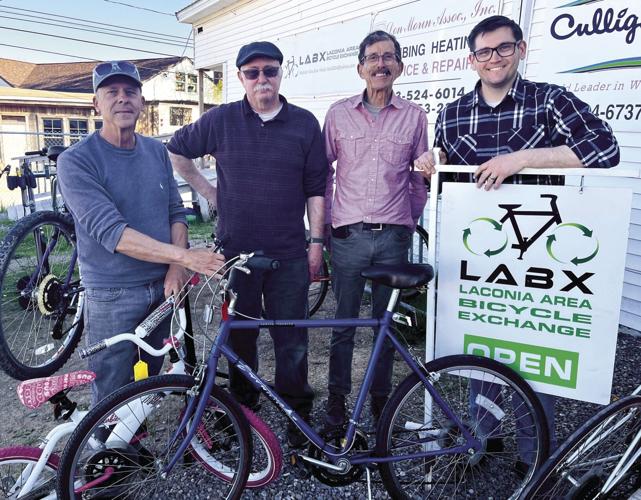


LACONIA — Bicycling season is shifting into high gear, and the Laconia Area Bicycle Exchange is ready to make bikes accessible to everyone.
The bike exchange, also known as LABX, is run entirely by volunteers who refurbish donated bikes and sell them at affordable prices. LABX also offers repairs.
LABX prices its bikes on a need-based sliding scale: those who can pay more are asked to do so, and those whose ability to pay is more limited are accommodated. Adult bicycles start at ten dollars per bike and children’s start at five. Spare tires and wheels are five dollars, and helmets and locks are also available for purchase.
John Rogers, a Gilford native, founded LABX in 2014 as an expansion of work he had been doing for several years fixing up found bicycles and donating them to youth in need. According to the LABX website, Rogers made his vision to bring this kind of service to the entire community a reality with support from Better Together, the City of Laconia, civic leaders, Piche’s Ski Shop, MC Cycle & Sports and the New Hampshire Charitable Foundation. LABX is a member of the Bike-Walk alliance of New Hampshire, a 501(c)(3) organization.
Rogers stressed that LABX is an inclusive space where anyone can come and find a bicycle that fits their lifestyle and budget.
To some of its customers, the exchange offers not just a way to get around but a way to support a livelihood. Many customers at the exchange need bicycles to get to work because they do not have a car, Rogers said, which is why the exchange chose its slogan of “biking for success.”
Though LABX is a great resource for those in need, it services and welcomes community members from a spectrum of backgrounds.
“It’s such an under-utilized, under-appreciated program,” said volunteer Arthur Hroskowski, who works downtown and often rides a bicycle to work because he lives nearby. “There’s no better place to get a bike, no matter who you are,” he said.
More high-end bicycles that are donated will be sold to customers who can afford to pay a higher price for them – though, said Rogers, this pricing is still much lower than typical used upscale bikes at other venues.
“The bike exchange allows people to afford and get access to a high end bike who couldn’t afford it,” brand-new or from a store, Hroskowski said.
Revenue from these types of sales, as well as the exchange’s donation system for incoming bicycles, helps to cover operating costs for the exchange. Donations to LABX are tax deductible and in some cases count towards a replacement bike from the exchange, but all bikes given to LABX are strictly donations.
The exchange uses the revenue from bike sales to pay rent at its New Salem Street location, buy new bike seats – which need replacing very often – reflectors to ensure that each outgoing bike is safe, and a small supply of locks that they keep on hand to sell. Volunteers who repair and refurbish bicycles are not paid and many, but not all, of the spare parts used in tune ups are also donated or come from donated bikes.
“Sometimes I will sell a bike for fifteen or twenty dollars, when the seat alone cost me fifteen,” said Rogers. As a nonprofit organization, making money off each sale is not the point. Rather, sales to those in need are balanced by the sales of more high-end donated bikes, ensuring that everyone who comes to LABX gets a bike that meets their needs as well as their price point.
Rogers said that bike theft is a huge problem in the region and stressed that keeping a bike safe requires a suitable lock such as a chain lock or a solid metal lock rather than a cable one.
LABX has about a half-dozen regular volunteers who make bike refurbishments and fittings for new bike owners happen. Many volunteers at LABX do not start out as experts in bike mechanics, but through mentoring from other volunteers and a loyalty to the program they develop the capability to, as longtime volunteer Cliff King described, “do just about anything necessary to fix a bike.”
King has been volunteering at the exchange since just after it opened eight years ago. Having just moved to the area with his family, King found the bike exchange while trying to get rid of some bikes after the move. He never left.
King said that he was drawn to LABX because he found the program deeply meaningful and beneficial to the community. Over time, King has come to appreciate how even if the scope in which the exchange is able to help people is limited, it is no less needed.
The exchange is in need of someone who would be able to help maintain their website and do some light marketing, as well as volunteers. Also needed are a printer or copier office supplies, children's ride-along bike seats, and, of course, more bikes.
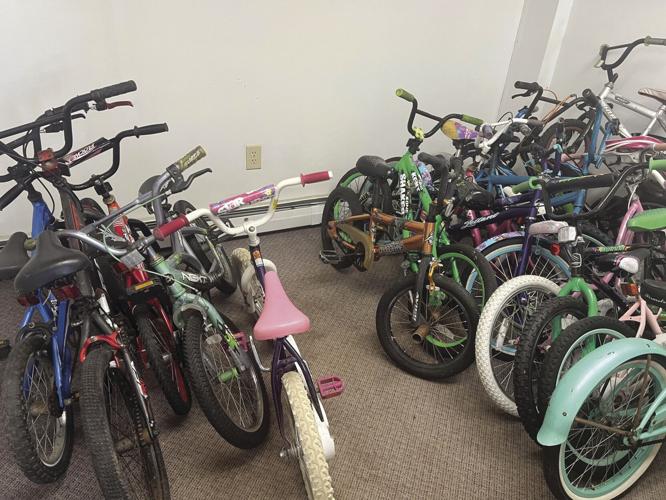
Currently the exchange has a high number of older road bikes ready to find a home, according to Rogers. Mountain bikes tend to be more popular and are in shorter stock, as well as usually being priced a bit higher. There are also a large number of children’s bikes of all sizes available at the exchange.
LABX is located at 97 New Salem St., and is open Tuesdays from 4 to 5:30 p.m. and Thursdays and Saturdays from 11 a.m. to 1 p.m. For more information, visit lab.bike or contact labe2014@yahoo.com.


(0) comments
Welcome to the discussion.
Log In
Keep it Clean. Please avoid obscene, vulgar, lewd, racist or sexually-oriented language.
PLEASE TURN OFF YOUR CAPS LOCK.
Don't Threaten. Threats of harming another person will not be tolerated.
Be Truthful. Don't knowingly lie about anyone or anything.
Be Nice. No racism, sexism or any sort of -ism that is degrading to another person.
Be Proactive. Use the 'Report' link on each comment to let us know of abusive posts.
Share with Us. We'd love to hear eyewitness accounts, the history behind an article.